Class 3 Science · CBSE / NCERT
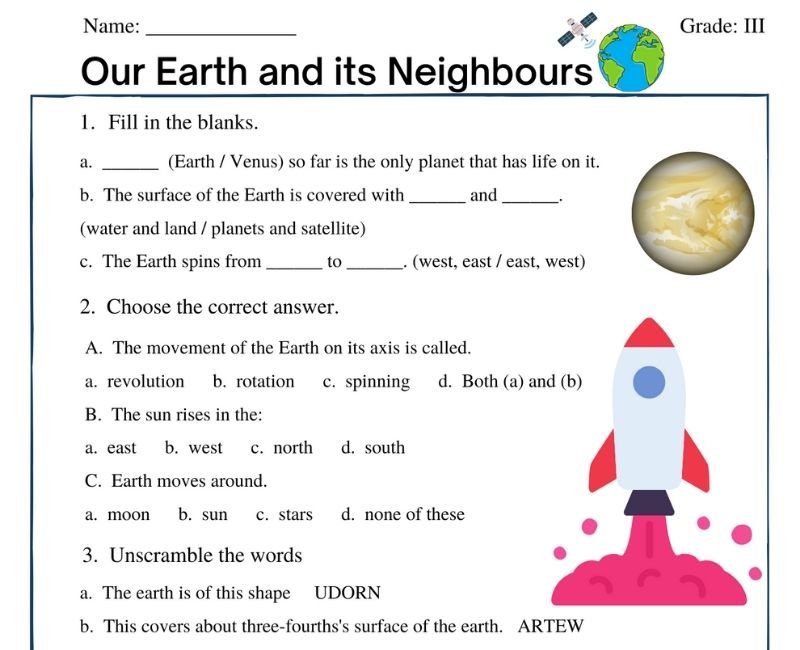
Our Earth and Its Neighbours Class 3 Science Worksheet NCERT with Quiz and Activities
Why do we have day and night? Why does the Moon shine? Which planets live next door to us? Find out with this Our Earth and Its Neighbours worksheet for Class 3: take the Our Earth and Its Neighbours Class 3 quiz, spin the Earth in the labs and play the Our Earth and Its Neighbours Class 3 activities online, in line with CBSE and the NCERT book Our Wondrous World.
Flip the cards and try the Earth’s Neighbours Lab, then tap the Games, Labs or Challenges island.
Our Earth and Its Neighbours Class 3 Online Quiz
20 questions · tap an answer to move on · full review at the end
Which planet do we live on?
Our Earth and Its Neighbours Class 3 Activities
Spin, shine, sort and fly. Earn up to 3 stars in every activity.
This Our Earth and Its Neighbours worksheet for Class 3 lets children explore like young astronauts. Flip the fact cards, match the planets to their clues in the Earth’s Neighbours Lab, then play the games, do the labs and try the challenges.
Fact cards: tap a card to flip it
Earth’s Neighbours Lab
Drag each space world onto the clue card that describes it (or tap it). Match all five.
🔭 Read each clue card: drag every space world to the card that describes it.
- 🔥Clue 1: Closest to the Sun, very hot by day and very cold at night
Which world is this? - ☁️Clue 2: Hottest planet, thick cloudy air
Which world is this? - 💧Clue 3: Air, water and life
Which world is this? - 🏜️Clue 4: Red, dusty and cold
Which world is this? - 🌑Clue 5: Goes round the Earth, no air
Which world is this? - ⬜Step 6: What did we find?
Match all 5 clues to unlock.
Challenge marks: 0 / 15 (0 of 5 challenges done)
Finish all 5 challenges to see your comment.
Practice sheet
Type your answers in the boxes. For word answers write in small letters. Press Check when you finish.
AName the planet. Use the word bank
BWrite yes or no
CWrite the number
DComplete the sentence with one word
Our Earth and Its Neighbours Class 3 Complete Guide
The Earth is our home in space, and it has neighbours: the Sun, the Moon and the other planets. This guide explains the topic in simple words for Class 3 students, parents and teachers. It goes with the Our Earth and Its Neighbours worksheet for Class 3 on this page and covers the shape of the Earth, land and water, day and night, the year, the Moon, the Sun and the eight planets.
Introduction to NCERT Class 3 Science Our Earth and Its Neighbours
Book: Our Wondrous World (The World Around Us), the NCERT textbook for Grade 3. Topic: Our Earth and Its Neighbours. Board: CBSE and other schools that follow NCERT. The topic builds on what children see every day: the Sun rising and setting, the Moon at night and a globe in the classroom. This page is built around the learning goals schools test for the topic; it is not a copy of a single chapter.
What is there in this topic
- The shape of the Earth and the globe
- Land and water: continents and oceans
- Rotation: day and night
- Revolution: one year
- Why life is found on the Earth
- The Sun, a star
- The Moon, Earth's natural satellite
- The eight planets and Earth's neighbours
Learning objectives
These objectives are written for this page from the topic's goals; they are not copied from the NCERT book.
- Describe the shape of the Earth and use a globe.
- Explain that most of the Earth is covered with water.
- Explain how day and night happen and what a year is.
- Explain why the Moon shines.
- Name the eight planets and Earth's nearest neighbours.
Learning outcomes
After this page a child can:
- Say that the Earth is round and a globe is its model.
- Name some continents and oceans.
- Explain that the Earth's spinning gives day and night.
- Say that the Earth takes about 365 days to go round the Sun.
- Explain why only the Earth has life.
Our Earth and Its Neighbours Class 3 resources on this page
| Resource | What it does |
|---|---|
| Our Earth and Its Neighbours Class 3 quiz | 20 questions in three levels with a full answer review |
| Flip cards | Six cards: our Earth, land and water, spinning Earth, round the Sun, our Moon and our neighbours |
| Earth's Neighbours Lab | Match Mercury, Venus, Earth, Mars and the Moon to their clue cards |
| 5 games | Continent or ocean, own light bubbles, planet nickname memory, pack for the Moon, smallest to biggest |
| 5 science labs | Land and water, day and night, spin or orbit, moonlight, rocket trip |
| 5 challenges | Marked out of 3 each with a total out of 15 |
| Practice sheet | 16 questions with pictures, word banks and a live score |
Our Earth
The Earth is round like a ball. A globe is a small model of the Earth. About three-fourths of the Earth is covered with water, so from space it looks blue and is called the Blue Planet. Large pieces of land are called continents (7) and huge bodies of salt water are called oceans (5). India is in Asia, the biggest continent.
| Continents (7) | Oceans (5) |
|---|---|
| Asia, Africa, North America, South America, Antarctica, Europe, Australia | Pacific, Atlantic, Indian, Southern, Arctic |
How the Earth moves
| Movement | What happens | Time | Result |
|---|---|---|---|
| Rotation | The Earth spins like a top | About 24 hours | Day and night |
| Revolution | The Earth goes round the Sun | About 365 days | One year |
The Sun, the Moon and the planets
The Sun is a star. It makes its own light and heat. The Moon goes round the Earth, so it is the Earth's natural satellite. It has no light of its own: it shines because sunlight falls on it. The Moon has no air and no water.
| Planet (from the Sun) | Remember it by |
|---|---|
| 1. Mercury | Closest to the Sun, smallest planet |
| 2. Venus | Hottest and brightest planet, Earth's neighbour |
| 3. Earth | The Blue Planet, has life |
| 4. Mars | The Red Planet, Earth's neighbour |
| 5. Jupiter | Biggest planet |
| 6. Saturn | Bright rings |
| 7. Uranus | Spins on its side |
| 8. Neptune | Farthest from the Sun |
Types of questions
- Name the planet
- Yes or no questions
- Numbers: 8 planets, 24 hours, 365 days, 7 continents
- Fill in the blank with a word bank
- Order of planets from the Sun
- Reason questions about day and night and life on the Earth
Solved examples
Common mistakes
| Mistake | Correct idea |
|---|---|
| The Earth is flat | The Earth is round like a ball |
| The Sun moves round the Earth | The Earth goes round the Sun |
| The Moon makes its own light | The Moon reflects sunlight |
| The Sun is a planet | The Sun is a star |
| The Earth has more land than water | About three-fourths is water |
| Day and night happen because the Sun goes away | The Earth spins |
Daily life
We see the Sun rise in the east and set in the west because the Earth spins. A calendar shows the 365 days of a year. On a clear night the Moon and sometimes Venus and Mars can be seen in the sky.
What your child learns from the Our Earth and Its Neighbours worksheet
- To understand the Earth as a planet
- To explain everyday events like day and night
- To compare the Earth with its neighbours
- To value the air and water that keep us alive
Tips for parents and teachers
- Shine a torch on a ball in a dark room to show day and night.
- Spin a globe and find India, the oceans and the continents.
- Watch the Moon for a week and draw its shape each night.
- Make up a line to remember the planet order.
- Let the child retry the challenges to earn 3 stars.
Related Science Worksheets
- Living and Non-Living Things Worksheet Class 3
- Soil Worksheet Class 3
- Light Sound and Force Worksheet Class 3
- Parts of a Plant Worksheet Class 3
- Air Water and Weather Worksheet Class 3
- Sun Moon and Stars Worksheet Class 3
- Birds Beaks and Claws Worksheet Class 3
- Safety and First Aid Worksheet Class 3
- States of Matter Worksheet Class 3
- Food and Feeding Habits of Animals Worksheet Class 3
- Housing and Clothing Worksheet Class 3
- Nesting Habits of Birds Worksheet Class 3
Frequently Asked Questions
What is Our Earth and Its Neighbours for Class 3?
It is a Class 3 Science topic about the Earth, its shape, land and water, how it moves, and its neighbours in space: the Sun, the Moon and the planets.
What is the shape of the Earth?
The Earth is round like a ball. A globe is a small model of the Earth.
How do day and night happen?
The Earth spins like a top once in about 24 hours. The side facing the Sun has day and the other side has night. This spinning is called rotation.
What is a year?
A year is the time the Earth takes to go once round the Sun, about 365 days. This movement is called revolution.
Why is the Earth called the Blue Planet?
About three-fourths of the Earth is covered with water, so it looks blue from space.
Why does the Moon shine?
The Moon has no light of its own. It shines because sunlight falls on it and bounces off.
Which planets are the Earth's neighbours?
Venus and Mars are the planets closest to the Earth. The Moon is our closest neighbour in space.
Does this page have Our Earth and Its Neighbours Class 3 questions and answers?
Yes. The 20-question Our Earth and Its Neighbours Class 3 quiz shows the correct answer and a reason for every question at the end, and the practice sheet has a Show answers button for all 16 questions.
Is this worksheet based on CBSE and NCERT?
Yes. It follows the CBSE Class 3 Science syllabus and the NCERT approach used in the Grade 3 book Our Wondrous World.
What activities can children do on this page?
They can match planets to clue cards, sort continents and oceans, spin the Earth to make day and night, light up the Moon with a torch, pack a rocket for the Moon and fly to Venus and Mars, all on the screen.
Can my child use these activities on a phone?
Yes. All drag activities work with a finger on phones and tablets and with a mouse on computers. Tapping also works.
What is included on this page?
A 20-question quiz with review, flip cards, the Earth's Neighbours Lab, 5 games, 5 science labs, 5 marked challenges, a 16-question practice sheet, a complete guide, 12 related Class 3 Science worksheets and these FAQs.
 Download