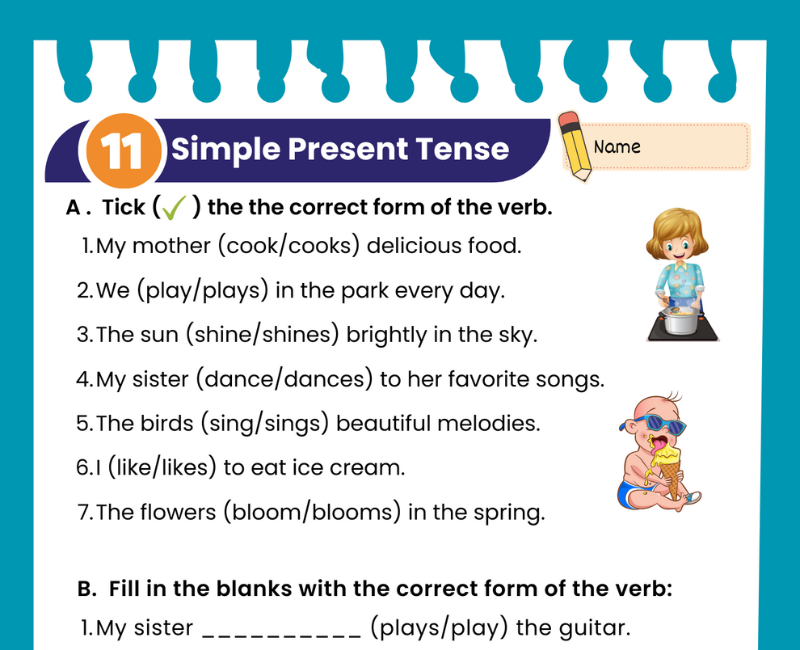
Simple Present Tense Worksheet for Class 2
Explore everyday routines through clear diagrams, a picture quiz, memory games and practical language workshops. Notice the subject and choose the verb that fits.
0 of 20 answered
1. Complete the daily habit: I ? my teeth every morning.
You can return to any question and change your answer.
Routine or happening now
Learning goal: Distinguish a repeated action from an action in progress.
- Read each sentence and notice the time clue.
- Tap Routine or Happening now. Sort all six cards.
We visit Granny every weekend.
Your turn!
Four grammar discoveries
Learning goal: Notice useful grammar facts and exceptions.
- Open all four discovery cards.
- Read the example and say a new example of your own.
A fact does not need a daily time word
A square has four sides. This is a general fact even without every day.
I is special
I names one speaker but takes the base action verb: I collect shells. Do not add s just because there is one person.
Does keeps the next verb simple
Compare He paints with Does he paint? The base verb paint follows does.
Be follows its own pattern
I am ready. She is ready. They are ready. Ask Is she ready? Do not say Does she is ready?
Your turn!
Simple Present Tense for Class 2 Meaning Rules and Examples
A daily routine tells us what someone does regularly. “I pack my bag every morning” describes a repeated action. This simple present tense worksheet for Class 2 with online quiz and online activities connects those familiar routines with subject and verb agreement, sentence building and meaningful grammar practice.
What is the simple present tense?
The simple present is a verb form used for habits, repeated actions and general facts. It can also describe a present state, such as a feeling or possession.
Examples: I water a plant each evening. Our dog likes its bed. A week has seven days.
What does present simple mean?
Present simple and simple present are two names for the same tense. It does not mean that every action is happening at this exact moment.
Compare: I paint on Sundays. I am painting now. The first is a routine; the second is an action in progress.
When do we use the simple present tense?
| Use | Example | Meaning |
|---|---|---|
| Habit or routine | Alia folds her blanket every morning. | An action that repeats. |
| Regular activity | We visit the library on Saturdays. | Something that happens regularly. |
| General fact | A week has seven days. | A fact rather than a single event. |
| Present state | I like mangoes. | A present preference. |
Words such as usually, often, sometimes, every morning and on Sundays can help describe frequency. They are useful clues, but always read the whole sentence. A general fact does not need an everyday time word.
Simple present tense rules for subjects and verbs
The subject tells us who or what the sentence is about. The base verb is the plain form, such as help, open or carry. In affirmative action sentences, the subject helps us choose the verb form.
| Subject | Verb rule | Examples |
|---|---|---|
| I you we they | Use the base verb. | I help. You help. We help. They help. |
| He she it or one name | Usually add s or es; some verbs change spelling. | He helps. She fixes. It moves. Alia carries. |
| Two or more people or things | Use the base verb. | The girls help. Alia and Kabir help. |
Adding s es and ies to verbs
| Pattern for he she it | Examples |
|---|---|
| Most verbs: add s. | help → helps; open → opens; smile → smiles |
| Common endings ch sh s x z: add es. | teach → teaches; push → pushes; miss → misses; mix → mixes; buzz → buzzes |
| Consonant + y: change y to ies. | carry → carries; hurry → hurries |
| Vowel + y: keep y and add s. | buy → buys; enjoy → enjoys |
| Useful special forms | go → goes; do → does; have → has |
Affirmative negative and question sentences
These are three useful sentence forms for simple present tense exercises. An affirmative sentence tells us something. A negative says something does not happen or is not true. An interrogative sentence asks a question.
| Form | I you we they | He she it |
|---|---|---|
| Affirmative | They draw animals. | She draws animals. |
| Negative | They do not draw cars. | She does not draw cars. |
| Question | Do they draw animals? | Does she draw animals? |
| Short answer | Yes they do. / No they do not. | Yes she does. / No she does not. |
She draws. → She does not draw. → Does she draw?
Don’t means do not. Doesn’t means does not. The apostrophe shows that letters have been left out.
Question pattern: Do or Does + subject + base verb + the rest of the question. You can also add a question phrase: “What does Alia draw?” or “Where do they play?” Questions that ask who performs an action can follow another pattern: “Who helps you?”
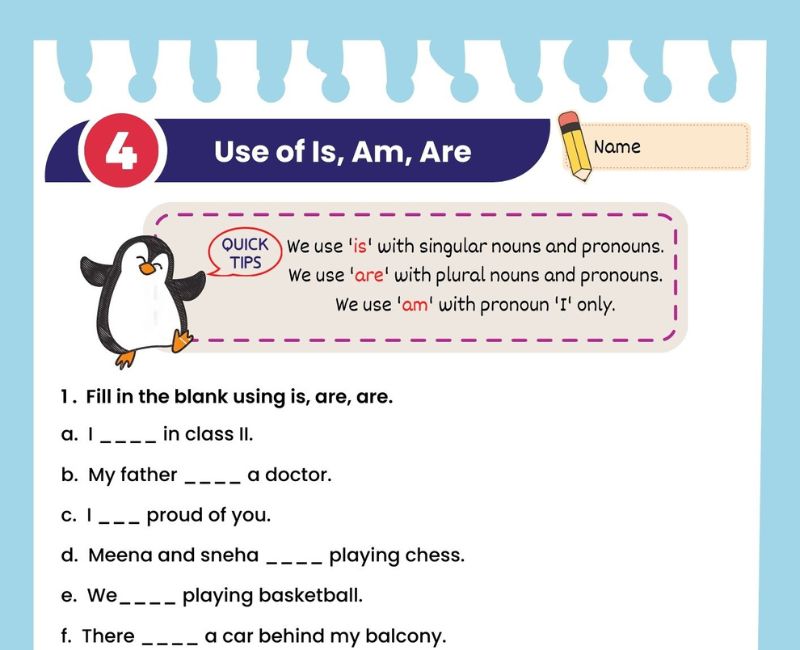
A special note about am is and are
The verb be has its own simple present forms: I am, he/she/it is, you/we/they are. Make a negative by adding not: “She is not tired.” Make a question by putting is first: “Is she tired?” Do not apply the action verb pattern to write “Does she is tired?”
Common simple present tense mistakes
| Incorrect | Correct | Reason |
|---|---|---|
| He open the gate daily. | He opens the gate daily. | He takes opens in this affirmative sentence. |
| They opens the gate daily. | They open the gate daily. | They takes the base verb. |
| She doesn’t draws. | She doesn’t draw. | Use a base verb after doesn’t. |
| Does he helps? | Does he help? | Does comes before the subject; help stays plain. |
| She carrys a bag. | She carries a bag. | Consonant + y changes to ies. |
Use the simple present tense worksheet download already available on this page for written practice. The simple present tense online quiz for Class 2 adds diagram and photo questions. The online activities add sorting, a mind map, spelling investigations, a class survey and routine writing. Together they provide present simple exercises from basic recognition to independent sentence use.
Frequently Asked Questions
What is the simple present tense for Class 2?
It is a verb form used for habits repeated actions general facts and present states. For example: I draw every evening. A week has seven days.
Are present simple and simple present the same?
Yes. Both names refer to the same tense. Present simple exercises and simple present tense exercises practise the same grammar.
When do we add s or es to a verb?
In affirmative action sentences with he she it or one name we usually add s or es: she opens; Kabir watches. I you we and they use the base verb.
What is the rule for verbs ending in y?
With he she or it change consonant plus y to ies: carry becomes carries. Keep y after a vowel and add s: enjoy becomes enjoys.
How do we use do and does in questions?
Use Do with I you we and they. Use Does with he she and it. Put the subject next then the base verb: Do they help? Does she help?
How do we make a simple present negative?
Use do not or don’t with I you we and they. Use does not or doesn’t with he she and it. Keep the next verb in its base form: She doesn’t draw.
Why is doesn’t plays wrong?
The verb after doesn’t must be the base form play. Write He doesn’t play. In an affirmative sentence write He plays.
What are examples of daily routine sentences?
I pack my bag each morning. My sister checks her timetable. We walk to school. Each sentence describes a repeated action.
What are the three common sentence forms?
Affirmative negative and interrogative are common sentence forms. Examples are She helps. She does not help. Does she help?
What is the difference between simple present and present continuous?
Simple present can describe a routine: I paint on Sundays. Present continuous can describe an action in progress: I am painting now.
Are am is and are simple present verbs?
Yes. They are simple present forms of be. Their question and negative patterns differ from action verbs: Is she ready? She is not ready.
Which time words are used with simple present tense?
Often usually sometimes every day and on Mondays commonly describe frequency. Read the whole sentence because a time word alone does not decide the tense.
Photo credit and grammar references
Duck photo by Milada Vigerova via Wikimedia Commons · CC0. The routine diaries are invented learning contexts.
British Council present simple for children · British Council present simple reference
 Download