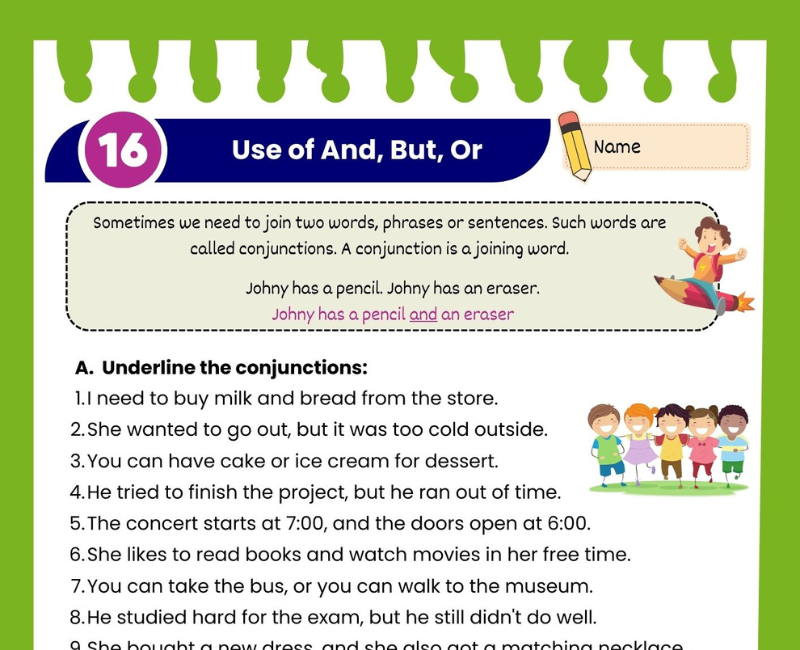
Conjunctions And But Or Worksheet for Class 2
Add ideas, show a contrast or offer a choice. Explore picture rules, sentence-building games and practical language labs to make every joining word meaningful.
Explore a conjunctions worksheet for Class 2 with online quiz and online activities. Practise and but or joining words, sentence combining, addition, contrast and alternatives through picture questions, sorting, memory games, a mind map and practical instruction tasks.
0 of 20 answered
1. What does a conjunction do?
You can return to any question and change your answer.
Meaning clue sorting
Learning goal: Match addition contrast and alternatives to and but or.
- Read the meaning clue.
- Choose and but or. Complete all six clues.
Add both rain boots and a coat to a list.
Your turn!
Four conjunction discoveries
Learning goal: Learn useful facts about conjunctions and context.
- Open all four discovery cards.
- Read each example and make a new example of your own.
And can join more than naming words
Compare cups and plates with sing and clap or soft and warm. The joined words can have different jobs in different examples.
But does not cancel the first fact
The path is long but pleasant. Both descriptions can be true. But highlights their contrast.
Or does not always mean only one
You may have tea or juice or both permits both. In a choose-one task the extra instruction sets the limit.
A conjunction does not take a plural ending
One cat and one dog. Cats and dogs. The joining word and stays unchanged.
Your turn!
Conjunctions for Class 2 Meaning Rules and Examples
Joining words help us connect ideas clearly. Compare “I packed a cap” with “I packed a cap and a scarf.” The word and adds another item. This conjunctions worksheet for Class 2 with online quiz and online activities focuses on and, but and or so children can connect ideas by meaning rather than guess a word for a blank.
What is a conjunction?
A conjunction is a word that joins words, phrases or parts of a sentence. In beginner grammar, conjunctions are often called joining words.
Examples: cups and plates; small but strong; rice or pasta. The joining word tells us how the connected ideas relate.
Which type are and but and or?
These three words are coordinating conjunctions. They can connect matching kinds of words or ideas, such as two nouns, two actions or two complete clauses.
For Class 2, begin with three useful purposes: addition, contrast and alternatives. These are uses of the words, not the only types of conjunctions in English.
And but or meanings and examples
| Joining word | Main use in this lesson | Example |
|---|---|---|
| and | Add information or include both. | I packed a cap and a scarf. |
| but | Highlight a contrast. | The bag is old but useful. |
| or | Offer alternatives. | Would you like rice or pasta? |
How to use and
Use and when you want to add one item, action or description to another. “Bring a cup and a plate” asks for both. “We sang and clapped” includes both actions. And is not limited to joining naming words.
| What is joined? | Example | Meaning |
|---|---|---|
| Two nouns | cups and plates | Both kinds of objects. |
| Two actions | We sang and clapped. | Both actions happened. |
| Two descriptions | The blanket is soft and warm. | Both descriptions apply. |
| Two complete ideas | I opened the box, and my sister lifted the lid. | The second idea is added. |
When listing several items, and commonly comes before the last item: “I packed glue, paper and tape.” Commas help separate the earlier items. A comma before the final and is also used in some writing styles.
How to use but
Use but to draw attention to a difference or an unexpected contrast. “The bag is old but useful” tells us that both descriptions are true. But does not cancel the first idea or mean that one part must be false.
Old and useful are not opposites. But highlights the idea that something old can still be useful.
Look for the relationship between the ideas rather than searching only for opposite words.
But can connect descriptions or complete ideas. Compare “The bowl is small but deep” with “I wanted to walk, but it began to rain.” You will often see a comma before but when it connects two complete clauses. Do not insert a comma automatically into every short phrase with but.
How to use or
Use or to present alternatives: “Would you like a badge or a bookmark?” In a task that says choose one, select one option. The word or does not always mean only one is allowed; a sentence can explicitly say “You may choose a badge or a bookmark or both.” Read the whole instruction.
| Message | Joining word | What to do |
|---|---|---|
| Bring a cup and a plate. | and | Bring both objects. |
| Choose one: a cup or a plate. | or | Select one option for this task. |
| You may take a cup or a plate or both. | or | The full instruction permits both. |
Joining sentences without unnecessary repetition
When the same subject performs both actions, a joined sentence can often use that subject once. Keep the original meaning and make sure the sentence remains complete.
| Two short sentences | Joined sentence | Notice |
|---|---|---|
| Tara reads. Tara writes. | Tara reads and writes. | The name is needed only once. |
| I can hop. I can skip. | I can hop and skip. | I can is shared by both actions. |
| The bag is old. The bag is useful. | The bag is old but useful. | But highlights the contrast. |
“I like pears and plums” adds both fruits.
“Would you like pears or plums?” offers alternatives.
More than one joining word can sometimes fit a sentence, but the intended message changes.
Common conjunction mistakes
| Mistake or confusion | Clearer understanding |
|---|---|
| Using or when the task asks for both items. | Use and to add both in this meaning. |
| Thinking but always joins opposite words. | But highlights contrast, including unexpected differences. |
| Thinking or always forbids selecting both. | Read the full rule. Some contexts allow both alternatives. |
| Writing The bag is old and but useful. | Choose the one connector that gives the intended relation: old but useful. |
| Writing ands for plural nouns. | The conjunction stays and: a cup and a plate; cups and plates. |
Conjunctions in complete writing
Begin a sentence with a capital letter and finish a statement with a full stop. Use a question mark when offering alternatives in a question. Read the joined sentence aloud to check that it makes sense and does not become an endless chain of ands.
A useful extension: English includes other conjunctions such as because and so. Some express reasons or results. This page concentrates on and, but and or; learning these three does not mean that English has only three conjunctions.
Use the and but or worksheet for Class 2 download available on this page for written practice. The online quiz adds picture-based meaning questions and explanations. The online activities add sentence combining, sorting, memory, a mind map, editing, drawing and real-object instruction labs. On submission, learners see marks out of 20 and move to corrections for wrong or unanswered questions.
Frequently Asked Questions
What is a conjunction for Class 2?
A conjunction is a joining word that connects words, phrases or parts of a sentence. And, but and or are three common examples.
What are and but and or used for?
In this lesson, and adds information, but highlights a contrast, and or offers alternatives. Read the whole sentence to understand the intended meaning.
When should we use and?
Use and to add an item, action or description: cups and plates; sing and clap; soft and warm.
When should we use but?
Use but to highlight a contrast: The bag is old but useful. Both ideas may be true; but shows how they contrast.
When should we use or?
Use or to offer alternatives: Would you like rice or pasta? A separate instruction such as choose one can set a limit on the choice.
Are and but and or coordinating conjunctions?
Yes. They are coordinating conjunctions and can connect matching kinds of words or ideas, such as two nouns, two actions or two complete clauses.
Does and join only nouns?
No. It can also join actions, descriptions and larger parts of a sentence: We sang and clapped. The blanket is soft and warm.
Does but mean one idea is false?
No. In The bag is old but useful, both descriptions can be true. But highlights a contrast rather than cancelling an idea.
Does or always mean choose only one?
No. Context matters. Choose one: a badge or a bookmark limits the choice to one. You may take a badge or a bookmark or both explicitly permits both.
How do we join sentences without repeating the subject?
If the same subject performs both actions, it can often appear once. Tara reads. Tara writes. becomes Tara reads and writes.
Can we start a sentence with and or but?
Yes, English permits this. For beginner practice, first learn to connect ideas clearly within a sentence and keep the meaning complete.
Can different conjunctions fit the same blank?
Sometimes yes, with different meanings. A useful exercise gives enough context to show whether the speaker means addition, contrast or alternatives.
Photo credit and grammar references
Chair photo by Amitbalani via Wikimedia Commons · CC0. Meaning diagrams are original teaching illustrations.
 Download