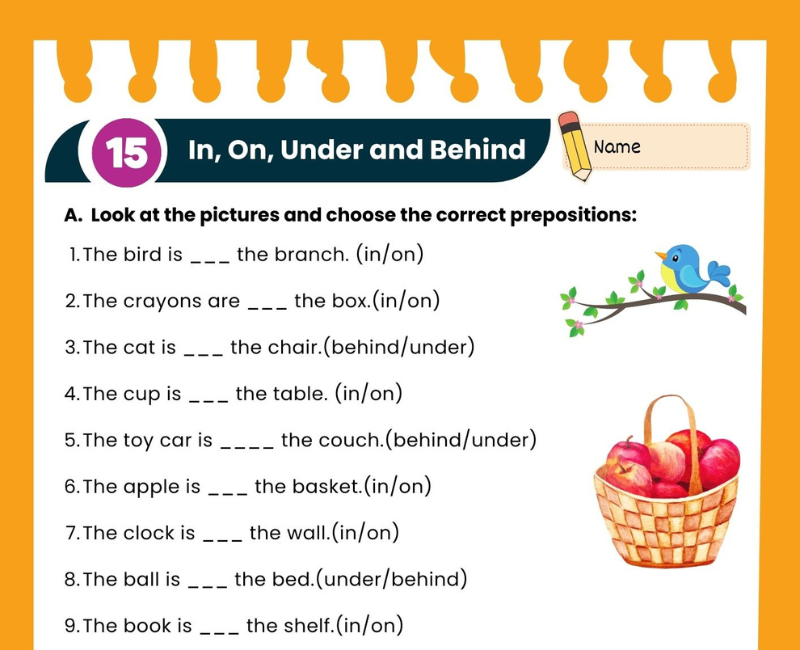
Prepositions In On Under and Behind Worksheet for Class 2
Look closely and say where things are. Explore position pictures, a moving star, memory games and real-object language labs using in on under and behind.
Explore a prepositions worksheet for Class 2 with online quiz and online activities. Practise in on under and behind through clear position diagrams, picture questions, sentence building, a mind map, memory games and practical object-placement tasks.
0 of 20 answered
1. Look at the picture. The ball is the basket.
You can return to any question and change your answer.
Position clue sorting
Learning goal: Match descriptions to in on under or behind.
- Read the position clue.
- Choose in on under or behind. Complete all eight clues.
inside a pencil case
Your turn!
Four place word discoveries
Learning goal: Learn useful facts about surfaces visibility and word forms.
- Open all four discovery cards.
- Read the examples and explain one discovery using an object near you.
On is not only for flat table tops
A picture can be on a wall. The surface may be vertical.
Under does not require contact
A toy under a shelf need not touch the shelf. Its position is beneath it.
Behind does not always mean invisible
An object can be partly visible at the back of another object. Check the view and the relation.
The place word stays the same for a group
One button is in the tin. Several buttons are in the tin. In does not become ins.
Your turn!
Prepositions for Class 2 Meaning Rules and Examples
Where is the missing toy? A clear answer needs more than a naming word. “The toy is in the basket” tells us both the object and its position. This prepositions worksheet for Class 2 with online quiz and online activities teaches four useful prepositions of place: in, on, under and behind.
What is a preposition of place?
A preposition of place shows where someone or something is in relation to another person, place or thing. In “The ribbon is in the drawer,” in connects the ribbon with the drawer.
For this lesson, ask Where is it? and name the object used to describe the position.
What is the reference object?
The reference object is the thing we use to explain another thing’s position. In “The ribbon is in the drawer,” the drawer is the reference object.
Compare “The ball is in the basket” with “The basket is on the mat.” Each sentence describes a different relationship.
In on under and behind meanings
| Place word | Meaning in this lesson | Example |
|---|---|---|
| in | Inside a space or container. | The ribbon is in the drawer. |
| on | On and touching a surface. | The label is on the bottle. |
| under | Beneath the reference object. | The slippers are under the bed. |
| behind | At the back of the reference object. | The broom is behind the door. |
How to use in
Use in when the object is inside a container, room or another space. Examples include a coin in a purse, toys in a drawer and children in a room. The container does not have to be closed: a pencil can be in an open pencil case.
How to use on
Use on for a position on a surface. In familiar object examples, the object touches that surface: a cup on a tray, a picture on a wall or a sticker on a bottle. The surface can be horizontal or vertical. On does not only mean resting on the top of a table.
A coin in a purse is inside it.
A coin on a purse rests on its outside surface.
Look at the relationship rather than simply noticing that the two objects are close.
How to use under
Use under for familiar positions beneath an object: a box under a bench or a rug under a chair. The lower object does not need to touch the object above it. A toy under a shelf may have a gap between itself and the shelf.
How to use behind
Use behind for a position at the back. Examples include a bicycle behind a shed or a toy behind an upright book. A picture may hide part of the rear object, but behind does not always mean completely invisible. Keep the same viewpoint when comparing pictures or real objects.
Under and behind are different
| Question | Under | Behind |
|---|---|---|
| What relationship matters? | A beneath or lower position. | A position at the back. |
| Example | A shoe under a stool. | A shoe behind a door. |
| Must the object be hidden? | No. It may be clearly visible beneath the stool. | No. It may still be partly or fully visible. |
| Must the objects touch? | No. | No. |
Building a complete position sentence
| Object | Linking verb | Place word | Reference object |
|---|---|---|---|
| The coin | is | in | the purse. |
| The cup | is | on | the tray. |
| The slippers | are | under | the bed. |
| The broom | is | behind | the door. |
In these examples, the preposition comes before a noun phrase such as the purse or the bed. It can also come before a pronoun: “The toy is behind it.” Naming the reference object is usually clearer when someone does not know what it refers to.
The button is in the tin.
The buttons are in the tin.
Change the noun and is or are when needed. Keep in unchanged.
Where questions and negative sentences
| Question | Answer | Negative example |
|---|---|---|
| Where is the coin? | It is in the purse. | It is not on the purse. |
| Where are the slippers? | They are under the bed. | They are not on the bed. |
A negative statement alone may not tell the exact location. “The toy is not in the box” leaves several possibilities. Add a clear answer such as “It is behind the box.”
Common preposition mistakes
| Mistake | Clearer understanding |
|---|---|
| Using on for every nearby object. | Check whether the object is inside, on a surface, beneath or at the back. |
| Treating under and behind as the same. | Compare beneath with at the back. |
| Writing The ball is in without naming a clear place. | Write The ball is in the basket. |
| Writing The toys are ins the box. | Write The toys are in the box. The place word stays the same. |
| Assuming a partly hidden object must be inside. | Check its relation to the front object. It may be behind it. |
A useful extension: English has other place words, including beside, between and in front of. Prepositions can also express relationships such as time. This page concentrates on the four spatial meanings in its title so children can practise them carefully.
Use the preposition in on under and behind worksheet for Class 2 download available on this page for written practice. The online quiz adds picture-based questions and explanations. The online activities add a moving-object game, word and picture memory, a mind map, sentence building, drawing and real-object labs. On submission, learners see marks out of 20 and move to corrections for wrong or unanswered questions.
Frequently Asked Questions
What is a preposition for Class 2?
A preposition helps show a relationship between words. In this lesson, prepositions of place tell where an object is in relation to something else: in the bag, on the tray, under the bed or behind the door.
What are in on under and behind called?
In these examples, they are prepositions of place. They help answer Where is it? or Where are they?
What is the difference between in and on?
In describes an inside position. On describes a surface position. Compare a coin in a purse with a coin resting on the purse.
What does under mean?
In familiar object-position examples, under means beneath the reference object: a box under a bench or slippers under a bed.
What does behind mean?
Behind means at the back of the reference object. A toy can be behind an upright book and still be partly visible.
What is the difference between under and behind?
Under describes a beneath position. Behind describes a position at the back. A shoe under a stool is not the same relation as a shoe behind a door.
Can we use on for a wall?
Yes. On can describe a position on a vertical surface, such as a picture on a wall or a sticker on a bottle.
Does an object have to touch something to be under it?
No. A toy can be under a shelf without touching it. Look at the lower position beneath the reference object.
What is a reference object?
It is the thing used to describe another thing’s position. In The ball is in the basket, the basket is the reference object.
How do we write a complete preposition sentence?
Name the object, add a suitable verb, then the place phrase: The coin is in the purse. With a plural subject, write The coins are in the purse.
Do prepositions change for plural nouns?
No. The button is in the tin and The buttons are in the tin both use in. The noun and is or are change, but the preposition stays the same.
How can I tell an inside position from a hidden position?
Check the arrangement and the reference object. A toy inside a box is in it. A toy at the back of the box is behind it. Being partly hidden alone does not prove an inside position.
Photo credit and grammar references
Chair photo by Amitbalani via Wikimedia Commons · CC0. Position diagrams are original teaching illustrations.
British Council prepositions of place · Cambridge surface and inside meanings · Cambridge behind definition
 Download