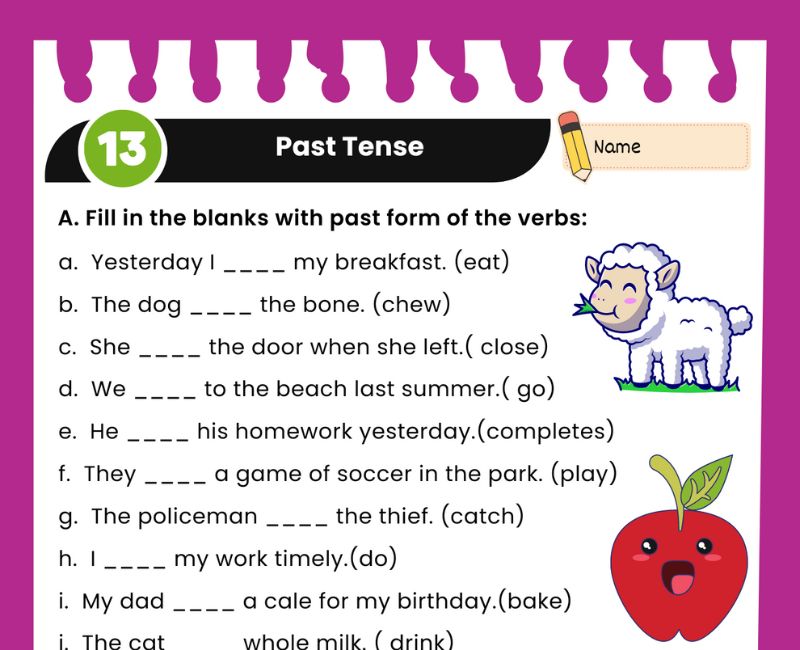
Past Tense Worksheet for Class 2
Travel back to yesterday through picture clues, verb memory games and short stories. Explore regular and irregular verbs and learn to ask what happened.
Explore a past tense worksheet for Class 2 with online quiz and online activities. Practise simple past tense verbs regular and irregular forms yesterday sentences did questions and negatives through picture clues memory matching story sequencing and practical language tasks.
0 of 20 answered
1. Yesterday I my room. Choose the past form of clean.
You can return to any question and change your answer.
Time clue sorting
Learning goal: Place time clues before now at now or after now.
- Read the time clue card.
- Choose Past Now or Future. Sort all six cards.
last night
Your turn!
Four verb discoveries
Learning goal: Learn useful facts about past verb forms.
- Open all four discovery cards.
- Read the examples and explain one fact in your own words.
A past form can stay the same
Cut stays cut: Today I cut shapes. Yesterday I cut shapes too. The time clue helps.
Same spelling can have a different sound
Read is spelled the same in the base and past forms. The past form sounds like red.
The action form stays the same across subjects
I laughed. She laughed. They laughed. Do not add s to a simple past action verb.
Did does the past tense work
He found a shell. Did he find a shell? He didn’t find a coin. Use the base verb after did or didn’t.
Your turn!
Past Tense for Class 2 Meaning Rules and Examples
The past tense helps us talk about events before now. “I washed my cup yesterday” tells us about a finished action. In this past tense worksheet for Class 2 with online quiz and online activities the main focus is the simple past tense also called the past simple.
What is simple past tense?
We use the simple past for completed actions and situations in the past. It helps us share yesterday’s news describe a visit and retell a story.
Examples: I helped my sister. The bus arrived late. We were happy after the game.
Words that show past time
Yesterday last night last week and two days ago often help locate an event before now.
A story can also make the past time clear without repeating a time word in every sentence. Read the whole context.
Regular and irregular past tense verbs
Regular and irregular are two useful verb groups. They are not two different tenses. Regular verbs follow an ed spelling pattern. Irregular verbs have past forms that do not follow that pattern.
| Group | Base form | Past form | Example |
|---|---|---|---|
| Regular | help | helped | I helped with the bags. |
| Regular | arrive | arrived | The bus arrived. |
| Irregular | take | took | We took a picnic. |
| Irregular | give | gave | She gave me a card. |
| Irregular | make | made | They made a model. |
| Irregular | have | had | He had a snack. |
Spelling rules for regular past verbs
| Pattern | Examples |
|---|---|
| Usually add ed. | jump → jumped; wash → washed |
| If a regular verb already ends in e add d. | smile → smiled; close → closed |
| Consonant + y changes to ied. | study → studied; hurry → hurried |
| Keep y after a vowel and add ed. | play → played; enjoy → enjoyed |
| In familiar one-syllable verbs with a short vowel and one final consonant double that consonant before ed. | clap → clapped; stop → stopped |
| Do not double final w x or y. | snow → snowed; fix → fixed; play → played |
Go becomes went. Eat becomes ate. See becomes saw. Draw becomes drew.
Learn irregular forms through examples and repeated use.
Affirmative negative and question sentences
An affirmative sentence tells us what happened. A negative says something did not happen. An interrogative sentence asks a question.
| Form | Pattern for action verbs | Example |
|---|---|---|
| Affirmative | Subject + past verb | They painted a fence. |
| Negative | Subject + did not + base verb | They did not paint a door. |
| Question | Did + subject + base verb? | Did they paint a fence? |
| Question word | What + did + subject + base verb? | What did they paint? |
She took a book. → She didn’t take a toy. → Did she take a book?
Didn’t means did not. Avoid did took and didn’t took.
The simple past action form usually stays the same with different subjects: I jumped. He jumped. They jumped. Do not add s to the past action verb. Did also stays the same with these subjects.
Was and were are different
The verb be has the past forms was and were. Use was with I he she it or one name. Use were with you we they or a plural subject.
| Statement | Negative | Question |
|---|---|---|
| I was ready. | I was not ready. | Was I ready? |
| She was at home. | She wasn’t at home. | Was she at home? |
| They were quiet. | They weren’t quiet. | Were they quiet? |
For these be sentences add not after was or were and move was or were before the subject for questions. Do not write “Did she was at home?”
Short answers
Did you finish? Yes, I did. / No, I didn’t.
Was she ready? Yes, she was. / No, she wasn’t.
Were they there? Yes, they were. / No, they weren’t.
Choose the helper that belongs to the question.
Common past tense mistakes
| Incorrect | Correct | Reason |
|---|---|---|
| We goed home. | We went home. | Go has an irregular past form. |
| She didn’t saw it. | She didn’t see it. | Use the base verb after didn’t. |
| Did he helped? | Did he help? | Use the base verb after did. |
| They was late. | They were late. | They takes were. |
| I studyed yesterday. | I studied yesterday. | Consonant + y changes to ied. |
Past tense exercises for Grade 2 become more meaningful when children use them to retell real or imagined events. Use First Next and Finally to organise a short account. These sequence words show order while the verbs and context show the time.
Use the past tense worksheet for Class 2 download already available on this page for written practice. The online quiz adds timelines and picture-based questions. The online activities add regular and irregular verb sorting memory games a mind map story sequencing a practical retelling lab and diary writing. After submission the quiz shows marks out of 20 and takes learners to corrections for wrong or unanswered questions.
Frequently Asked Questions
What is past tense for Class 2?
Past tense helps us describe events before now. This lesson focuses on simple past sentences such as I helped yesterday and We went home.
What is the simple past tense formula?
For affirmative action sentences use subject + past verb: She opened a box. Negatives use did not + base verb. Questions use Did + subject + base verb?
What are regular past tense verbs?
Regular verbs follow an ed spelling pattern: jump becomes jumped smile becomes smiled and study becomes studied.
What are irregular past tense verbs?
Irregular verbs do not follow the regular ed pattern. Examples include go → went eat → ate take → took and make → made.
When do we change y to ied?
For a regular verb ending in consonant plus y change y to ied: study → studied. Keep y after a vowel: play → played.
How do we make a negative past tense sentence?
Use did not or didn’t with the base action verb: She didn’t open the box. Do not use didn’t opened.
How do we ask questions with did?
Put Did before the subject and use the base verb: Did he help? What did they make?
Why is didn’t went incorrect?
The main verb after didn’t must be its base form go. Write She didn’t go. The affirmative sentence is She went.
What is the difference between was and were?
Use was with I he she it and one name. Use were with you we they and plural subjects: I was ready. They were ready.
Which time words often show the past?
Yesterday last night last week and two days ago often place events before now. The wider story may also make past time clear.
Does the past action verb change with he or they?
Usually no. Use the same simple past action form: He helped. They helped. The verb be is different because it uses was and were.
Can a verb have the same base and past spelling?
Yes. Cut stays cut. Read also keeps the same spelling but its past form sounds like red. Context and time clues help show the meaning.
Photo credit and grammar references
Duck photo by Milada Vigerova via Wikimedia Commons · CC0. The album note is an invented learning context. Diagrams are original teaching illustrations.
British Council past simple sentences · British Council past simple questions
 Download