40 Marks English Grammar Question Paper for Class 2
Bring your grammar learning together. Revise naming words, pronouns, describing words, verbs, tenses, articles, plurals, place words, joining words, reading and writing.
Explore an English grammar question paper for Class 2 with online quiz and online activities. The downloadable paper is titled 40 marks. The separate online quiz has 20 questions for 20 marks and covers every topic in the revision guide below.
0 of 20 answered
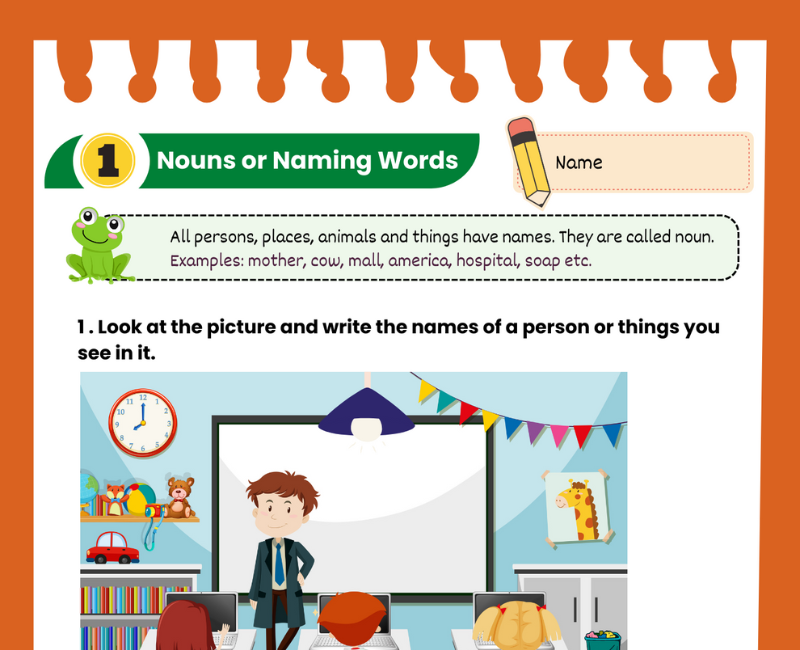
1. Look at the picture. Which word is a noun naming the thing?
You can return to any question and change your answer.
Word job sorting
Learning goal: Identify nouns action verbs and adjectives in context.
- Read the sentence and the named word.
- Choose its job in that sentence. Complete six rounds.
The rabbit hops. Word: rabbit
Your turn!
Four grammar discoveries
Learning goal: Notice useful grammar patterns and exceptions.
- Open all four discovery cards.
- Read the examples and explain one exception or change of word job.
One word can do different jobs
I play a game. We watched a play. Play is a verb in the first sentence and a noun in the second.
Choose a or an by sound
Compare an umbrella with a uniform. Uniform begins with a sound like you so it takes a here.
Not every plural adds s
One child becomes two children. One mouse becomes two mice. Learn each irregular form in context.
Not every past form adds ed
Play becomes played but go becomes went. The sentence Yesterday I went home uses an irregular past form.
Your turn!
Class 2 English Grammar Revision Rules Types and Examples
A mixed English grammar question paper for Class 2 checks whether learners can use familiar rules together. This page combines the resource titled 40 Marks English Grammar Question Paper for Class 2 PDF with a separate 20-mark online quiz and varied online activities. The online questions are original revision practice, rather than a transcription of the downloadable paper.
What does grammar mean?
Grammar is the way words change and combine to form meaningful phrases and sentences. For Class 2 practice, this includes naming words, pronouns, describing words, verbs, articles, number, place words, joining words and sentence punctuation.
Example: “Rina has two small boxes.” Rina is a proper noun, has is a verb, two gives number, small describes the boxes and boxes is a plural noun.
What is a mixed grammar paper?
A mixed grammar paper brings several topics into one assessment. The task might ask learners to choose, classify, complete, reorder, rewrite, read or compose.
The instruction matters. “Find a noun” asks for a word’s job. “Choose a verb” asks for a suitable form in the sentence. “Write a paragraph” needs connected ideas as well as accurate grammar.
What this question-paper page includes
| Resource | Marks or format | Purpose |
|---|---|---|
| Downloadable question paper | 40 marks, as stated in the resource title. | Written paper practice using the site’s download. |
| Online mixed grammar quiz | 20 questions × 1 mark = 20 marks. | Revise all the topics listed below with explanations. |
| Online activities | 15 learning tasks without an exam mark. | Practise sorting, editing, reading, speaking and writing. |
The printable paper and online quiz have different totals. The quiz result is out of 20 and is not a score for the downloadable 40-mark paper. School syllabuses and mark distributions vary; use the instructions on the actual paper for its requirements.
Nouns pronouns adjectives and verbs
| Topic | Meaning or rule | Example |
|---|---|---|
| Nouns | Naming words for people, places, animals, things or ideas. | The child carries a basket. |
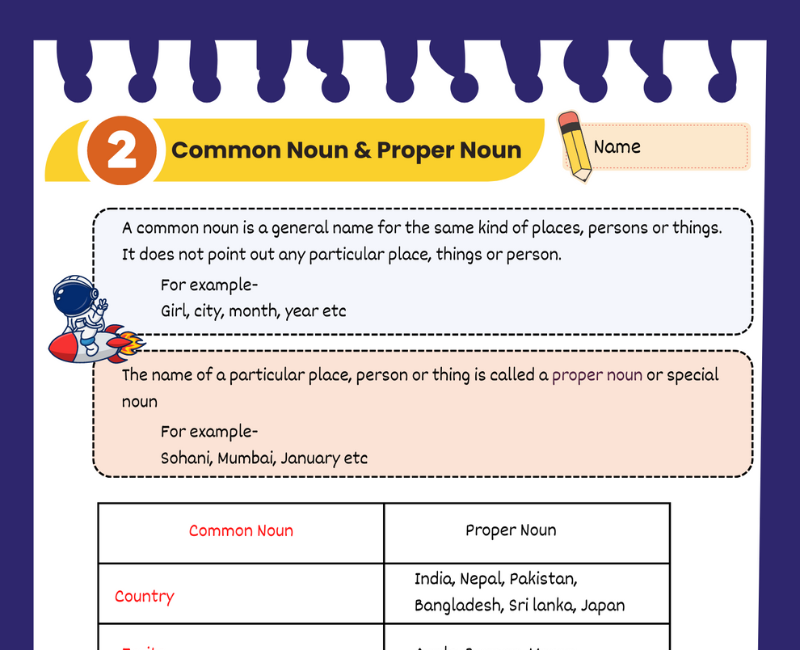
| Common and proper nouns | A common noun gives a general name. A proper noun names a particular person or place and begins with a capital. | girl → Anaya; city → Pune. |
| Subject pronouns | Forms such as I, he, she, we and they can act as subjects. | Ravi and I read. We read. |
| Object pronouns | Forms such as me, him, her, us and them can be objects of verbs or follow prepositions. | Please help us. Give it to her. |
| Adjectives | Words that describe or give information about a noun. | a striped scarf; a wooden chair. |
| Verbs | Words that can express actions or states. Not every verb names a visible movement. | Birds fly. The bag is heavy. |
“We play outside” uses play as a verb. “We watched a play” uses play as a noun. Identify the job in context rather than memorising one permanent label for every word.
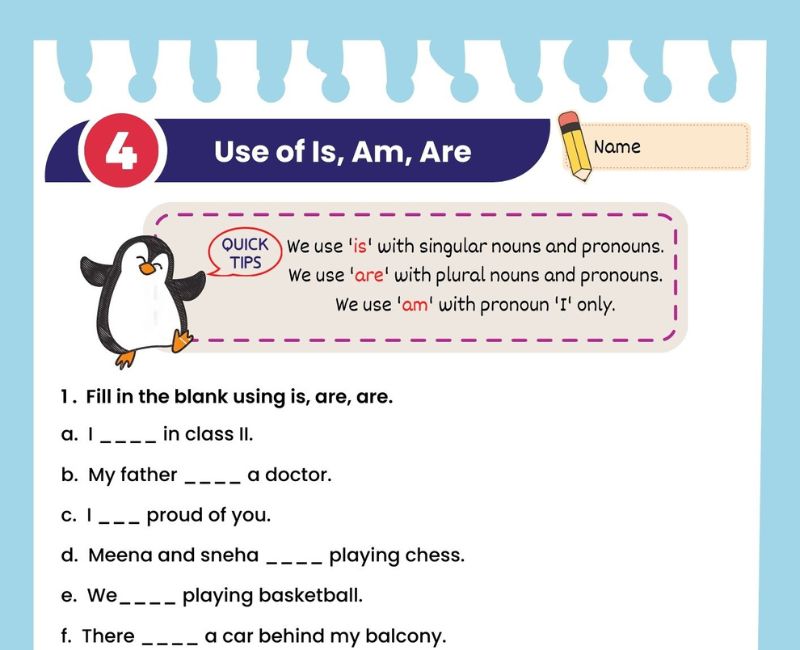
Is am are was were has and have
| Forms | Use in these beginner statements | Examples |
|---|---|---|
| am | Present form of be with I. | I am ready. |
| is | Present form of be with he, she, it or one named person or thing. | She is ready. The box is open. |
| are | Present form of be with you, we, they or plural subjects. | You are ready. The boxes are open. |
| was | Past form of be with I, he, she, it or a singular named subject in ordinary past statements. | I was at home yesterday. |
| were | Past form of be with you, we, they or plural subjects in these statements. | They were at home yesterday. |
| has | Present form of have with he, she, it or a singular named subject. | Tara has a kite. |
| have | Present form with I, you, we, they or plural subjects. | I have a kite. Her friends have kites. |
Simple present present continuous and past tense
| Tense | Useful beginner pattern | Example |
|---|---|---|
| Simple present | Use for habits and general facts. Many verbs add s or es with he, she, it or a singular named subject. | I walk every day. She brushes her teeth. |
| Present continuous | For these actions happening now, use am, is or are + verb-ing. | I am drawing. The children are playing. |
| Simple past | Use for completed past events. Some verbs add ed and others have irregular forms. | We played yesterday. We went home. |
Read both the subject and the time clue. “Every morning” suggests a habit in these exercises. “Look” and “right now” can signal an action happening now. “Yesterday” signals past time. Time words support meaning; they do not replace checking the whole sentence.
Articles singular and plural nouns prepositions and conjunctions
| Topic | Rule or meaning | Examples |
|---|---|---|
| A and an | Use with a singular countable noun in suitable contexts. Choose by the next sound. | a cup; an egg; a uniform; an umbrella. |
| The | Use when the reader can identify the particular person or thing, including something already introduced. | I saw a dog. The dog was sleeping. |
| Singular and plural nouns | Singular means one. Plural means more than one. Learn regular patterns and irregular forms. | box → boxes; child → children; mouse → mice. |
| In on under behind | These prepositions can show position. | in the box; on the table; under the chair; behind the door. |
| And but or | And adds, but highlights contrast and or offers alternatives. | bread and jam; old but useful; tea or juice. |
In a task that says “choose one”, or offers the alternatives for that task. Or does not always mean that both are forbidden: an instruction can explicitly allow “one or both”. But can connect two true ideas that contrast; it does not cancel the first idea.
Capital letters punctuation composition and comprehension
| Skill | What to practise | Example or task |
|---|---|---|
| Capitals and punctuation | Begin sentences and names with capitals. Write I as a capital. Use a full stop for a statement and a question mark for a direct question. | Where is Meera? She is at home. |
| Short composition | Introduce one topic, add relevant details and finish with a connected thought. | Write a short paragraph about a favourite place. |
| Reading comprehension | Understand a passage and use its details or supported clues to answer questions. | Find who helped, what happened and why. |
A grammar question can have one intended answer, while a composition can have many good answers. Written work needs review for meaning, relevance, organisation and language. The online quiz can check selected-answer skills; it cannot give a complete assessment of a learner’s original writing.
Question types for mixed Class 2 English practice
This revision page uses word identification, common/proper noun classification, fill-in boxes, subject–verb choices, pronoun replacement, picture-based questions, sentence building, tense changes, error detection, short reading questions and composition tasks. The activities use different sentences from the quiz so learners apply the rules again.
Common grammar errors with corrections
| Draft | Correction | Reason |
|---|---|---|
| They is playing. | They are playing. | They takes are in this present continuous sentence. |
| He have a bag. | He has a bag. | He takes has here. |
| a umbrella | an umbrella | Umbrella begins with a vowel sound. |
| two childs | two children | Children is the irregular plural. |
| Yesterday we go home. | Yesterday we went home. | The completed past event needs went. |
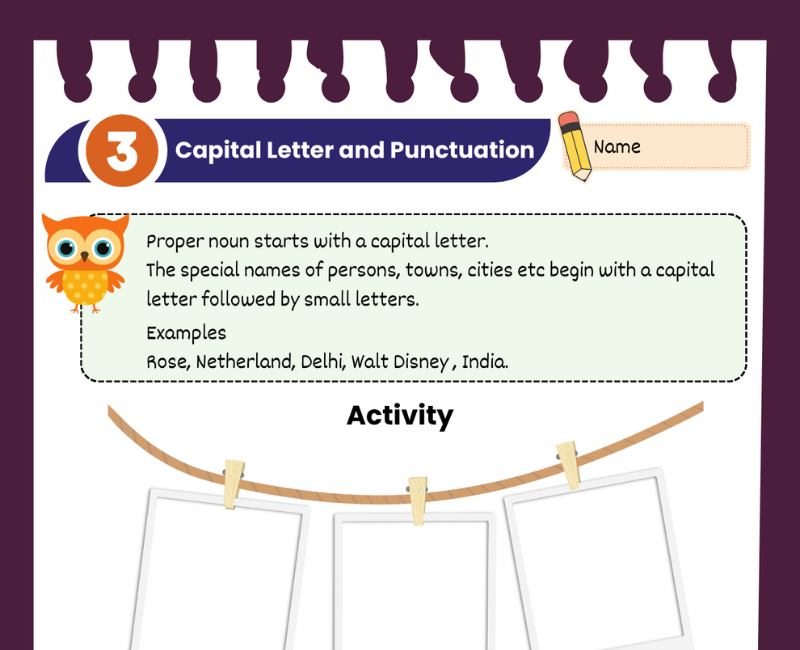
| where is rina. | Where is Rina? | Capitalise the beginning and name. Use a question mark. |
Use this Class 2 English grammar question paper with online quiz and online activities to connect the topic worksheets into mixed practice. The expandable lesson, question explanations and related worksheets make it possible to revisit a rule after an error. The floating quiz bar displays the timer during the attempt and the score out of 20 after submission.
Frequently Asked Questions
What topics are included in this Class 2 English grammar revision?
The online practice covers nouns, common and proper nouns, capitals, punctuation, is/am/are, was/were, subject and object pronouns, adjectives, verbs, has/have, articles, three basic tense areas, singular and plural nouns, prepositions, conjunctions, composition and comprehension.
Is the online quiz also out of 40 marks?
No. The downloadable resource is titled a 40-mark paper. The separate online quiz contains 20 questions worth one mark each and displays a score out of 20.
What question types can be used in a Class 2 grammar paper?
Mixed practice can include identification, classification, fill-in-the-blanks, multiple choice, sentence ordering, rewriting, error correction, passage questions and short writing. The exact paper pattern depends on the school and resource.
What is the difference between common and proper nouns?
A common noun gives a general name such as city or child. A proper noun names a particular person or place such as Pune or Tara and begins with a capital.
When do we use is am and are?
In these present statements, use I am; he, she or it is; and you, we or they are. Singular and plural named subjects follow the corresponding pattern.
When do we use was and were?
For ordinary past statements, use I, he, she or it was and you, we or they were. A time clue such as yesterday can help identify the past meaning.
How are has and have different?
In the simple present, he, she, it or a singular named subject usually takes has. I, you, we, they and plural subjects take have.
How do we choose a or an?
Choose according to the next sound in a suitable singular countable noun phrase: an apple but a uniform. The spelling of the first letter alone is not enough.
How do we tell simple present from present continuous?
Simple present can describe habits: She reads every day. Present continuous uses am, is or are plus verb-ing for these actions now: She is reading now.
Do all plural nouns add s and all past verbs add ed?
No. Some forms are irregular: child becomes children and mouse becomes mice; go becomes went. Learn the form in a meaningful sentence.
What should a short composition include?
Keep the writing on one topic, introduce it clearly, add connected details and give a suitable ending. Follow the length requested in the task and review grammar and punctuation.
How should comprehension answers be checked?
Compare each answer with the passage. Direct answers use stated details, while inferences need supporting clues. Different wording can express a good written answer, so open responses need human review.
Grammar references and photo credit
British Council grammar practice · Present simple and present continuous · Articles reference. Online questions and diagrams are original revision practice.
Chair photo by Amitbalani via Wikimedia Commons · CC0. A text alternative appears if the photograph cannot load.
 Download