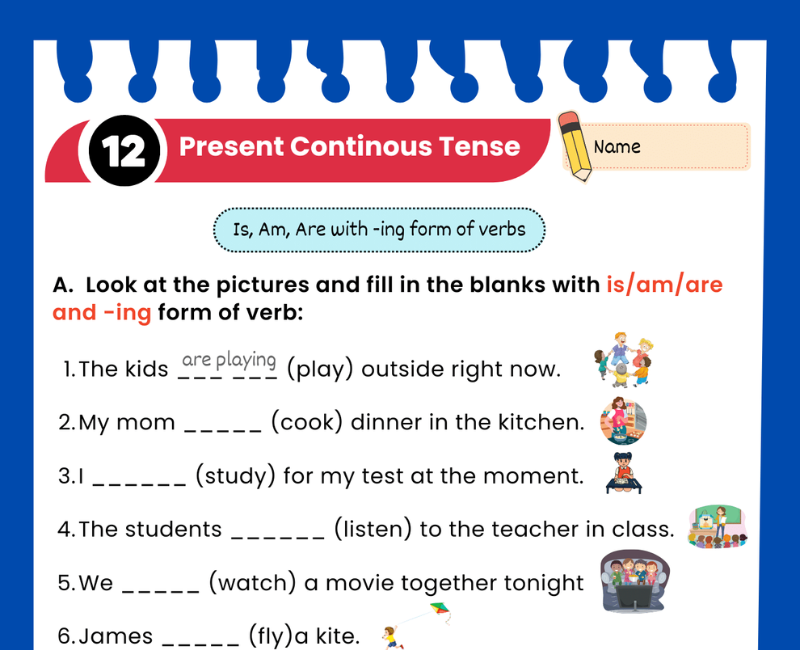
Present Continuous Tense Worksheet for Class 2
Look closely at actions happening now. Explore clear picture questions, hands-on language labs and creative games using am is are and verb-ing.
Explore a present continuous tense worksheet for Class 2 with online quiz and online activities. Practise actions happening now, am is are, ing words, negative sentences and questions through picture clues, memory matching, a mind map and practical observation tasks.
0 of 20 answered
1. I ? eating my lunch now.
You can return to any question and change your answer.
Helper sorting station
Learning goal: Match each subject with am is or are.
- Read the subject card.
- Choose am is or are. Sort all eight subjects.
I
Your turn!
Four grammar discoveries
Learning goal: Extend your understanding with short useful facts.
- Open all four discovery cards.
- Read the examples and make one new example of your own.
Two names for one form
Present continuous and present progressive name the same form: I am learning.
You always takes are here
You may mean one person or several people. Use You are listening in either case.
The y stays in the ing form
Try becomes trying and carry becomes carrying. Do not use the ies spelling from tries or carries.
An ing word alone is not enough
In this tense write The baby is smiling. The words The baby smiling do not make a complete sentence.
Your turn!
Present Continuous Tense for Class 2 Meaning Rules and Examples
The present continuous tense helps us describe an action that is in progress. Imagine a child moving a brush across paper. “The child is painting” tells us what is happening in that scene. This tense is also called the present progressive tense.
Meaning and definition
We commonly use the present continuous for actions happening at the moment of speaking. The action has started and is still going on.
Examples: I am opening my lunchbox. A bird is flying past the window. The children are cheering.
Present continuous tense formula
Subject + am / is / are + verb-ing
In “She is painting” She is the subject is is the helping verb and painting is the ing form of the main verb. Both parts of the verb phrase matter.
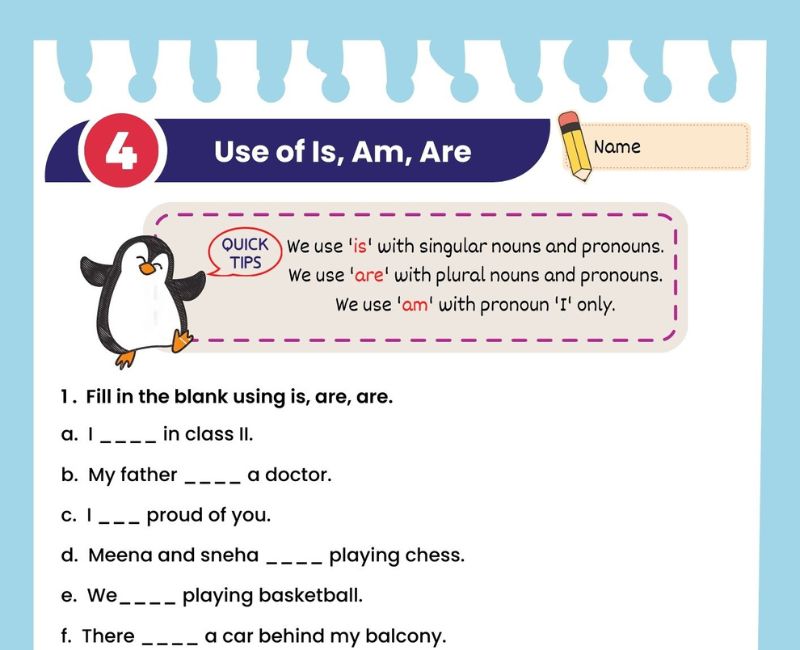
How to choose am is and are
| Subject | Helping verb | Example |
|---|---|---|
| I | am | I am drawing a star. |
| He she it or one name | is | Leena is opening a box. |
| You we they or a plural subject | are | The girls are reading a map. |
I am waving. She is waving. They are waving.
Change the helping verb to match the subject. Do not add s to waving.
Making ing words
Many present continuous tense exercises ask you to change a base verb into its ing form. Start with familiar examples and notice the spelling pattern.
| Pattern | Examples |
|---|---|
| Usually add ing. | read → reading; help → helping |
| Usually drop a final silent e before ing. | smile → smiling; close → closing |
| In familiar one-syllable verbs with a short vowel and one final consonant double that consonant. | hop → hopping; clap → clapping |
| Do not double final w x or y. | snow → snowing; fix → fixing; play → playing |
| Keep y before ing. | try → trying; carry → carrying |
| Extension: change ie to y before ing. | lie → lying; tie → tying |
Useful exception: keep the double e in see → seeing. Spelling rules help us notice patterns but some words need extra care.
Affirmative negative and interrogative sentence forms
These are three common sentence forms. An affirmative sentence tells us about an action. A negative sentence says an action is not happening. An interrogative sentence asks a question.
| Form | Pattern | Example |
|---|---|---|
| Affirmative | Subject + am/is/are + verb-ing | He is peeling a banana. |
| Negative | Subject + am/is/are + not + verb-ing | He is not peeling an orange. |
| Question | Am/Is/Are + subject + verb-ing? | Is he peeling a banana? |
| Question word | What + am/is/are + subject + doing? | What is he doing? |
To ask a question: move the helping verb before the subject.
They are cheering. → They are not cheering. → Are they cheering?
Short answers and contractions
| Question | Yes answer | No answer |
|---|---|---|
| Is he listening? | Yes he is. | No he is not. / No he isn’t. |
| Are they waiting? | Yes they are. | No they are not. / No they aren’t. |
| Are you reading? Answer about yourself. | Yes I am. | No I am not. / No I’m not. |
Common contractions include I’m for I am she’s for she is and they’re for they are. We use isn’t for is not and aren’t for are not. In ordinary positive short answers write “Yes she is” rather than “Yes she’s.”
Present continuous and simple present
Compare “We make models on Fridays” with “We are making a model now.” The first describes a regular activity. The second describes an action in progress. Now right now at the moment and Look! often help establish a scene but read the whole sentence rather than relying on one clue word.
A useful extra: present continuous can also describe temporary situations or arranged future events. For Class 2 begin with clear actions happening now. Some verbs that describe states usually take the simple present: “I know the answer” rather than “I am knowing the answer.”
Common mistakes to avoid
| Incorrect | Correct | Why? |
|---|---|---|
| She painting. | She is painting. | The helper is missing. |
| We is listening. | We are listening. | We needs are. |
| He is clap. | He is clapping. | The main verb needs its ing form. |
| Does she painting? | Is she painting? | This question uses is before the subject. |
| I am writeing. | I am writing. | Drop the final silent e in write. |
Use the present continuous tense worksheet for Class 2 download available on this page for written practice. The online quiz adds action diagrams and photo-based questions. The online activities extend the lesson through sorting memory matching sentence building a mind map observation tasks and picture reporting. The quiz includes answers and explanations after submission.
Frequently Asked Questions
What is the present continuous tense for Class 2?
It is commonly used for actions happening now. Form it with am is or are and an ing verb: I am drawing. She is smiling. They are waiting.
Are present continuous and present progressive the same?
Yes. They are two names for the same form. Both use a form of be with a main verb ending in ing.
What is the present continuous tense formula?
The affirmative pattern is subject + am/is/are + verb-ing. For example: The children are cheering.
When do we use am is and are?
Use am with I. Use is with he she it or one name. Use are with you we they and plural subjects.
How do we form the negative?
Put not after am is or are: I am not shouting. She is not moving. They are not waiting.
How do we ask present continuous questions?
Put am is or are before the subject and keep the ing form: Is she smiling? Are they listening?
What are common ing spelling rules?
Usually add ing. Drop a final silent e in many verbs such as smile → smiling. Double the final consonant in familiar short verbs such as hop → hopping. Keep y in carry → carrying.
Why is “She painting” incomplete?
As an affirmative sentence it is missing is. Write She is painting. A present continuous action needs a helping verb and an ing form.
What is the difference between simple present and present continuous?
Simple present can describe a routine: We make models on Fridays. Present continuous can describe an action in progress: We are making a model now.
Which words often go with the present continuous tense?
Now right now and at the moment often help describe actions in progress. A picture or conversation may also supply the context without a time word.
How do we give short answers?
Use the matching form of be: Is she listening? Yes she is. Are they waiting? No they aren’t. Are you reading? Yes I am.
Does every ing word show the present continuous tense?
No. In this tense the ing verb works with am is or are. I am painting is present continuous but an ing word can have other jobs in other sentences.
Photo credit and grammar references
Duck photo by Milada Vigerova via Wikimedia Commons · CC0. Action diagrams are original teaching illustrations.
British Council grammar for children · Present continuous reference · Cambridge verb spelling reference
 Download