Microorganisms: Friend and Foe Worksheet with Online Quiz
Meet the helpful and harmful microbes with games, labs and a quiz. On WitKnowLearn you get the Microorganisms: Friend and Foe online quiz, online activities and interactive games, a microbe lab, a virtual lab and a worksheet-style practice sheet for science.
Microorganisms: Friend and Foe Online Quiz
20 questions: 10 easy, 5 average and 5 thinking. Tap an answer and the next question comes up.
Microorganisms: Friend and Foe Activities
👆 Tap a tab to switch: Learn, Games, Labs, Challenges, Virtual Lab and Practice sheet
Microorganisms: Friend and Foe: Friend and Foe
A short read before you play. These notes cover microorganisms, their uses and the harm they can do.
🦠 Tiny living things
Microorganisms are living things too small to see without a microscope. They are bacteria, fungi, protozoa, algae and viruses, and they live in air, water, soil and even inside our bodies.
🥛 Friendly microbes
Lactobacillus turns milk into curd, yeast makes bread rise and moulds give antibiotics like penicillin. Rhizobium in legume roots fixes nitrogen, and decomposers recycle dead matter.
🦟 Harmful microbes and safety
Germs cause diseases such as cholera, malaria and polio. Mosquitoes and houseflies are carriers. Vaccines, clean water, covered food and preservation by salt, sugar, oil and cold keep us safe.
Microorganisms: Friend and Foe Activities
Follow every step on the Number Train. Earn up to 3 stars in every activity.
This page covers microorganisms, their uses and the harm they can do for school science. It covers the groups of microorganisms, their uses in food, medicine and agriculture, the diseases they cause and food preservation.
The activities are pitched at upper middle school level. Sort friends and foes, count bacterial doublings, match diseases with carriers and follow one bacterium in the studio. Explore more science worksheets on WitKnowLearn after this chapter.
Key ideas and facts to know
| Disease | Cause | Carrier or source |
|---|---|---|
| Cholera | bacteria | contaminated water |
| Malaria | protozoan | Anopheles mosquito |
| Polio | virus | contaminated water or contact |
How to use this page
- Flip the six cards and try the Microbe Lab in the Learn tab.
- Play the five games and the five labs to practise each idea.
- Finish the five challenges to collect up to 15 points.
- Do two virtual experiments and follow one bacterium in the studio.
- Take the 20-question online quiz, with assertion and reason and case study questions, and fill in the practice sheet.
Worked examples
80 ÷ 20 = 4 doublings, so 16 bacteria.
Salting and refrigeration.
This Microorganisms: Friend and Foe worksheet gives you online activities and interactive games that make the chapter clear. Every activity has a goal, a hint and a short fact, so students learn while they enjoy.
Complete Guide: Microorganisms: Friend and Foe
This guide is for students, parents and teachers. It covers microorganisms, their uses and the harm they can do and shows how to use the quiz, labs and games on this page.
Introduction to Microorganisms: Friend and Foe
Microorganisms are everywhere. Some make our food and medicines, and some cause diseases, so we need to know both sides.
What is there in this chapter
- Microorganisms and their types
- Useful microorganisms
- Medicines and vaccines
- Nitrogen fixation
- Harmful microorganisms
- Food preservation
Learning objectives
- Name the groups of microorganisms.
- Explain how microbes help us and harm us.
- Describe ways to prevent disease and spoilage.
- Reason with assertions and case studies.
Learning outcomes
- I can name useful microbes and their uses.
- I can match diseases with their cause and carrier.
- I can solve doubling problems.
Microorganisms: Friend and Foe resources on this page
| Resource | What it gives |
|---|---|
| Online quiz | 20 questions: 10 easy, 5 average and 5 thinking, with assertion and reason and case study questions and a full review |
| Flip cards | 6 picture cards with one-line rules |
| Microbe Lab | A hands-on lab with 3 rounds |
| Games | 5 interactive games |
| Labs | 5 activity labs |
| Virtual Lab | 2 experiments plus a studio that doubles one bacterium every 20 minutes |
| Challenges | 5 challenges, 15 points in all |
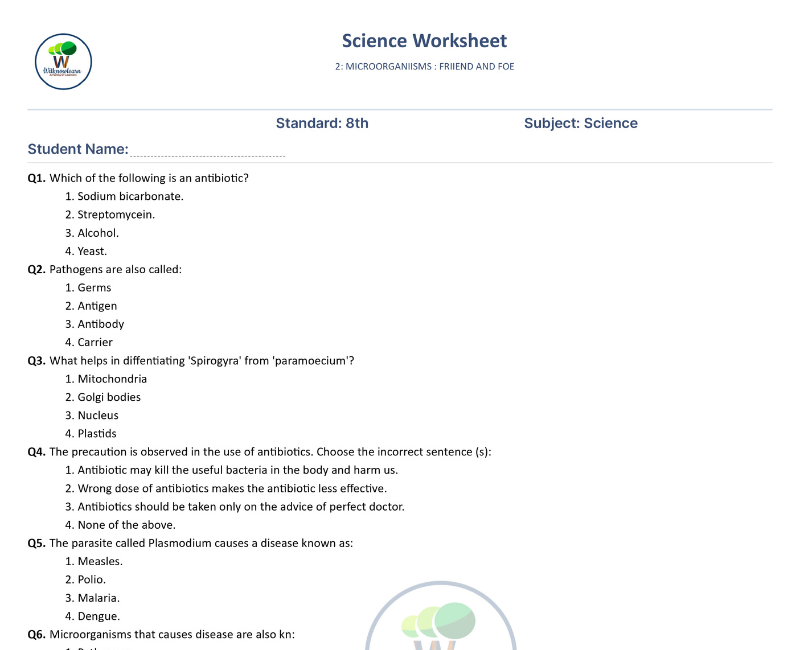
| Practice sheet | A worksheet-style sheet with 16 questions, name and date lines and a live score |
Key facts
| Idea | Rule |
|---|---|
| Lactobacillus | makes curd |
| Yeast | makes bread rise |
| Antibiotic | acts on bacteria only |
| Vaccine | builds immunity |
| Rhizobium | fixes nitrogen |
Types of questions you may see
- Friend and foe sorting
- Doubling calculations
- Assertion and reason on vaccines
- Case studies on disease spread
Solved examples
The Aedes mosquito.
3 × 8 = 24.
Common mistakes
| Mistake | Correct idea |
|---|---|
| Giving antibiotics for a viral cold | Antibiotics act on bacteria only |
| Saying all microbes are harmful | Many microbes are useful |
| Mixing up Anopheles and Aedes | Anopheles carries malaria, Aedes carries dengue |
Microorganisms: Friend and Foe in daily life
Curd, bread, medicines, vaccines and safe food all depend on knowing how microorganisms behave.
Tips for parents and teachers
- Link each disease with its cause and carrier.
- Practise doubling with small numbers first.
- Practise one assertion and one case study each week.
Related Science Worksheets
Microorganisms: Friend and Foe FAQs
What are microorganisms?
They are living things too small to see without a microscope, such as bacteria, fungi, protozoa, algae and viruses.
Which microbe makes curd?
Lactobacillus bacteria turn milk into curd.
What is the difference between an antibiotic and a vaccine?
An antibiotic kills or stops bacteria. A vaccine prepares the body to fight a germ.
How can food be preserved?
By salt, sugar, oil, vinegar, heat, cold and pasteurisation.
What can students do on this page?
Students can take a 20-question online quiz with assertion and reason and case study questions, play five games, try five online activities, finish five challenges, run the Microbe Lab, do two virtual experiments, follow one bacterium as it doubles and compare the dots and bars views,, and fill in a 16-question practice sheet with a Show answers button.
 Download