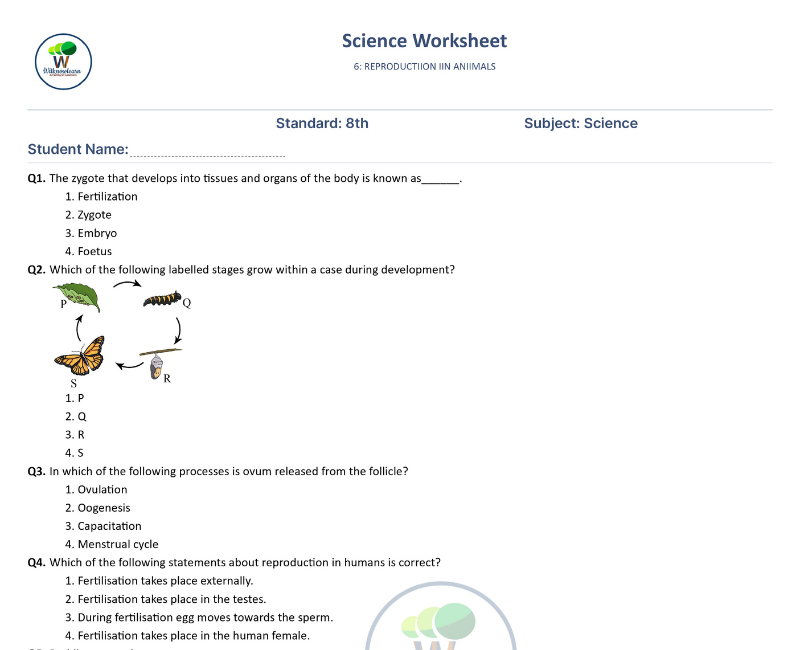
Reproduction in Animals Worksheet with Online Quiz
Learn how animals reproduce with games, labs and a quiz. On WitKnowLearn you get the Reproduction in Animals online quiz, online activities and interactive games, a life lab, a virtual lab and a worksheet-style practice sheet for science.
Reproduction in Animals Online Quiz
20 questions: 10 easy, 5 average and 5 thinking. Tap an answer and the next question comes up.
Reproduction in Animals Activities
👆 Tap a tab to switch: Learn, Games, Labs, Challenges, Virtual Lab and Practice sheet
Reproduction in Animals: How Animals Reproduce
A short read before you play. These notes cover reproduction in animals, from gametes and fertilisation to life cycles and cloning.
🧬 Gametes and fertilisation
Reproduction makes new individuals. In sexual reproduction a sperm from the male and an ovum from the female fuse in fertilisation to form a zygote. Fertilisation is internal in hens and humans and external in frogs and fish.
🐸 Birth, eggs and metamorphosis
Oviparous animals such as hens and frogs lay eggs, while viviparous animals such as cows and humans give birth. A frog grows from egg to tadpole to adult, and a butterfly from egg to larva to pupa to adult.
🪸 One parent and cloning
Asexual reproduction needs one parent. Amoeba divides by binary fission and Hydra forms buds. A clone is an exact copy of its parent, and Dolly the sheep was the first cloned mammal.
Reproduction in Animals Activities
Follow every step on the Number Train. Earn up to 3 stars in every activity.
This page covers reproduction in animals, from gametes and fertilisation to life cycles and cloning for school science. It covers sexual and asexual reproduction, fertilisation, oviparous and viviparous animals, metamorphosis and cloning.
The activities are pitched at upper middle school level. Sort egg layers and live birth animals, count Amoebae and eggs, match young stages and follow a laying hen in the studio. Explore more science worksheets on WitKnowLearn after this chapter.
Key ideas and facts to know
| Animal | Fertilisation | Young one |
|---|---|---|
| Frog | external | tadpole |
| Hen | internal | chick |
| Human | internal | baby |
| Butterfly | internal | caterpillar |
How to use this page
- Flip the six cards and try the Life Lab in the Learn tab.
- Play the five games and the five labs to practise each idea.
- Finish the five challenges to collect up to 15 points.
- Do two virtual experiments and follow a laying hen in the studio.
- Take the 20-question online quiz, with assertion and reason and case study questions, and fill in the practice sheet.
Worked examples
6 × 5 = 30 eggs.
2 × 8 = 16 Amoebae.
This Reproduction in Animals worksheet gives you online activities and interactive games that make the chapter clear. Every activity has a goal, a hint and a short fact, so students learn while they enjoy.
Complete Guide: Reproduction in Animals
This guide is for students, parents and teachers. It covers reproduction in animals, from gametes and fertilisation to life cycles and cloning and shows how to use the quiz, labs and games on this page.
Introduction to Reproduction in Animals
Reproduction keeps every species alive. Animals reproduce in different ways, but all pass life from one generation to the next.
What is there in this chapter
- Sexual reproduction
- Fertilisation
- Oviparous and viviparous animals
- Metamorphosis
- Asexual reproduction
- Cloning
Learning objectives
- Describe fertilisation and the zygote.
- Compare egg laying and live birth.
- Explain asexual reproduction and cloning.
- Reason with assertions and case studies.
Learning outcomes
- I can describe how a zygote forms.
- I can describe the life cycles of a frog and a butterfly.
- I can solve egg and division problems.
Reproduction in Animals resources on this page
| Resource | What it gives |
|---|---|
| Online quiz | 20 questions: 10 easy, 5 average and 5 thinking, with assertion and reason and case study questions and a full review |
| Flip cards | 6 picture cards with one-line rules |
| Life Lab | A hands-on lab with 3 rounds |
| Games | 5 interactive games |
| Labs | 5 activity labs |
| Virtual Lab | 2 experiments plus a studio that follows a laying hen week by week |
| Challenges | 5 challenges, 15 points in all |
| Practice sheet | A worksheet-style sheet with 16 questions, name and date lines and a live score |
Key facts
| Idea | Rule |
|---|---|
| Sperm | male gamete |
| Ovum | female gamete |
| Zygote | fertilised egg |
| Binary fission | Amoeba divides in two |
| Budding | Hydra |
Types of questions you may see
- Egg layer or live birth sorting
- Egg and division calculations
- Assertion and reason on fertilisation
- Case studies on life cycles
Solved examples
Cow and dog.
16 Amoebae.
Common mistakes
| Mistake | Correct idea |
|---|---|
| Calling a tadpole a larva of a butterfly | A tadpole is the young of a frog |
| Saying fertilisation happens in the testis | The sperm and egg fuse at fertilisation |
| Mixing up oviparous and viviparous | Oviparous lay eggs, viviparous give birth |
Reproduction in Animals in daily life
Farms, fisheries, hatcheries and wildlife parks all depend on knowing how animals reproduce.
Tips for parents and teachers
- Draw each life cycle in order.
- Match every animal with its young one.
- Practise one assertion and one case study each week.
Related Science Worksheets
Reproduction in Animals FAQs
What is fertilisation?
It is the fusion of a sperm and an egg to form a zygote.
What is the difference between oviparous and viviparous animals?
Oviparous animals lay eggs. Viviparous animals give birth to young ones.
What is metamorphosis?
It is the change in form as an animal grows, as in a tadpole becoming a frog.
What is a clone?
A clone is an exact copy of a parent produced from one cell. Dolly the sheep was the first cloned mammal.
What can students do on this page?
Students can take a 20-question online quiz with assertion and reason and case study questions, play five games, try five online activities, finish five challenges, run the Life Lab, do two virtual experiments, follow a laying hen week by week and compare the dots and bars views,, and fill in a 16-question practice sheet with a Show answers button.
 Download