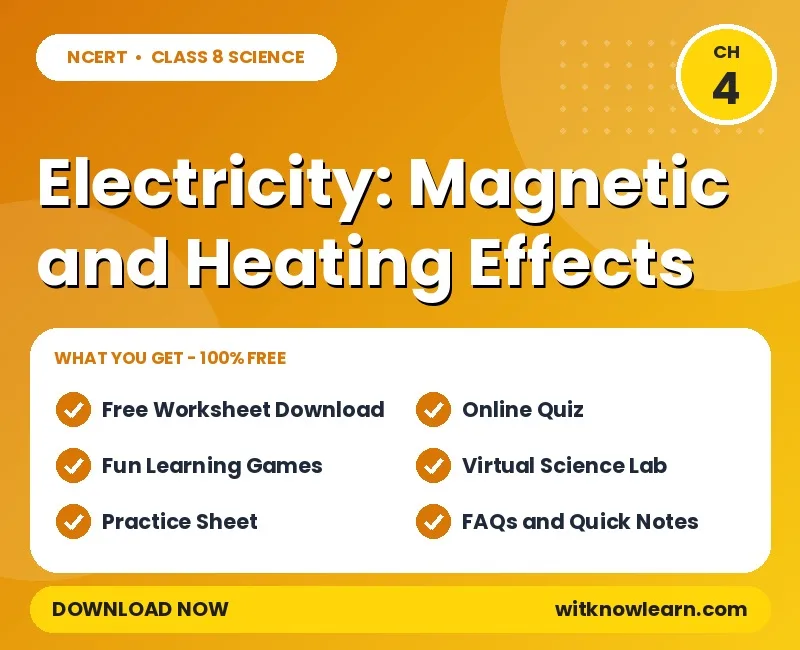
Electricity: Magnetic and Heating Effects Class 8 Science Worksheet with Quiz and Activities
Explore electromagnets, heating effects and batteries with games, labs and a quiz. On WitKnowLearn you get the Electricity: Magnetic and Heating Effects Class 8 online quiz, online activities and interactive games, a electric effects lab, a virtual lab and a worksheet-style practice sheet for Class 8 Science.
Electricity: Magnetic and Heating Effects Class 8 Online Quiz
Includes assertion and reason, case study and higher order thinking questions. Tap an answer and the next question comes up.
Electricity: Magnetic and Heating Effects Class 8 Activities
👆 Tap a tab to switch: Learn, Games, Labs, Challenges, Virtual Lab and Practice sheet
Electricity: Magnetic and Heating Effects: Effects of Electric Current
A short read for Class 8 before you play. These notes cover the magnetic and heating effects of electric current and cells and batteries.
🧭 A magnetic field from current
Oersted found that a compass needle deflects near a current carrying wire. A coil with an iron core becomes an electromagnet that can lift iron.
🔥 Heat from current
A conductor opposes current and some electrical energy changes to heat. Nichrome is used in heaters, kettles and irons because of its high resistance.
🔋 Cells and batteries
Chemical reactions in cells produce electricity. Voltaic cells use two metals and an electrolyte, dry cells are single use and Li-ion batteries are rechargeable.
Electricity: Magnetic and Heating Effects Class 8 Science Activities
Follow every step on the Number Train. Earn up to 3 stars in every activity.
This page covers the magnetic and heating effects of electric current and cells and batteries for Class 8 science. It covers the magnetic effect of current, electromagnets, the heating effect, Voltaic cells, dry cells and rechargeable batteries.
The activities are pitched at Class 8 level. Sort devices by effect, strengthen an electromagnet and follow crane lifts in the studio. Explore more Class 8 science worksheets on WitKnowLearn after this chapter.
Key ideas and facts to know
| Effect | Cause | Example |
|---|---|---|
| Magnetic | current in a coil | lifting electromagnet |
| Heating | resistance of wire | electric kettle |
| Chemical | metals in electrolyte | lemon cell |
How to use this page
- Flip the six cards and try the Electric Effects Lab in the Learn tab.
- Play the five games and the five labs to practise each idea.
- Finish the five challenges to collect up to 15 points.
- Do two virtual experiments and follow crane lifts in the studio.
- Take the online quiz, with assertion and reason and case study questions, and fill in the practice sheet.
Worked examples
4 × 5 = 20 clips.
30 × 6 = 180 s.
This Electricity: Magnetic and Heating Effects worksheet for Class 8 science gives you online activities and interactive games that make the chapter clear. Every activity has a goal, a hint and a short fact, so students learn while they enjoy.
Complete Guide: Class 8 Science Electricity: Magnetic and Heating Effects
This guide is for Class 8 students, parents and teachers. It covers the magnetic and heating effects of electric current and cells and batteries for Class 8 science and shows how to use the quiz, labs and games on this page.
Introduction to Electricity: Magnetic and Heating Effects
This chapter links electricity to magnetism and heat and explains how cells and batteries work.
What is there in this chapter
- Magnetic effect of current
- Electromagnets
- Lifting electromagnets
- Heating effect
- Voltaic cell
- Dry cells and rechargeable batteries
Learning objectives
- Explain the magnetic effect of current.
- Make and strengthen an electromagnet.
- Describe cells and batteries.
- Reason with assertions and case studies.
Learning outcomes
- I can describe Oersted's discovery.
- I can say why nichrome is used in heaters.
- I can compare dry cells and rechargeable batteries.
Electricity: Magnetic and Heating Effects Class 8 resources on this page
| Resource | What it gives |
|---|---|
| Online quiz | Assertion and reason, case study and higher order thinking questions with a full review |
| Flip cards | 6 picture cards with one-line rules |
| Electric Effects Lab | A hands-on lab with 3 rounds |
| Games | 5 interactive games |
| Labs | 5 activity labs |
| Virtual Lab | 2 experiments plus a studio that follows crane lifts |
| Challenges | 5 challenges, 15 points in all |
| Practice sheet | A worksheet-style sheet with 16 questions, name and date lines and a live score |
Key facts
| Idea | Rule |
|---|---|
| Electromagnet | works only while current flows |
| Nichrome | high resistance |
| Voltaic cell | two metals and electrolyte |
| Dry cell | single use |
Types of questions you may see
- Magnetic or heating sorting
- Clip and time calculations
- Assertion and reason on electromagnets and nichrome
- A short case study on a nail electromagnet
Solved examples
4 × 6 = 24 clips.
The magnetic field disappears when the current stops.
Common mistakes
| Mistake | Correct idea |
|---|---|
| Saying an electromagnet stays magnetic without current | It works only while current flows |
| Using copper for heating elements | Nichrome has higher resistance |
| Saying dry cells are rechargeable | Dry cells are single use |
Electricity: Magnetic and Heating Effects in daily life
Electric bells, motors, cranes, kettles, irons, torches and phones all use the effects of electric current.
Tips for parents and teachers
- Draw each circuit with a switch.
- Link every device to its effect.
- Practise one assertion and one case study each week.
Related Class 8 Science Worksheets
Electricity: Magnetic and Heating Effects Class 8 FAQs
What is the magnetic effect of electric current?
When electric current flows through a conductor such as a wire, it produces a magnetic field around it. The field disappears when the current stops.
Who discovered the magnetic effect of electric current?
Hans Christian Oersted, a professor in Denmark, noticed in 1820 that a compass needle deflected whenever a circuit was closed or opened.
What is a magnetic field?
The region around a magnet or a current carrying wire where its magnetic effect can be felt, for example by the deflection of a compass needle.
What is an electromagnet?
A current carrying coil that behaves like a magnet is an electromagnet. Most have an iron core to make them stronger.
How can we make an electromagnet stronger?
Increase the current by using more cells, increase the number of turns of the coil and use an iron core.
How do we reverse the poles of an electromagnet?
Change the direction of the current in the coil by swapping the connections to the cell.
How does a lifting electromagnet work?
A strong electromagnet hung from a crane lifts iron and steel objects when the current is ON and releases them when it is OFF.
What are uses of the magnetic effect of electric current?
Electromagnets, electric bells, motors, fans and loudspeakers use the magnetic effect.
What is the heating effect of electric current?
When current flows through a conductor, some electrical energy changes to heat because of resistance. This warming is the heating effect.
Why is nichrome wire used in heating devices?
Nichrome offers a higher resistance than copper of the same size and length, so it generates more heat for a given current.
What does the heat produced in a wire depend on?
It depends on the material, thickness and length of the wire, the size of the current and the time for which current flows.
Which appliances work on the heating effect?
Room heaters, stoves, kettles, irons, immersion rods and hair dryers contain a heating element.
What is a Voltaic cell?
A cell with two different metal electrodes dipped in an electrolyte, in which a chemical reaction produces electricity. It is also called a Galvanic cell.
How can we make a cell from lemons?
Put a copper wire and an iron nail in each lemon, join the lemons in a chain and connect an LED. Lemon juice acts as the electrolyte.
What is a dry cell?
A dry cell has a zinc container as the negative terminal, a carbon rod with a metal cap as the positive terminal and a moist paste as the electrolyte. It is single use.
What are rechargeable batteries?
They can be recharged and reused many times, for example Li-ion batteries in phones and laptops, but they slowly wear out.
What can students do on this page?
Students can take an online quiz with assertion and reason and case study questions, play five games, try five online activities, finish five challenges, run the Electric Effects Lab, do two virtual experiments, follow crane magnet lifts and compare the dots and bars views,, and fill in a 16-question practice sheet with a Show answers button.
 Download