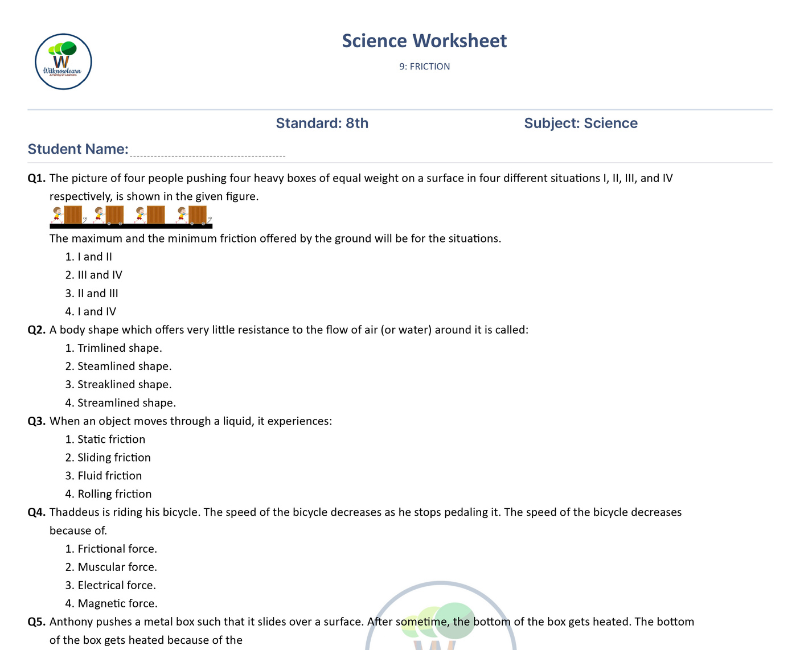
Friction Worksheet with Online Quiz
Discover the force that opposes motion with games, labs and a quiz. On WitKnowLearn you get the Friction online quiz, online activities and interactive games, a friction lab, a virtual lab and a worksheet-style practice sheet for science.
Friction Online Quiz
20 questions: 10 easy, 5 average and 5 thinking. Tap an answer and the next question comes up.
Friction Activities
👆 Tap a tab to switch: Learn, Games, Labs, Challenges, Virtual Lab and Practice sheet
Friction: The Force That Opposes Motion
A short read before you play. These notes cover friction, its kinds, its uses and how to increase or reduce it.
📦 What friction does
Friction is the force that opposes the relative motion between surfaces in contact. It depends on how rough the surfaces are and how hard they are pressed together, and it acts opposite to the motion.
⚽ Kinds of friction
Static friction acts before an object starts moving, sliding friction acts on a sliding object and rolling friction on a rolling one. Static is largest and rolling is smallest. Air and water cause fluid friction, or drag.
🛢️ Using and reducing friction
Friction lets us walk, write and brake, but it also causes heat and wear. Oil, ball bearings and streamlined shapes reduce friction, while grooves, rough soles and sand increase it.
Friction Activities
Follow every step on the Number Train. Earn up to 3 stars in every activity.
This page covers friction, its kinds, its uses and how to increase or reduce it for school science. It covers what friction is, the factors affecting it, static, sliding, rolling and fluid friction, and ways to increase or reduce friction.
The activities are pitched at upper middle school level. Sort friction raisers and reducers, find net force and friction saved, and push a box against friction in the studio. Explore more science worksheets on WitKnowLearn after this chapter.
Key ideas and facts to know
| Kind of friction | Example | Size |
|---|---|---|
| Static | box at rest | largest |
| Sliding | dragged box | medium |
| Rolling | rolling ball | smallest |
How to use this page
- Flip the six cards and try the Friction Lab in the Learn tab.
- Play the five games and the five labs to practise each idea.
- Finish the five challenges to collect up to 15 points.
- Do two virtual experiments and push a box against friction in the studio.
- Take the 20-question online quiz, with assertion and reason and case study questions, and fill in the practice sheet.
Worked examples
70 − 45 = 25 N.
Rolling friction is much smaller than sliding friction.
This Friction worksheet gives you online activities and interactive games that make the chapter clear. Every activity has a goal, a hint and a short fact, so students learn while they enjoy.
Complete Guide: Friction
This guide is for students, parents and teachers. It covers friction, its kinds, its uses and how to increase or reduce it and shows how to use the quiz, labs and games on this page.
Introduction to Friction
Friction is all around us. It stops us slipping, lets brakes work and also wears things out, so we increase or reduce it as needed.
What is there in this chapter
- What friction is
- Factors affecting friction
- Kinds of friction
- Advantages and disadvantages
- Increasing and reducing friction
- Fluid friction
Learning objectives
- Define friction and its factors.
- Compare static, sliding and rolling friction.
- Suggest ways to change friction.
- Reason with assertions and case studies.
Learning outcomes
- I can explain what affects friction.
- I can order the kinds of friction.
- I can solve net force problems.
Friction resources on this page
| Resource | What it gives |
|---|---|
| Online quiz | 20 questions: 10 easy, 5 average and 5 thinking, with assertion and reason and case study questions and a full review |
| Flip cards | 6 picture cards with one-line rules |
| Friction Lab | A hands-on lab with 3 rounds |
| Games | 5 interactive games |
| Labs | 5 activity labs |
| Virtual Lab | 2 experiments plus a studio that pushes a box against friction |
| Challenges | 5 challenges, 15 points in all |
| Practice sheet | A worksheet-style sheet with 16 questions, name and date lines and a live score |
Key facts
| Idea | Rule |
|---|---|
| Friction | opposes motion |
| Static | largest |
| Rolling | smallest |
| Lubricant | reduces friction |
| Streamlined shape | cuts drag |
Types of questions you may see
- Increase or reduce sorting
- Net force calculations
- Assertion and reason on grip
- Case studies on machines
Solved examples
60 − 25 = 35 N.
Use oil and use ball bearings.
Common mistakes
| Mistake | Correct idea |
|---|---|
| Saying friction acts along the motion | Friction acts opposite to the motion |
| Saying rolling friction is the largest | Rolling is the smallest |
| Thinking friction is always bad | It also gives grip and braking |
Friction in daily life
Walking, writing, braking, lighting a match and oiling a bicycle chain all involve friction.
Tips for parents and teachers
- Test two surfaces and compare.
- Talk about when friction helps and when it harms.
- Practise one assertion and one case study each week.
Related Science Worksheets
Friction FAQs
What is friction?
Friction is the force that opposes the relative motion between two surfaces in contact.
Which friction is the smallest?
Rolling friction is smaller than sliding friction, and static friction is the largest.
How can friction be reduced?
By using oil or grease, ball bearings, polishing and streamlined shapes.
Why does friction produce heat?
Rubbing surfaces turn some motion energy into heat.
What can students do on this page?
Students can take a 20-question online quiz with assertion and reason and case study questions, play five games, try five online activities, finish five challenges, run the Friction Lab, do two virtual experiments, push a box against friction and compare the dots and bars views,, and fill in a 16-question practice sheet with a Show answers button.
 Download