Reaching the Age of Adolescence Worksheet with Online Quiz
Learn about growing up with games, labs and a quiz. On WitKnowLearn you get the Reaching the Age of Adolescence online quiz, online activities and interactive games, a growth lab, a virtual lab and a worksheet-style practice sheet for science.
Reaching the Age of Adolescence Online Quiz
20 questions: 10 easy, 5 average and 5 thinking. Tap an answer and the next question comes up.
Reaching the Age of Adolescence Activities
👆 Tap a tab to switch: Learn, Games, Labs, Challenges, Virtual Lab and Practice sheet
Reaching the Age of Adolescence: Growing Up
A short read before you play. These notes cover adolescence, puberty, hormones, the menstrual cycle and staying healthy.
📏 Puberty and adolescence
Adolescence is the stage from about 11 to 19 years when puberty begins. The body grows fast, the voice deepens in boys, the skin gets oilier and feelings change. These changes are normal and happen at different ages.
🦋 Glands and hormones
Hormones are chemical messengers made by endocrine glands. Insulin from the pancreas controls blood sugar, thyroxine from the thyroid needs iodine and adrenaline from the adrenal glands prepares us for emergencies.
🧬 Chromosomes and health
Body cells have 46 chromosomes. A sperm carries X or Y and every egg carries X, so the father decides the sex of a baby. A balanced diet, exercise, sleep and hygiene keep adolescents healthy.
Reaching the Age of Adolescence Activities
Follow every step on the Number Train. Earn up to 3 stars in every activity.
This page covers adolescence, puberty, hormones, the menstrual cycle and staying healthy for school science. It covers adolescence and puberty, endocrine glands and hormones, the menstrual cycle, sex determination and healthy habits.
The activities are pitched at upper middle school level. Sort physical and emotional changes, match glands with hormones, do growth and calendar sums and follow a growth spurt in the studio. Explore more science worksheets on WitKnowLearn after this chapter.
Key ideas and facts to know
| Gland | Hormone | Job |
|---|---|---|
| Pancreas | insulin | controls blood sugar |
| Thyroid | thyroxine | controls metabolism |
| Adrenal | adrenaline | emergency response |
How to use this page
- Flip the six cards and try the Growth Lab in the Learn tab.
- Play the five games and the five labs to practise each idea.
- Finish the five challenges to collect up to 15 points.
- Do two virtual experiments and follow a growth spurt in the studio.
- Take the 20-question online quiz, with assertion and reason and case study questions, and fill in the practice sheet.
Worked examples
5 × 4 = 20 cm.
Lack of iodine.
This Reaching the Age of Adolescence worksheet gives you online activities and interactive games that make the chapter clear. Every activity has a goal, a hint and a short fact, so students learn while they enjoy.
Complete Guide: Reaching the Age of Adolescence
This guide is for students, parents and teachers. It covers adolescence, puberty, hormones, the menstrual cycle and staying healthy and shows how to use the quiz, labs and games on this page.
Introduction to Reaching the Age of Adolescence
Adolescence is a time of rapid change in body and mind. Knowing how hormones work helps students understand and manage these changes.
What is there in this chapter
- Puberty and its changes
- Endocrine glands and hormones
- The menstrual cycle
- Sex determination
- Staying healthy
Learning objectives
- Describe the changes of adolescence.
- Match glands with hormones.
- Explain how chromosomes decide sex.
- Reason with assertions and case studies.
Learning outcomes
- I can describe puberty changes.
- I can name glands and their hormones.
- I can plan healthy habits.
Reaching the Age of Adolescence resources on this page
| Resource | What it gives |
|---|---|
| Online quiz | 20 questions: 10 easy, 5 average and 5 thinking, with assertion and reason and case study questions and a full review |
| Flip cards | 6 picture cards with one-line rules |
| Growth Lab | A hands-on lab with 3 rounds |
| Games | 5 interactive games |
| Labs | 5 activity labs |
| Virtual Lab | 2 experiments plus a studio that follows a growth spurt year by year |
| Challenges | 5 challenges, 15 points in all |
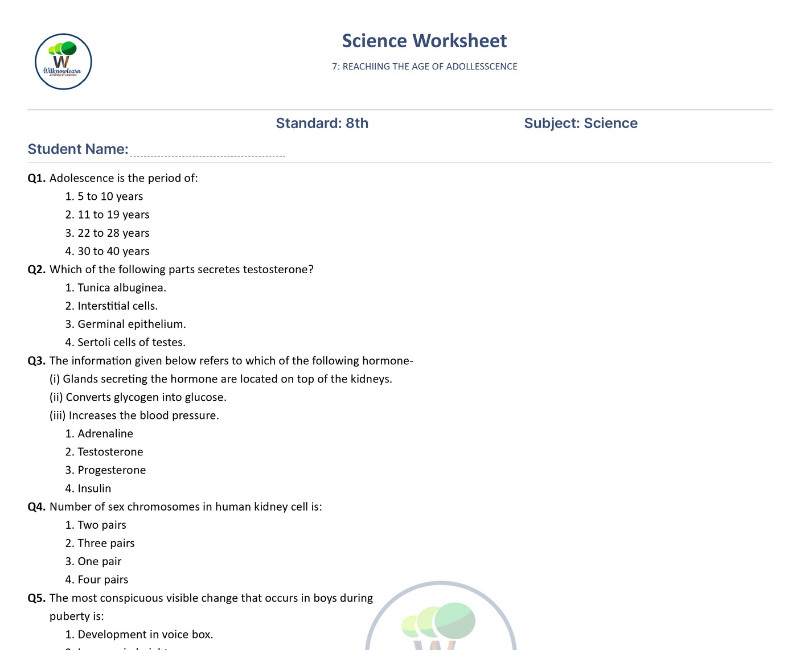
| Practice sheet | A worksheet-style sheet with 16 questions, name and date lines and a live score |
Key facts
| Idea | Rule |
|---|---|
| Adolescence | about 11 to 19 years |
| Insulin | controls blood sugar |
| Thyroxine | needs iodine |
| Chromosomes | 46 in a body cell |
| Cycle | about 28 days |
Types of questions you may see
- Physical or emotional sorting
- Growth and calendar sums
- Assertion and reason on hormones
- Case studies on health
Solved examples
The pancreas.
23, half of 46.
Common mistakes
| Mistake | Correct idea |
|---|---|
| Saying thyroxine controls blood sugar | Insulin controls blood sugar |
| Saying the mother decides the sex | The father's sperm carries X or Y |
| Thinking puberty is an illness | It is a normal stage |
Reaching the Age of Adolescence in daily life
Health education, diet, sleep and exercise in daily life all rest on understanding adolescence.
Tips for parents and teachers
- Talk openly and kindly about changes.
- Encourage a balanced diet and sleep.
- Practise one assertion and one case study each week.
Related Science Worksheets
Reaching the Age of Adolescence FAQs
What is adolescence?
It is the stage between childhood and adulthood, from about 11 to 19 years, when puberty occurs.
What are hormones?
Chemical messengers released by endocrine glands into the blood.
Why is iodised salt important?
Iodine is needed to make thyroxine, and a lack causes goitre.
What decides the sex of a baby?
The sperm carries X or Y while every egg carries X, so the father's sperm decides.
What can students do on this page?
Students can take a 20-question online quiz with assertion and reason and case study questions, play five games, try five online activities, finish five challenges, run the Growth Lab, do two virtual experiments, follow a growth spurt year by year and compare the dots and bars views,, and fill in a 16-question practice sheet with a Show answers button.
 Download