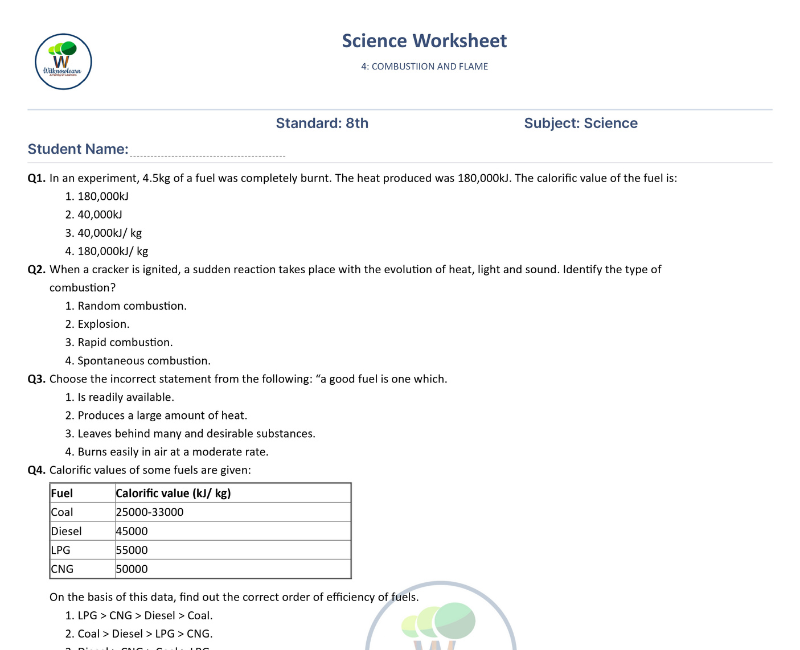
Combustion and Flame Worksheet with Online Quiz
Learn about fire, flames and fuels with games, labs and a quiz. On WitKnowLearn you get the Combustion and Flame online quiz, online activities and interactive games, a fire lab, a virtual lab and a worksheet-style practice sheet for science.
Combustion and Flame Online Quiz
20 questions: 10 easy, 5 average and 5 thinking. Tap an answer and the next question comes up.
Combustion and Flame Activities
👆 Tap a tab to switch: Learn, Games, Labs, Challenges, Virtual Lab and Practice sheet
Combustion and Flame: Burning and Flames
A short read before you play. These notes cover combustion, the fire triangle, flame zones and fuels.
🔥 What is combustion
Combustion is burning of a substance in air to give heat. Burning needs a fuel, oxygen and heat up to the ignition temperature. Together they form the fire triangle, and removing any one puts the fire out.
🕯️ Zones of a flame
A candle flame has three zones. The dark inner zone holds unburnt wax vapour, the yellow middle zone has partial burning and the blue outer zone has complete burning and is the hottest. Goldsmiths use this zone.
⛽ Fuels and fire safety
The calorific value of a fuel is the heat from 1 kg, in kJ per kg. LPG gives more than wood. Water cools most fires, but oil and electrical fires need carbon dioxide or smothering. Dial 101.
Combustion and Flame Activities
Follow every step on the Number Train. Earn up to 3 stars in every activity.
This page covers combustion, the fire triangle, flame zones and fuels for school science. It covers combustion, the fire triangle, kinds of combustion, flame zones, calorific value of fuels and the harmful effects of burning.
The activities are pitched at upper middle school level. Sort combustible materials, work out the heat from fuels, practise fire safety and follow a burning candle in the studio. Explore more science worksheets on WitKnowLearn after this chapter.
Key ideas and facts to know
| Fuel | Calorific value (kJ per kg) | Remark |
|---|---|---|
| LPG | 55000 | very efficient |
| Petrol | 45000 | vehicle fuel |
| Coal | 25000 | industrial fuel |
| Wood | 17000 | cooking fuel |
How to use this page
- Flip the six cards and try the Fire Lab in the Learn tab.
- Play the five games and the five labs to practise each idea.
- Finish the five challenges to collect up to 15 points.
- Do two virtual experiments and burn a candle in the studio.
- Take the 20-question online quiz, with assertion and reason and case study questions, and fill in the practice sheet.
Worked examples
4 × 25000 = 100000 kJ.
The oxygen is used up.
This Combustion and Flame worksheet gives you online activities and interactive games that make the chapter clear. Every activity has a goal, a hint and a short fact, so students learn while they enjoy.
Complete Guide: Combustion and Flame
This guide is for students, parents and teachers. It covers combustion, the fire triangle, flame zones and fuels and shows how to use the quiz, labs and games on this page.
Introduction to Combustion and Flame
Combustion gives us heat and light, but fire needs care. Knowing how it burns helps us use fuels well and stay safe.
What is there in this chapter
- Combustion and its conditions
- Kinds of combustion
- Flame and its zones
- Fuels and calorific value
- Harmful effects of burning
- Fire safety
Learning objectives
- State the three conditions for burning.
- Describe the zones of a flame.
- Compare fuels by calorific value.
- Reason with assertions and case studies.
Learning outcomes
- I can explain how to put out different fires.
- I can describe the three flame zones.
- I can solve calorific value problems.
Combustion and Flame resources on this page
| Resource | What it gives |
|---|---|
| Online quiz | 20 questions: 10 easy, 5 average and 5 thinking, with assertion and reason and case study questions and a full review |
| Flip cards | 6 picture cards with one-line rules |
| Fire Lab | A hands-on lab with 3 rounds |
| Games | 5 interactive games |
| Labs | 5 activity labs |
| Virtual Lab | 2 experiments plus a studio that follows a burning candle |
| Challenges | 5 challenges, 15 points in all |
| Practice sheet | A worksheet-style sheet with 16 questions, name and date lines and a live score |
Key facts
| Idea | Rule |
|---|---|
| Fire triangle | fuel, oxygen, heat |
| Ignition temperature | lowest temperature to catch fire |
| Outermost zone | hottest |
| Calorific value | kJ per kg |
| Helpline | 101 |
Types of questions you may see
- Combustible or not
- Heat from fuel calculations
- Assertion and reason on flames
- Case studies on fire safety
Solved examples
3 × 40000 = 120000 kJ.
The outermost zone, as it is hottest.
Common mistakes
| Mistake | Correct idea |
|---|---|
| Saying the innermost zone is hottest | The outermost zone is hottest |
| Using water on an oil fire | Use CO2 or smother it |
| Forgetting oxygen in the fire triangle | Burning needs oxygen |
Combustion and Flame in daily life
Cooking, heating, vehicles and industry all use combustion, so fire safety is a life skill.
Tips for parents and teachers
- Draw the fire triangle for each fire.
- Practise calorific sums with round numbers.
- Practise one assertion and one case study each week.
Related Science Worksheets
Combustion and Flame FAQs
What is combustion?
Combustion is burning of a substance in air that gives heat and often light.
What are the conditions for burning?
A fuel, oxygen and heat up to the ignition temperature.
Which zone of a flame is the hottest?
The outermost non-luminous zone.
What is calorific value?
The heat produced by burning 1 kg of a fuel, in kJ per kg.
What can students do on this page?
Students can take a 20-question online quiz with assertion and reason and case study questions, play five games, try five online activities, finish five challenges, run the Fire Lab, do two virtual experiments, follow a burning candle and compare the dots and bars views,, and fill in a 16-question practice sheet with a Show answers button.
 Download