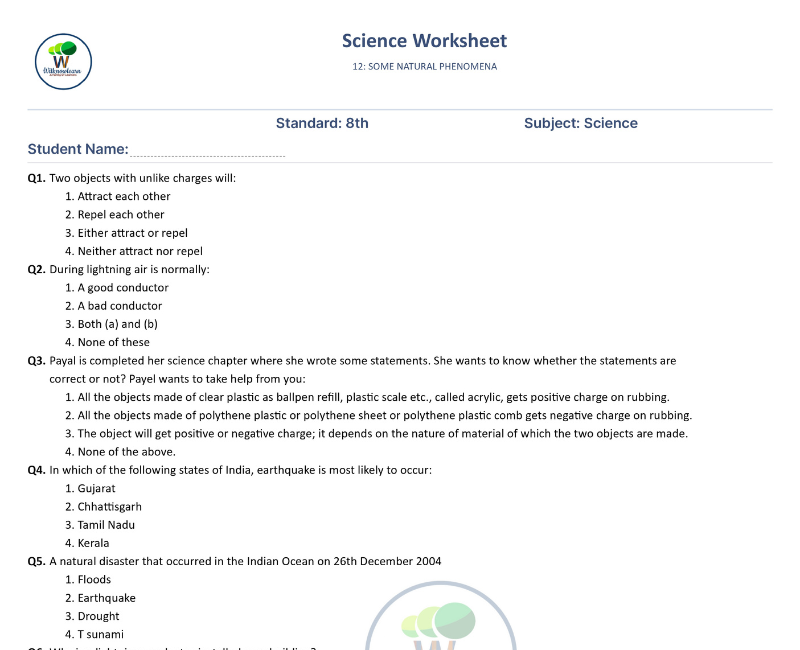
Some Natural Phenomena Worksheet with Online Quiz
Explore charge, lightning and earthquakes with games, labs and a quiz. On WitKnowLearn you get the Some Natural Phenomena online quiz, online activities and interactive games, a natural phenomena lab, a virtual lab and a worksheet-style practice sheet for science.
Some Natural Phenomena Online Quiz
Includes assertion and reason, case study and higher order thinking questions. Tap an answer and the next question comes up.
Some Natural Phenomena Activities
👆 Tap a tab to switch: Learn, Games, Labs, Challenges, Virtual Lab and Practice sheet
🧪 Natural Phenomena Lab
Do the experiment on screen: 3 rounds, then see what we found.
Lab progress
- 🧪 Round 1 of 3
- ⬜ Round 2 of 3
- ⬜ Round 3 of 3
- ⬜ What did we find?
⛈️ Safe or Unsafe in a Storm?
⭐⭐⭐Goal: Sort 8 actions by whether they are safe in a thunderstorm.
How to play: Drag each card into its bin, or tap a card and then tap a bin.
Avoid tall objects, metal and open ground.
Safe
good choiceUnsafe
risky choiceFACTS: Shelter keeps you safe.
🫧 Fact or Myth Bubbles
⭐⭐⭐Goal: Pop the 5 true facts. Leave the 4 myths.
How to play: Tap a bubble to pop it. Myth bubbles wobble and stay.
Think about charge, lightning and quakes.
FACTS: Check each claim.
🧠 Phenomena Memory
⭐⭐⭐Goal: Match each clue with its answer.
How to play: Flip two cards. If they match, they stay open. Find all 6 pairs.
Link each clue to the term it describes.
FACTS: Match clues with terms.
📝 Reasoning Gaps
⭐⭐⭐Goal: Fill each gap with the right word. One word is extra.
How to play: Drag a word into a gap, or tap a word and then tap a gap.
Read the whole sentence before choosing.
A rubbed plastic scale attracts paper because it becomes .
Thunder is heard after the flash because sound is than light.
A lightning conductor sends the charge to the .
The focus of a quake lies underground and the lies above it.
Seismic activity is recorded by a .
FACTS: Reasons matter.
⚖ Which Is More?
⭐⭐⭐Goal: In each pair, tap the greater value.
How to play: Tap one card in every pair.
Work out each value first.
FACTS: Work it out.
⚡ Storm Distance Lab
⭐⭐⭐Goal: Find the distance of each flash from the delay of thunder.
How to play: Drag a number into each gap.
Distance = 340 × delay.
After 2 s of waiting, the flash was m away.
With a 6 s gap, the flash was m away.
A pause of 10 s means it was m away.
If thunder takes 15 s, it was m away.
FACTS: Light is fast, sound is slow.
🎈 Charge Lab
⭐⭐⭐Goal: Complete each sentence about charges.
How to play: Drag the right word into each gap.
Like charges repel, unlike attract.
Two rods charged alike will each other.
A glass rod and a silk cloth rubbed together get charges.
Unlike charges each other.
A charged body can pull light, uncharged pieces.
FACTS: Charges push and pull.
🌍 Quake Lab
⭐⭐⭐Goal: Complete each statement about earthquakes.
How to play: Drag the right word into each gap.
Recall the earthquake terms.
An earthquake is a sudden shaking of the .
The place where it starts underground is the .
Its strength is given on the scale.
Waves from a quake are recorded by a .
FACTS: Quakes shake the crust.
🛡️ Safety Lab
⭐⭐⭐Goal: Complete each safety rule.
How to play: Drag the right word into each gap.
Avoid tall and metal things in a storm.
During lightning, avoid standing near a tall .
In an earthquake, hide under a strong away from glass.
During a storm, unplug electrical .
After a quake, leave buildings by the , not the lift.
FACTS: Be ready before the event.
🔬 Lightning or Earthquake?
⭐⭐⭐Goal: Sort 8 facts by the phenomenon they describe.
How to play: Drag each card into a bin, or tap a card and then tap a bin.
Think about charge and the crust.
Lightning
charge and cloudsEarthquake
the shaking crustFACTS: Two destructive natural events.
❓ Reasoning Quiz
⭐⭐⭐Goal: Answer 3 questions. Each correct answer earns 1 point.
How to play: Tap the best option.
Think before you choose.
1. A balloon rubbed on wool sticks to a wall because
2. Why is a thick metal strip used in a lightning conductor?
3. Which quake is stronger: magnitude 7 or magnitude 6?
FACTS: Reasoning wins.
💦 True or False Splash
⭐⭐⭐Goal: Decide if each statement is true or false.
How to play: Tap True or False.
Think about the cause.
1. If two charged balloons repel, they must carry the same kind of charge.
2. A quake of magnitude 6 is only slightly stronger than one of magnitude 5.
3. A person in a car with closed windows is relatively safe in lightning.
FACTS: Check each.
➗ Two-Step Sums
⭐⭐⭐Goal: Solve 3 calculations. Type the number.
How to play: Type your answer and press Check.
Use speed times time.
1. Thunder after 7 s at 340 m per s (m)
2. A wave at 5 km per s covers 90 km in (s)
3. Magnitude 8 against 6: times larger ground motion
FACTS: Rates help.
🔗 Match the Tool
⭐⭐⭐Goal: Match each tool with its job.
How to play: Drag each card onto its partner, or tap a card and then tap a partner.
Think of storms and quakes.
FACTS: Tools protect people.
📖 Story Problems
⭐⭐⭐Goal: Read 3 short stories and choose the best answer.
How to play: Tap an answer.
Think about charge and shelter.
1. 🌩️ Kabir counts 15 s between a flash and its thunder. The flash was about
2. 🏫 During a quake a teacher tells pupils to drop under desks. This helps because
3. 🎈 Two rubbed balloons push each other apart. They have
FACTS: Science in real life.
⛈️ Thunder Distance Experiment
⭐⭐⭐Aim
To find how far each flash was from the delay of its thunder at 340 m per second.
Objectives
- Multiply the delay by 340.
Procedure
- Take the delay in seconds.
- Multiply by 340.
- Type the distance.
- Choose the conclusion.
Distance = 340 × delay.
Observation table
| Delay (s) | Distance (m) |
|---|---|
| 3 | |
| 5 | |
| 8 | |
| 10 |
Conclusion
Outcomes
- I can find the distance of a storm.
- I know light reaches us first.
🌍 Quake Wave Experiment
⭐⭐⭐Aim
To find the time a quake wave of 5 km per second takes to reach stations at different distances.
Objectives
- Divide distance by speed.
Procedure
- Take the distance in kilometres.
- Divide by 5.
- Type the time.
- Choose the conclusion.
Time = distance ÷ 5.
Observation table
| Distance (km) | Time (s) |
|---|---|
| 50 | |
| 100 | |
| 150 | |
| 200 |
Conclusion
Outcomes
- I can find a wave travel time.
- I know distance changes the arrival time.
⛈️ Counting the Storm Distance
⭐⭐⭐Aim
To use the rule that every 3 s of delay between a flash and its thunder means about 1 km.
Objectives
- Divide the delay by 3.
- See the distance grow.
- Compare dots and bars.
Procedure
- Type each answer and the next stage is drawn.
- Use the Dots view and Bars view buttons.
- Read the finished results.
- Answer the questions and choose the conclusion.
Distance in km = delay ÷ 3.
Read your figure
Outcomes
- I can find the distance from the delay.
- I can find the delay from the distance.
- I know a longer delay means a farther storm.
Read the chapter first. Write each answer on the line. The page checks your answer as you type.
A. Thunder
B. Quake waves
C. Richter scale
D. Counting charges
Some Natural Phenomena: Storms and Shaking Ground
A short read before you play. These notes cover static charge, lightning, safety and earthquakes.
🎈 Charge
Rubbing moves charge between objects. Like charges repel and unlike charges attract. A charged object attracts light neutral things, and an electroscope can detect charge.
⚡ Lightning
Charge builds up in clouds and jumps to the ground as lightning. Thunder follows because sound is slower than light. Lightning conductors, earthing, closed cars and shelter keep us safe.
🌍 Earthquakes
An earthquake is a sudden shaking of the crust. A seismograph records the waves and the Richter scale gives the magnitude. Strong, flexible buildings and quick action reduce harm.
Some Natural Phenomena Activities
Follow every step on the Number Train. Earn up to 3 stars in every activity.
This page covers static charge, lightning, safety and earthquakes for school science. It covers charging by rubbing, lightning, lightning safety, earthquakes, the seismograph and the Richter scale.
The activities are pitched at upper middle school level. Sort safe and unsafe actions, find the distance of a storm and compare quake strengths. Explore more science worksheets on WitKnowLearn after this chapter.
Key ideas and facts to know
| Term | Meaning | Tool |
|---|---|---|
| Charge | rubbing moves it | electroscope |
| Lightning | cloud discharge | lightning conductor |
| Earthquake | shaking crust | seismograph |
How to use this page
- Flip the six cards and try the Natural Phenomena Lab in the Learn tab.
- Play the five games and the five labs to practise each idea.
- Finish the five challenges to collect up to 15 points.
- Do two virtual experiments and count the storm distance in the studio.
- Take the online quiz, with assertion and reason and case study questions, and fill in the practice sheet.
Worked examples
340 × 6 = 2040 m.
100 ÷ 5 = 20 s.
This Some Natural Phenomena worksheet gives you online activities and interactive games that make the chapter clear. Every activity has a goal, a hint and a short fact, so students learn while they enjoy.
Complete Guide: Some Natural Phenomena
This guide is for students, parents and teachers. It covers static charge, lightning, safety and earthquakes and shows how to use the quiz, labs and games on this page.
Introduction to Some Natural Phenomena
Lightning and earthquakes are powerful natural events. Knowing the science helps us stay safe.
What is there in this chapter
- Charging by rubbing
- Types of charge
- Lightning
- Lightning safety
- Earthquakes
- Measuring quakes
Learning objectives
- Explain charging by rubbing.
- Explain lightning and safety measures.
- Reason about earthquake waves and the Richter scale.
- Reason with assertions and case studies.
Learning outcomes
- I can say how charge moves.
- I can work out the distance of a storm.
- I can compare quake strengths.
Some Natural Phenomena resources on this page
| Resource | What it gives |
|---|---|
| Online quiz | Assertion and reason, case study and higher order thinking questions with a full review |
| Flip cards | 6 picture cards with one-line rules |
| Natural Phenomena Lab | A hands-on lab with 3 rounds |
| Games | 5 interactive games |
| Labs | 5 activity labs |
| Virtual Lab | 2 experiments plus a studio that counts storm distance |
| Challenges | 5 challenges, 15 points in all |
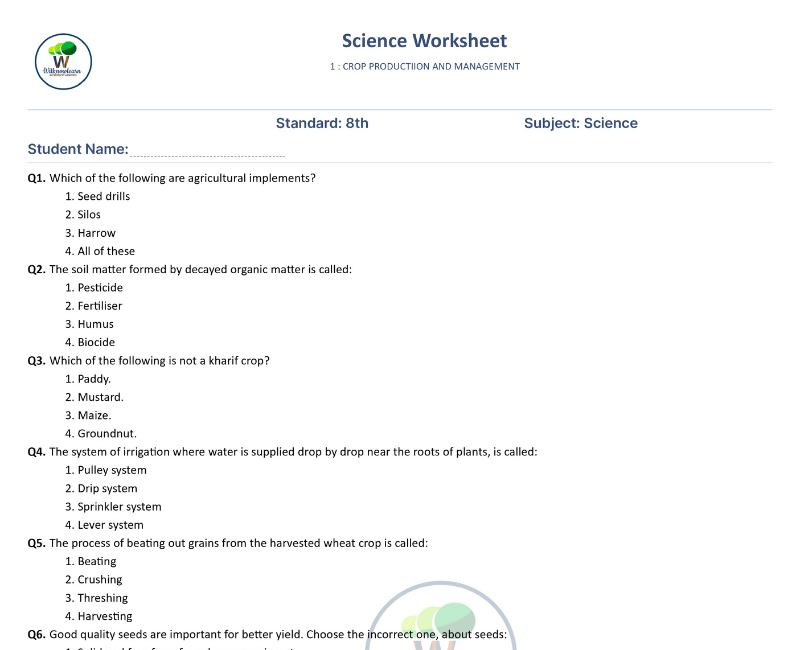
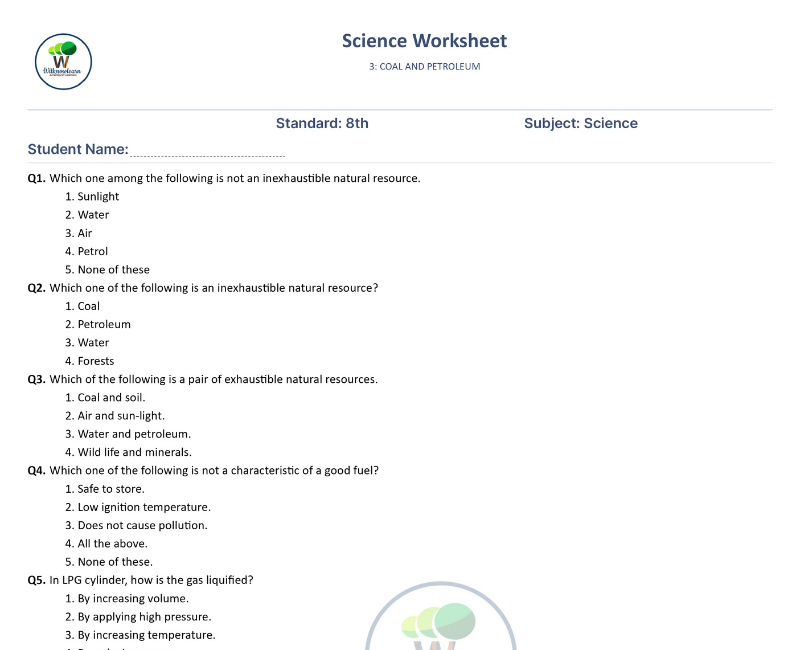
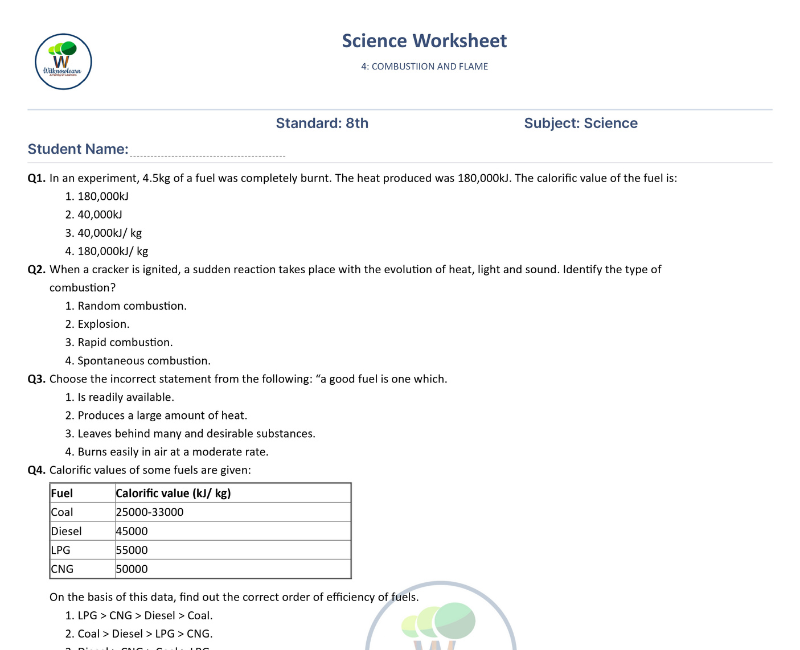
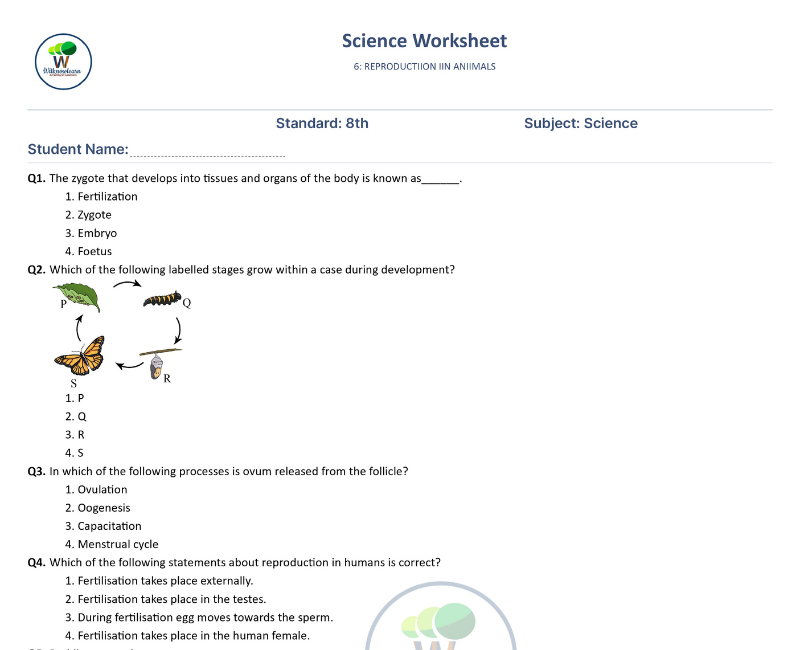
| Practice sheet | A worksheet-style sheet with 16 questions, name and date lines and a live score |
Key facts
| Idea | Rule |
|---|---|
| Like charges | repel |
| Unlike charges | attract |
| Seismograph | records quake waves |
| Richter scale | about 10 times per unit |
Types of questions you may see
- Safe and unsafe sorting
- Distance and time calculations
- Assertion and reason on lightning
- A short case study on static charge
Solved examples
340 × 5 = 1700 m.
10 × 10 = 100 times.
Common mistakes
| Mistake | Correct idea |
|---|---|
| Sheltering under a tall tree | Move to a building or closed car |
| Thinking Richter scale is linear | Each unit is about ten times more |
| Taking the lift after a quake | Use the stairs |
Some Natural Phenomena in daily life
Weather alerts, building codes and earthing in our homes all come from these ideas.
Tips for parents and teachers
- Make an earthquake plan at home.
- Unplug devices during storms.
- Practise one assertion and one case study each week.
Related Science Worksheets
Some Natural Phenomena FAQs
What causes lightning?
Charge builds up in clouds and discharges to the ground or another cloud.
Why is thunder heard after lightning is seen?
Light travels much faster than sound.
What does a seismograph do?
It records the waves of an earthquake.
What does the Richter scale measure?
The magnitude of an earthquake.
What can students do on this page?
Students can take an online quiz with assertion and reason and case study questions, play five games, try five online activities, finish five challenges, run the Natural Phenomena Lab, do two virtual experiments, count the distance of a storm and compare the dots and bars views,, and fill in a 16-question practice sheet with a Show answers button.
 Download