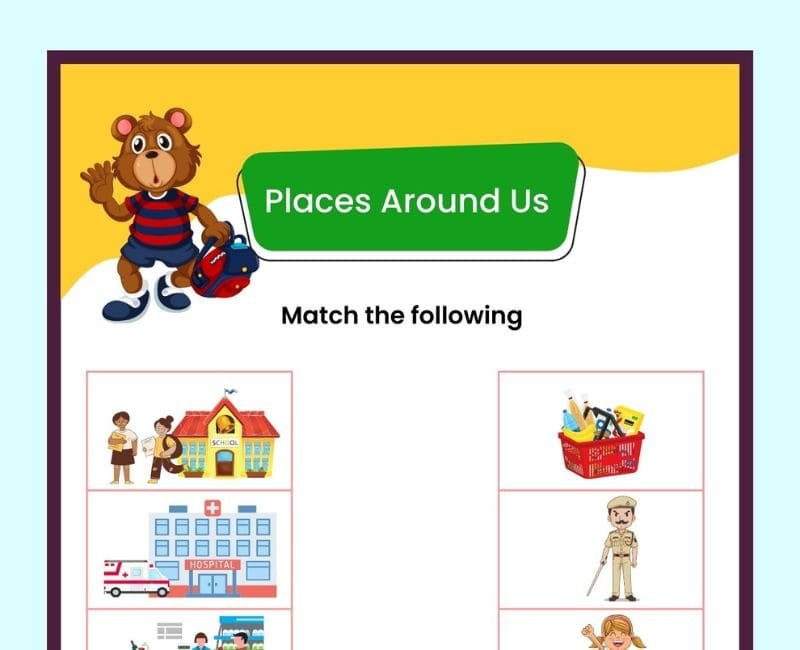
Let’s Explore Places Around Us!
Where do we learn, play and buy food? Discover familiar places with 20 quiz questions and 10 online games and activities below.
⬇ Scroll down to answer, tap, match and trace!
📝 Places Around Us Quiz for Nursery
20 picture-based questions: 5 easy, 7 average and 8 thinking questions. An adult can read aloud. The timer starts when you answer or move to another question.
Question 1 of 20 • Easy • Answered 0/20
Where do children go to learn?
Question navigation — green means answered.
🎮 Places Around Us Online Games for Nursery
Explore, match, sort and remember. Choose one game below. Buttons stay close to the picture and stack on phones.
1. Explore the Neighbourhood
Tap a place picture or its name to find out what happens there.
Ready to play!
2. Match Picture and Place
Choose a picture card, then tap the matching place name.
Ready to play!
3. Pack for a Visit
Choose an item, then send it to the place where we would use it.
Ready to play!
4. Picture Memory
Find two cards showing the same place picture.
Find the matching pictures.
5. A Trip to the Park
Put this little story in order. Tap the first step, then the next.
Begin with how you go to the park.
🎨 Places Around Us Online Activities for Preschool
Trace place names, draw a park, build a neighbourhood and practise keeping shared places tidy.
6. Trace Place Words
Pick a word and trace its pale letters with your finger or mouse. One red pen keeps it simple.
Trace PARK with the red pen.
7. Draw a Park
Follow the outline or choose a blank board. Add trees, a path or a playground.
Ready to play!
8. Build a Neighbourhood
Tap each button to add a place to your neighbourhood picture.
Ready to play!
9. Count Park Trees
Tap trees to plant exactly the requested number. Tap again to remove one.
Plant 2 trees. You have 0.
10. Park Tidy-Up
Choose an item, then tap where it belongs. Keep natural things in their place and litter in the bin.
Ready to play!
📄 Places Around Us Worksheet for Nursery
Use the worksheet download provided on this page for paper practice, then try the online quiz and games for revision.
Read more about this nursery EVS topic ▾
A places around us worksheet for nursery introduces children to the neighbourhood through familiar pictures and simple conversations. School, park, hospital, market, library and post office are useful starting points. Children can name a place, talk about what happens there and connect it with an experience of their own.
Begin with two places your child already knows. Point to a school picture and ask, “What do children do here?” Then show a park and invite the child to describe playing, walking or seeing trees. Accept spoken answers and pointing before expecting independent reading. Some children may know a clinic rather than a large hospital, or a small shop rather than a market; use these local examples too.
The Places Around Us online quiz offers 20 questions with picture clues. The first five practise basic recognition, the next seven connect people and objects with places, and the final eight use short everyday situations. “Thinking” here means choosing a sensible action from a familiar story, rather than advanced schoolwork. Read the options slowly and let the child explain a choice.
The ten online games and activities add hands-on practice. Children explore place cards, match picture pairs, sort objects by destination, play a memory game and arrange a simple park visit. They can also trace short words with a red pen, draw on a park outline, add buildings to a neighbourhood, count trees and sort items for a park tidy-up. These tasks support vocabulary, observation, counting, turn-taking and pencil control.
Use the printable neighbourhood worksheet alongside these activities in short sessions. A teacher can introduce a place to a small group, while a parent can connect the pictures with a supervised walk. Ask children to stay with a trusted adult during outings and to ask that adult for help if unsure.
Continue familiar-world learning with the My School worksheet and the Family Tree worksheet. Keep each session comfortable: naming one new place and describing its purpose is a useful step.
Frequently Asked Questions
Which places should nursery children learn first?
Start with familiar places such as home, school, a park, a shop and a clinic or hospital. Add a library or post office when the child has a meaningful example.
Can a child play without reading independently?
Yes. An adult can read the instructions and buttons aloud. Children can recognise pictures and tap their choices.
How are the thinking questions suitable for nursery?
They use short situations, such as wanting to borrow a book or needing a doctor. They ask children to connect a simple need with a place.
Where can I download the Places Around Us worksheet?
Use the existing worksheet download near the top of this page. The quiz and games are separate online practice.
Do the tracing activities work on a phone?
Use a finger to draw on the tracing board. Undo removes the latest stroke, and Clear removes the drawing while keeping the guide.
Should children visit these places on their own?
No. Discuss neighbourhood places with a trusted adult, and keep outings supervised.
 Download