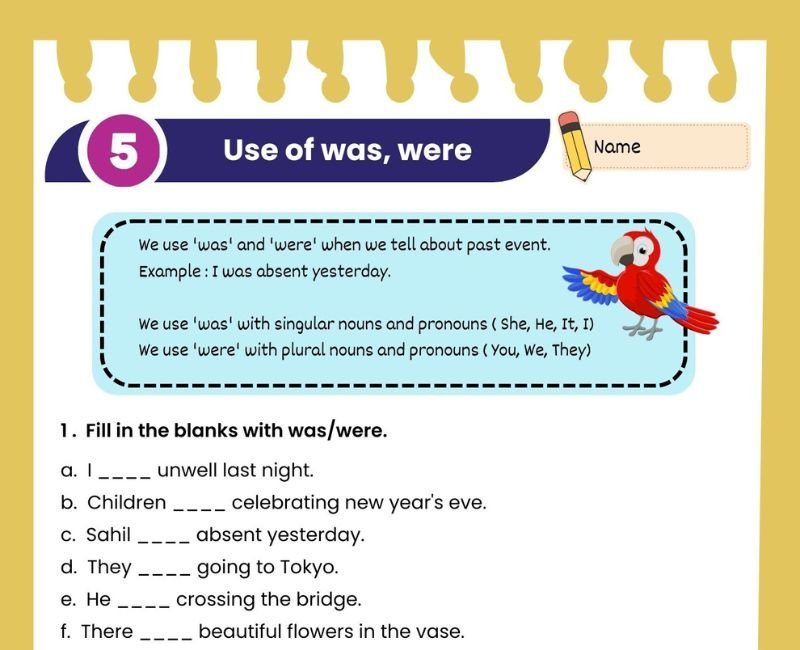
Was Were Worksheet with Online Activities and Quiz
Step into yesterday. Discover how was and were help us talk about earlier places, feelings and situations through picture clues, meaningful games and creative workshops.
This was were worksheet for Class 2 with online quiz and online activities helps children practise past tense sentences, subject matching, questions and negatives. Explore picture questions, memory games, a mind map, sentence correction and diary writing. Use the worksheet download already provided on this page for paper practice.
How to take the quiz
- Read the question and study its picture when shown.
- Tap an answer. It is saved and the next question opens.
- Use Previous or a number to return and change an answer.
- Select End quiz to see your score and explanations.
There are 10 easy questions, 5 average questions and 5 thinking questions. The 20 minute timer starts with your first answer or question navigation. Reading aloud does not start it. Time running out ends the quiz automatically.
Answers are kept for this attempt on this page. Reloading or restarting clears the attempt.
I ___ at the art club yesterday.
Your answer moves you forward. Use a number to return and revise.
Time clue sorting
Learning goal: Recognise past present and future time clues.
- Read the time clue.
- Tap Past Present or Future. Sort all six.
last weekend
Your turn!
You were speech bubbles
Learning goal: Use were with both meanings of you.
- Read who is listening in each bubble.
- Tap the verbs to describe last week correctly.
Your turn!
Read the grammar guide
Was and were are past forms of be. They describe earlier situations, feelings, conditions and positions. This guide focuses on ordinary past reports.
| Subject | Use | Example |
|---|---|---|
| I | was | I was at the fair. |
| He She It | was | She was cheerful. |
| A singular noun | was | The rabbit was small. |
| You | were | You were our guest. |
| We They | were | They were outside. |
| Plural nouns | were | The rabbits were small. |
| Two people joined by and | were | Riya and I were partners. |
From now to then
I am ready now. → I was ready earlier.
She is at home now. → She was at home yesterday.
We are together now. → We were together last week.
Questions
Put was or were before the subject: Was he at the shop? Were they at the game? Do not add did to these be questions.
Negative sentences
Put not after was or were: The bus was not late. The roads were not busy. Was not can become wasn’t. Were not can become weren’t.
Time clues
Yesterday, last night, last week and a moment ago can signal past time. A past sentence does not always need a time phrase if the surrounding story already makes the time clear.
Check the whole subject
The children were excited uses were because children is plural. The box of crayons was full uses was because the subject is one box. My friend and I were there uses were because the whole subject means two people.
Was and were can also help an ing verb: The girl was drawing. The boys were drawing.
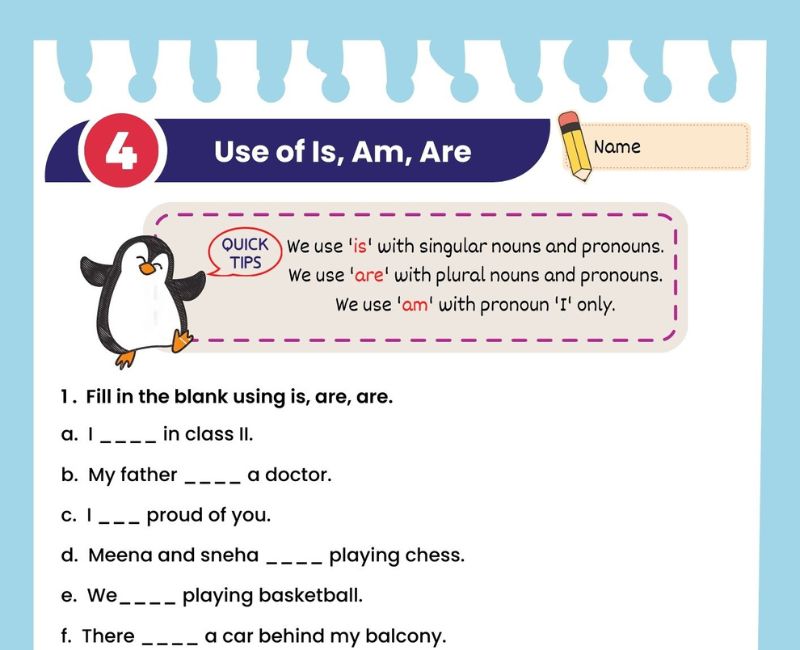
Revise present forms with the is am are worksheet for Class 2.
Teaching Tips for Parents and Teachers
Make before now visible
Put an object on a desk and move it. Ask where it was before. The past can mean a moment ago as well as yesterday.
Find the whole subject
Compare The child was here and The children were here. Then try The bag of books was heavy. The subject is one bag.
Practise you were with one and many
Address one child and then a group. Use You were helpful both times. The number of listeners changes but the verb stays were.
Use questions in conversation
Ask Were you at the playground? Practise Yes, I was. and No, I wasn’t. Notice the change from you to I.
Review creative work together
Check the past setting, subject and verb first. Then check capitals and sentence endings. Invented diary events are welcome when the sentences make sense.
Related English Grammar Worksheets
- Is am are worksheet for Class 2
- Noun worksheet for Class 2
- Common and proper nouns worksheet for Class 2
- Capital letters and punctuation worksheet for Class 2
- Adjectives worksheet for Class 2
- Has and have worksheet for Class 2
- Articles a an the worksheet for Class 2
- Singular and plural nouns worksheet for Class 2
- Noun worksheet for Class 1
- Doing words worksheet for Class 1
- Common collective and proper nouns worksheet for Class 3
- English grammar question paper for Class 2
Frequently Asked Questions
What is the difference between was and were?
Both are past forms of be. In ordinary past reports use was with I he she it and singular nouns. Use were with you we they and plural nouns.
Do we say I was or I were?
Use I was for an ordinary past statement: I was at home yesterday. Special imaginary expressions are a different topic.
Why do we say you were for one person?
You pairs with were in ordinary past statements whether it refers to one listener or several listeners.
Do names take was or were?
One person’s name takes was: Tara was at the game. Two separate people joined by and take were: Tara and Kabir were at the game.
Is it my friend and I was or my friend and I were?
Use my friend and I were because the whole subject means two people. Use I was when I is the subject on its own.
Does children take was or were?
Children takes were because it is plural. One child takes was: The child was here. The children were here.
How do we make questions with was and were?
Put was or were before the subject: Was she ready? Were you there? Finish a direct question with a question mark.
How do we make negative sentences?
Put not after was or were: I was not late. They were not tired. The short forms are wasn’t and weren’t.
Do we use did with was and were questions?
No. Ask Was he at school? rather than Did he was at school? Was or were moves before the subject.
Does every past sentence need yesterday?
No. Other clues can show past time. Sometimes the surrounding conversation or story already establishes the past.
When do we use there was and there were?
Use there was for one countable thing and there were for plural countable things: There was a kite. There were three kites.
How can children practise was and were at home?
Describe where toys were before moving them, discuss an imaginary trip, match present and past cards and write a short diary.
Photo credit and grammar references
Wooden chair photograph by Amitbalani via Wikimedia Commons, released under CC0 1.0. Its yesterday setting is an imagined lesson context. Diagrams are original illustrations.
References: British Council past simple be practice for children and British Council verb be reference.
 Download