Class 7 Maths · Fractions and Decimals Worksheet
Fractions and Decimals Class 7 Worksheet with Online Quiz, Games and Activities
How much is 2/3 of 3/4 of a cup, and why does dividing by 3/4 give a bigger answer? Find out with this Fractions and Decimals worksheet for Class 7 Maths: take the Fractions and Decimals Class 7 online quiz, build and measure with hands-on activities, try three maths experiments in the Virtual Lab and play interactive games online.
Flip the cards and try the Kitchen Fraction Lab, then tap the Games, Labs, Challenges or Virtual Lab button.
Fractions and Decimals Class 7 Online Quiz
20 questions · tap an answer to move on · full review at the end
Flip the cards, try the Kitchen Fraction Lab, then play the games, do the labs and take the challenges. Earn up to 3 stars in every activity.
Fact cards: tap a card to flip it
Kitchen Fraction Lab
Three kitchen problems need exact amounts. Work out how much is needed, then drag the level in the measuring jug to pour it and press Check. A wrong choice shows what goes wrong, so you can try again.
Challenge marks: 0 / 15 (0 of 5 challenges done)
Finish all 5 challenges to see your comment.
Virtual Lab: do real experiments step by step
Practice sheet
Fractions and Decimals Class 7 Activities
Pour exact amounts in the Kitchen Fraction Lab, build fraction walls, paint hundred grids, share pizzas fairly, balance fraction weights and measure with a ruler, then fold paper and read a rain gauge in the Virtual Lab. Earn up to 3 stars in every activity.
What are fractions and decimals?
A fraction such as 3/4 names a number of equal parts of a whole: the denominator (4) tells how many equal parts the whole is cut into, and the numerator (3) tells how many of them we take. Fractions can be proper (3/5, less than 1), improper (7/4, 1 or more) or mixed (1 3/4, a whole number and a proper fraction). Fractions that name the same amount, like 2/3, 4/6 and 8/12, are equivalent. A decimal is another way of writing a fraction with denominator 10, 100 or 1000: 0.7 = 7/10, 0.45 = 45/100 and 0.125 = 125/1000. The digits after the decimal point stand for tenths, hundredths and thousandths.
Changing between fractions and decimals
To change a decimal into a fraction, write the digits over 10, 100 or 1000 and simplify: 3.75 = 375/100 = 15/4. To change a fraction into a decimal, make the denominator 10, 100 or 1000 if possible (7/20 = 35/100 = 0.35) or divide the numerator by the denominator (1/8 = 1 ÷ 8 = 0.125). Knowing a few pairs by heart, such as 1/2 = 0.5, 1/4 = 0.25, 3/4 = 0.75 and 1/5 = 0.2, makes estimating and checking answers much faster.
Comparing and ordering
To compare fractions, give them a common denominator or change them to decimals: 5/8 = 0.625 is greater than 3/5 = 0.6. To compare decimals, line up the decimal points and compare the digits place by place from the left: 2.45 is less than 2.5 because 4 tenths are fewer than 5 tenths. Comparing with a benchmark such as 1/2 or 1 is often the quickest check.
Adding and subtracting
Fractions can be added or subtracted only when they have the same denominator: 1 1/2 − 5/8 = 12/8 − 5/8 = 7/8. Decimals are added and subtracted by lining up the decimal points and filling empty places with zeros: 4.6 + 0.85 = 4.60 + 0.85 = 5.45.
Multiplying fractions and decimals
- Multiply the numerators and multiply the denominators: 2/3 × 3/4 = 6/12 = 1/2. Simplifying before multiplying keeps numbers small.
- The word "of" means multiply: 3/8 of 40 litres = 15 litres.
- Multiplying by a fraction less than 1 makes a positive number smaller; multiplying by more than 1 makes it bigger.
- To multiply decimals, multiply as whole numbers and then count the total decimal places: 1.2 × 0.15 = 0.180.
- Multiplying by 10, 100 or 1000 moves the decimal point 1, 2 or 3 places to the right.
Dividing fractions and decimals
Two numbers whose product is 1 are reciprocals: the reciprocal of 5/8 is 8/5. To divide by a fraction, multiply by its reciprocal: 7 1/2 ÷ 3/4 = 15/2 × 4/3 = 10. Dividing asks "how many of these fit?", so dividing by a number smaller than 1 gives a bigger answer. To divide decimals, multiply both numbers by the same power of 10 so that the divisor becomes a whole number: 7.2 ÷ 0.08 = 720 ÷ 8 = 90. Dividing by 10, 100 or 1000 moves the decimal point to the left.
Fractions and decimals in daily life
Recipes use fractions of cups and spoons, shops weigh fruit as 1.75 kg, tailors cut cloth in 0.5 m lengths, and marks, money and distances are all written with decimals. Most word problems come down to one question: are we finding a part of something (multiply) or how many parts fit (divide)?
This Fractions and Decimals worksheet for Class 7 Maths brings the topic to life on WitKnowLearn with an online quiz, online activities and interactive games. Pour, build, paint, share, balance and measure with your own hands in the activities, then try three maths experiments in the Virtual Lab.
Fractions and Decimals Class 7 Maths Guide
Fractions and Decimals is a core Class 7 Maths topic. It covers types of fractions, equivalent fractions, comparing fractions and decimals, all four operations on fractions, multiplication and division of decimals, reciprocals, and word problems with money, length, weight and capacity. This guide explains each idea clearly for Class 7 students, parents and teachers. It goes with the Fractions and Decimals Class 7 worksheet on WitKnowLearn, which also has an online quiz, online activities, interactive games and a Virtual Lab on the same page.
What is there in this topic
- Proper, improper, mixed and equivalent fractions
- Comparing and ordering fractions and decimals
- Adding and subtracting fractions and decimals
- Multiplying fractions, including "fraction of a number"
- Reciprocals and dividing by a fraction
- Multiplying and dividing decimals, and by 10, 100 and 1000
- Word problems
Learning objectives
- Represent fractions and decimals with models and on a number line.
- Multiply and divide fractions and decimals correctly.
- Convert between fractions and decimals.
- Choose the right operation in a word problem.
Learning outcomes
After this page a student can:
- Show a product of fractions with an area model.
- Explain why dividing by 3/4 gives a bigger answer.
- Place the decimal point correctly in products and quotients.
- Solve recipe, shopping and measurement problems.
Fractions and Decimals Class 7 resources on this page
| Resource | What it does |
|---|---|
| Fractions and Decimals Class 7 online quiz | 20 questions in three levels with a full answer review |
| Flip cards | Six cards on parts of a whole, measuring, weighing, tenths, multiplying and dividing |
| Kitchen Fraction Lab | Pour exact amounts into a measuring jug for three recipe problems |
| 5 interactive games | Fraction wall builder, decimal grid painter, number line pins, pizza party and decimal point mover |
| 5 hands-on labs | Area model, scoop division, fraction balance, ruler measuring and place value blocks |
| 5 challenges | Number line estimator, fraction of a set, pie shader, ordering and equivalence machine, marked out of 3 each |
| Virtual Lab | Three maths experiments: paper folding, rainfall decimals and paper strips |
| Practice sheet | 16 questions with answer boxes and a live score |
Useful fraction and decimal pairs
| Fraction | Decimal | Fraction | Decimal |
|---|---|---|---|
| 1/2 | 0.5 | 1/8 | 0.125 |
| 1/4 | 0.25 | 3/8 | 0.375 |
| 3/4 | 0.75 | 1/20 | 0.05 |
| 1/5 | 0.2 | 1/25 | 0.04 |
Types of questions
- Comparing and ordering
- Operations on fractions
- Fraction of a quantity
- Reciprocals and division
- Decimal multiplication and division
- Conversions
- Word problems
Solved examples
Common mistakes
| Mistake | Correct |
|---|---|
| 1/2 + 1/3 = 2/5 | 3/6 + 2/6 = 5/6 |
| Dividing 3/4 ÷ 1/2 as 3/8 | 3/4 × 2 = 3/2 |
| 0.2 × 0.3 = 0.6 | 0.06: count both decimal places |
| Thinking 0.45 > 0.5 because 45 > 5 | Compare tenths: 4 < 5 |
| Forgetting to change mixed numbers before multiplying | 1 1/2 × 2/3 = 3/2 × 2/3 = 1 |
Daily life
Cooking, shopping, measuring cloth and wood, sharing food, reading fuel and electricity bills, and calculating marks all use fractions and decimals every day.
Tips for parents and teachers
- Cook a recipe together and halve or double it.
- Fold paper strips to make a fraction wall.
- Shade hundred grids to show decimals and percentages.
- Check shop bills and receipts together.
- Let students retry the challenges to earn 3 stars.
Related Class 7 Maths Worksheets
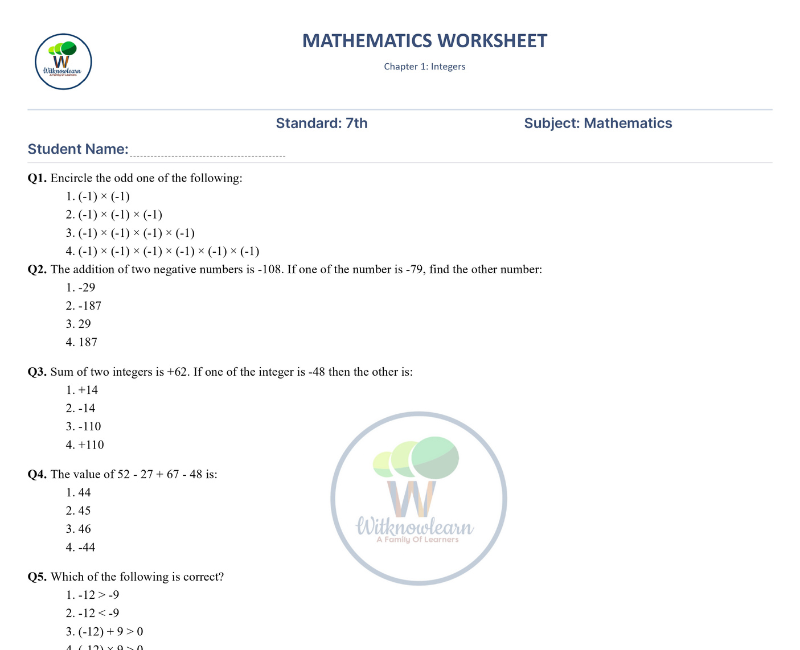
- Integers Class 7 Worksheet
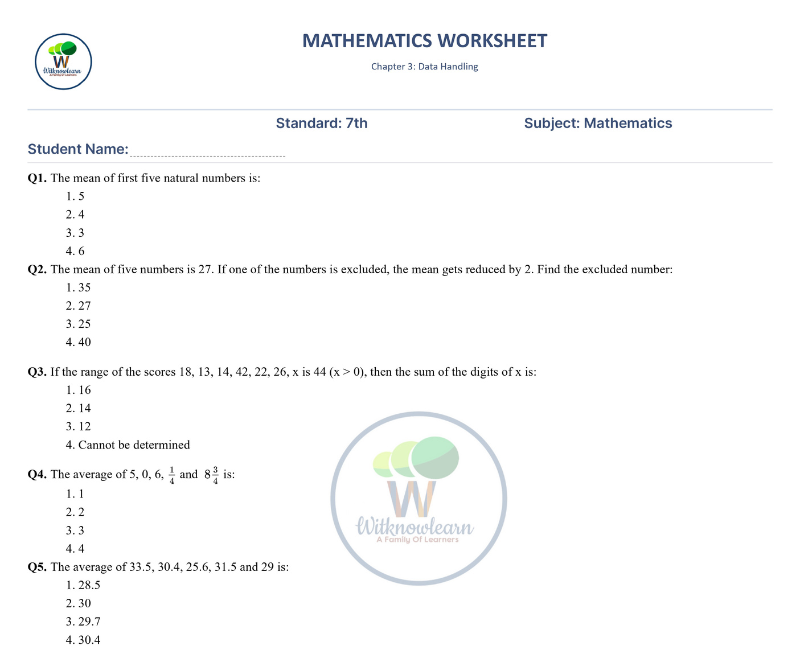
- Data Handling Class 7 Worksheet
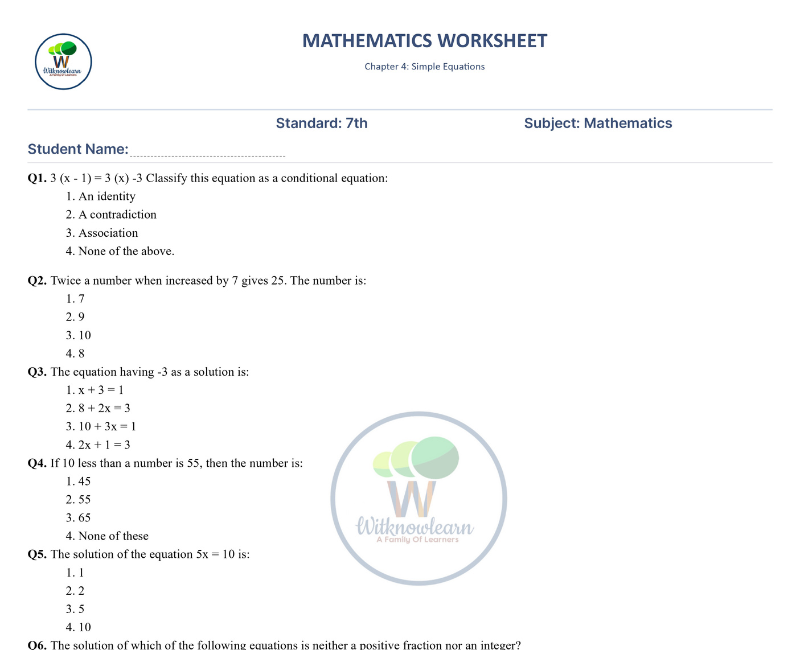
- Simple Equations Class 7 Worksheet
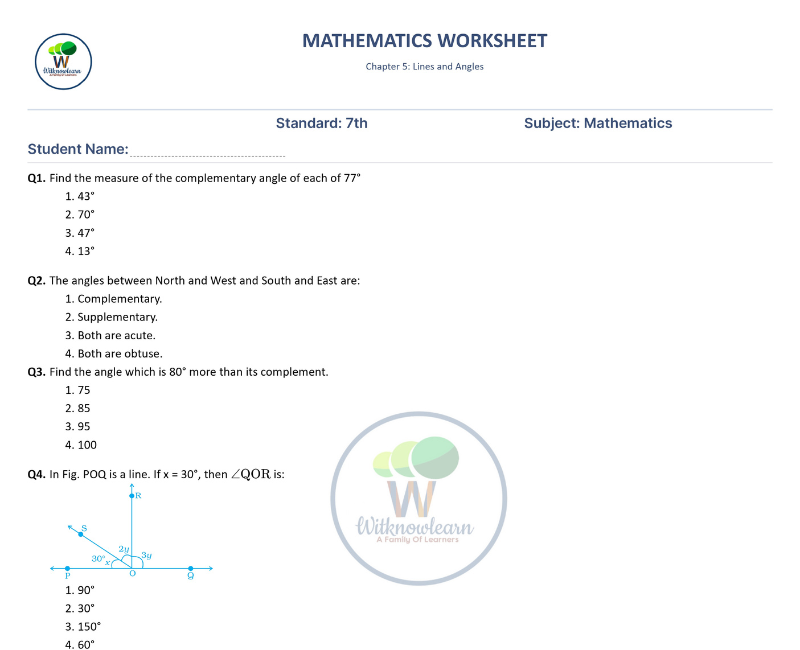
- Lines and Angles Class 7 Worksheet
- Triangle and Its Properties Class 7 Worksheet
- Comparing Quantities Class 7 Worksheet
- Rational Numbers Class 7 Worksheet
- Perimeter and Area Class 7 Worksheet
- Algebraic Expressions Class 7 Worksheet
- Exponents and Powers Class 7 Worksheet
- Symmetry Class 7 Worksheet
- Visualising Solid Shapes Class 7 Worksheet
Frequently Asked Questions
 Download