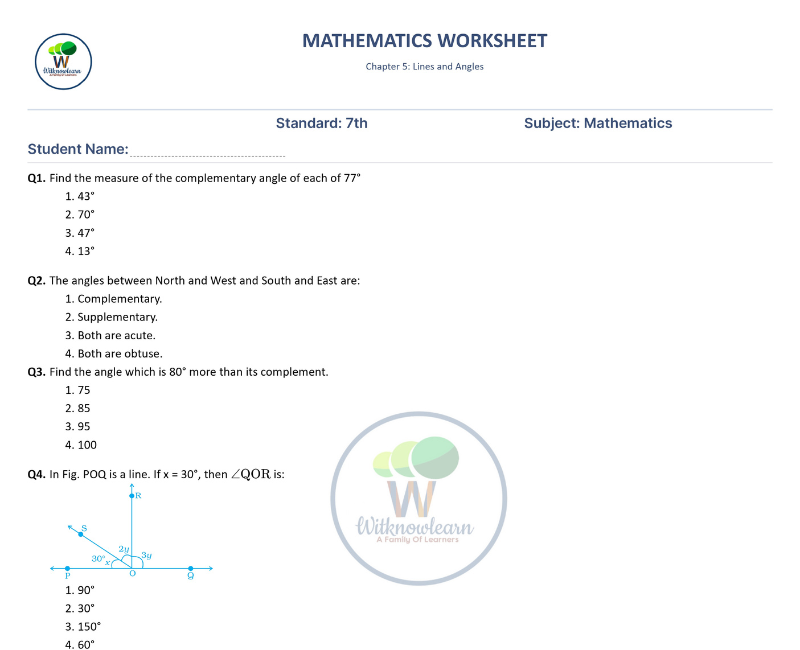
Class 7 Maths · Lines and Angles Worksheet
Lines and Angles Class 7 Worksheet with Online Quiz, Games and Activities
How do two lines make an angle, and what happens when a line crosses two parallel lines? Find out with this Lines and Angles worksheet for Class 7 Maths: take the Lines and Angles Class 7 online quiz, turn dials and drag angle cards in hands-on activities, try three maths experiments in the Virtual Lab and play interactive games online.
Flip the cards and try the Angle Builder Lab, then tap the Games, Labs, Challenges or Virtual Lab button.
Lines and Angles Class 7 Online Quiz
20 questions · tap an answer to move on · full review at the end
Flip the cards, try the Angle Builder Lab, then play the games, do the labs and take the challenges. Earn up to 3 stars in every activity.
Fact cards: tap a card to flip it
Angle Builder Lab
Three angle puzzles to solve with your hands. Drag the red arm around the dial until the angle is exactly right, then press Check. A wrong choice shows what goes wrong, so you can try again.
Challenge marks: 0 / 15 (0 of 5 challenges done)
Finish all 5 challenges to see your comment.
Virtual Lab: do real experiments step by step
Practice sheet
Lines and Angles Class 7 Activities
Drag the red arm on the Angle Builder Lab to make right angles and straight lines, sort angle cards, make complementary pairs, turn a rail until it is parallel, fit triangle corners on a line and rotate a transversal across parallel lines, then fold paper and trace angles in the Virtual Lab. Earn up to 3 stars in every activity.
Lines, rays and line segments
A line segment is a part of a line with two end points and a fixed length. A ray starts at one point and goes on forever in one direction. A line has no end points and goes on forever in both directions. An angle is formed when two rays meet at a common end point called the vertex. Angles are measured in degrees with a protractor.
Types of angles
An acute angle is less than 90°, a right angle is exactly 90°, an obtuse angle is more than 90° and less than 180°, and a straight angle is exactly 180°. An angle of more than 180° and less than 360° is a reflex angle. A good way to judge an angle is to compare it with the corner of a book, which is a right angle.
Complementary and supplementary angles
Two angles are complementary if their sum is 90°. They do not have to touch. The complement of 35° is 90° − 35° = 55°. Two angles are supplementary if their sum is 180°. The supplement of 110° is 180° − 110° = 70°. A complement is always smaller than 90° and a supplement of an acute angle is always obtuse.
Adjacent angles, linear pairs and vertically opposite angles
Adjacent angles share a vertex and one arm and lie on opposite sides of that arm. When the two outer arms form a straight line, the adjacent angles are a linear pair and add up to 180°. When two straight lines cross, they make four angles. The angles facing each other are vertically opposite angles and they are always equal. If one angle is 50°, the opposite angle is 50° and each of the others is 130°.
Parallel lines and a transversal
Parallel lines are lines in the same plane that never meet. A line that crosses two or more lines at different points is a transversal. A transversal across two lines makes eight angles. Corresponding angles are in the same position at the two crossing points, alternate interior angles are on opposite sides of the transversal between the lines, and co-interior angles are on the same side between the lines. If the lines are parallel, corresponding angles are equal, alternate interior angles are equal, and co-interior angles add up to 180°. The reverse is also true, so these facts can be used to test whether two lines are parallel.
Angle sum of a triangle
The three angles of any triangle add up to 180°. You can see this by tearing off the three corners and fitting them together on a straight line. So if two angles are 50° and 60°, the third is 180° − 110° = 70°.
This Lines and Angles worksheet for Class 7 Maths brings the topic to life on WitKnowLearn with an online quiz, online activities and interactive games. Students turn dials, drag angle cards, rotate transversals and fit triangle corners with their own hands, then try three maths experiments in the Virtual Lab.
Lines and Angles Class 7 Maths Guide
Lines and Angles is a core geometry topic of Class 7 Maths. It covers lines, rays and line segments, the types of angles, complementary and supplementary angles, adjacent angles, linear pairs, vertically opposite angles, parallel lines with a transversal and the angle sum of a triangle. This guide explains each idea clearly for Class 7 students, parents and teachers. It goes with the Lines and Angles Class 7 worksheet on WitKnowLearn, which also has an online quiz, online activities, interactive games and a Virtual Lab on the same page.
What is there in this topic
- Line, ray and line segment
- Acute, right, obtuse, straight and reflex angles
- Complementary and supplementary angles
- Adjacent angles and linear pairs
- Vertically opposite angles
- Parallel lines and a transversal
- Angle sum of a triangle
Learning objectives
- Name and classify angles by their size.
- Find the complement and the supplement of an angle.
- Use the angle facts for crossing lines and parallel lines.
- Find a missing angle of a triangle.
Learning outcomes
After this page a student can:
- Measure and draw angles with a protractor.
- Find missing angles using linear pairs and vertically opposite angles.
- Recognise corresponding, alternate and co-interior angles.
- Test whether two lines are parallel using angle facts.
Lines and Angles Class 7 resources on this page
| Resource | What it does |
|---|---|
| Lines and Angles Class 7 online quiz | 20 questions in three levels with a full answer review |
| Flip cards | Six cards on lines, angle types, complementary and supplementary angles, linear pairs, parallel lines and the triangle sum |
| Angle Builder Lab | Drag the red arm to make a right angle, a straight line and crossing lines in three cases |
| 5 interactive games | Set the angle, angle type sorter, make the pair, parallel railway and line, ray or segment |
| 5 hands-on labs | Triangle corners, transversal angle painter, linear pair hinge, transversal rotator and angle estimator |
| 5 challenges | Set three angles, supplementary pairs, crossing angles, order the angles and third angle dials, marked out of 3 each |
| Virtual Lab | Three maths experiments: paper folding, straws on a straight line and parallel lines with tracing paper |
| Practice sheet | 16 questions with answer boxes and a live score |
Angle facts at a glance
| Fact | Rule | Example |
|---|---|---|
| Complementary angles | Sum is 90° | 35° and 55° |
| Supplementary angles | Sum is 180° | 110° and 70° |
| Linear pair | Adjacent angles on a line add to 180° | 65° and 115° |
| Vertically opposite angles | They are equal | 50° and 50° |
| Triangle angle sum | Three angles add to 180° | 50° + 60° + 70° |
Types of questions
- Naming lines and angles
- Complement and supplement
- Linear pair problems
- Vertically opposite angle problems
- Parallel lines and a transversal
- Missing angle of a triangle
- Problems with an algebraic angle such as 2x
Solved examples
Common mistakes
| Mistake | Correct |
|---|---|
| Mixing up complement and supplement | Complement goes to 90°, supplement goes to 180°. |
| Saying adjacent angles are always supplementary | They are supplementary only if they form a straight line. |
| Using parallel-line rules when the lines are not parallel | The equal-angle rules need parallel lines. |
| Reading the wrong scale on a protractor | Start from the 0° on the arm you are using. |
| Forgetting the triangle sum | The three angles always add to 180°. |
Daily life
Roof frames, scissors, clock hands, road junctions, railway tracks, ladders and the pages of a book all show lines and angles at work.
Tips for parents and teachers
- Use two pencils or straws to make angles on a table.
- Fold paper to make 90°, 45° and 180°.
- Look for parallel lines and transversals in your street.
- Tear the corners of a paper triangle and fit them on a line.
- Let students retry the challenges to earn 3 stars.
Related Class 7 Maths Worksheets
- Integers Class 7 Worksheet
- Fractions and Decimals Class 7 Worksheet
- Data Handling Class 7 Worksheet
- Simple Equations Class 7 Worksheet
- Triangle and Its Properties Class 7 Worksheet
- Comparing Quantities Class 7 Worksheet
- Rational Numbers Class 7 Worksheet
- Perimeter and Area Class 7 Worksheet
- Algebraic Expressions Class 7 Worksheet
- Exponents and Powers Class 7 Worksheet
- Symmetry Class 7 Worksheet
- Visualising Solid Shapes Class 7 Worksheet
Frequently Asked Questions
 Download