Class 7 Maths · Visualising Solid Shapes Worksheet
Visualising Solid Shapes Class 7 Worksheet with Online Quiz, Games and Activities
How many faces, edges and vertices does a cube have, and what shadow does a cylinder make? Find out with this Visualising Solid Shapes worksheet for Class 7 Maths: take the Visualising Solid Shapes Class 7 online quiz, stack cubes and fold nets in hands-on activities, try three maths experiments in the Virtual Lab and play interactive games online.
Flip the cards and try the Block Builder Lab, then tap the Games, Labs, Challenges or Virtual Lab button.
Visualising Solid Shapes Class 7 Online Quiz
20 questions · tap an answer to move on · full review at the end
Flip the cards, try the Block Builder Lab, then play the games, do the labs and take the challenges. Earn up to 3 stars in every activity.
Fact cards: tap a card to flip it
Block Builder Lab
Three building puzzles to solve with your hands. Tap the squares of the top-view grid to stack cubes, so that the front and side views match, then press Check. A wrong choice shows what goes wrong, so you can try again.
Challenge marks: 0 / 15 (0 of 5 challenges done)
Finish all 5 challenges to see your comment.
Virtual Lab: do real experiments step by step
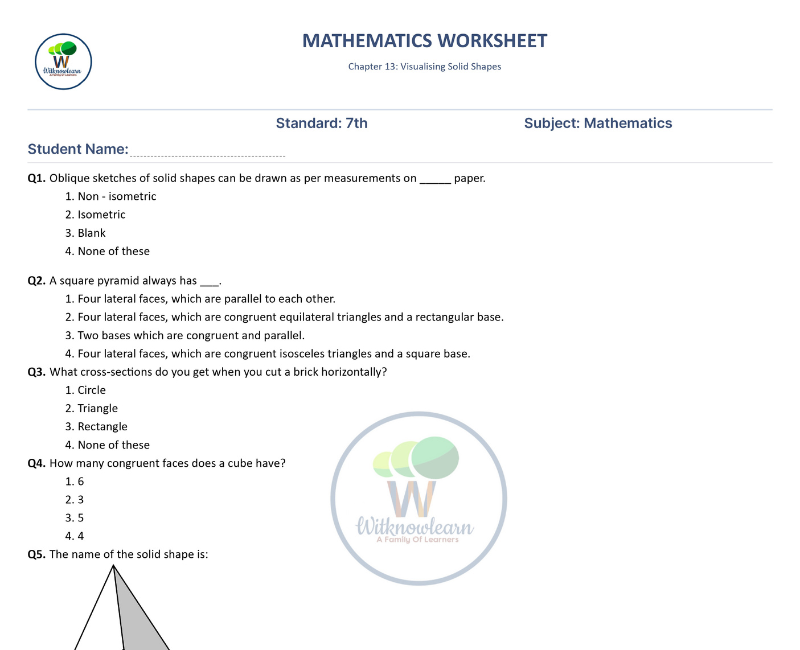
Practice sheet
Visualising Solid Shapes Class 7 Activities
Build stacks from their front and side views in the Block Builder Lab, turn a light to change a shadow, fill the faces, edges and vertices table, match views, sort sketches and fold cube nets, then build solids with sticks and look at them from the top in the Virtual Lab. Earn up to 3 stars in every activity.
Dimensions of shapes
A line has one dimension, length. A flat shape such as a square or a circle has two dimensions, length and breadth. A solid has three dimensions: length, breadth and height. Boxes, footballs, tins and pyramids are solids. We can look at a solid from the front, the side and the top, and each view can look different.
Faces, edges and vertices
A face is a flat surface of a solid. An edge is a line where two faces meet. A vertex is a corner where edges meet. A cube has 6 faces, 12 edges and 8 vertices. A square pyramid has 5 faces, 8 edges and 5 vertices. A triangular prism has 5 faces, 9 edges and 6 vertices. A cylinder has 3 faces, 2 edges and no vertices, a cone has 2 faces, 1 edge and 1 vertex and a sphere has 1 curved surface, no edges and no vertices.
For solids with flat faces the numbers follow a pattern called Euler’s formula: F + V − E = 2. For a cube, 6 + 8 − 12 = 2.
Nets of solids
A net is a flat pattern that folds to make a solid. A cube has 11 different nets, each made of 6 squares joined along edges. A pattern of 6 squares is a net only if it folds with no two squares landing on the same face. The Cube Net Folder lab lets you test this.
Shadows
A solid casts a shadow when light falls on it. The shadow depends on the solid and on the direction of the light. An upright cylinder lit from the side has a rectangle for a shadow. Lit from above, the same cylinder has a circle for a shadow. A cone lit from the side gives a triangle.
Drawing solids on paper
An oblique sketch is quick to draw, but it does not keep the exact measurements. An isometric sketch is drawn on isometric dot paper and keeps the lengths accurate. Designers and architects use isometric sketches to show buildings and objects.
Views of a solid
The front view, side view and top view of a solid together describe it. A stack of cubes shows this well. In the front view you see the tallest stack in each column. In the side view you see the tallest stack in each row. In the top view you see which squares have cubes. Architects and game designers use views to plan buildings and models.
Cross-sections
When a solid is sliced, the cut surface is its cross-section. Slicing a loaf of bread gives slices the same shape as its end. Slicing a cube parallel to a face gives a square. Slicing a cylinder across gives a circle.
This Visualising Solid Shapes worksheet for Class 7 Maths brings the topic to life on WitKnowLearn with an online quiz, online activities and interactive games. Students stack cubes, turn lights, drag views and fold nets with their own hands, then try three maths experiments in the Virtual Lab.
Visualising Solid Shapes Class 7 Maths Guide
Visualising Solid Shapes is a key topic of Class 7 Maths. It covers dimensions, faces, edges and vertices, nets, shadows, drawing solids on paper, front, side and top views and cross-sections. This guide explains each idea clearly for Class 7 students, parents and teachers. It goes with the Visualising Solid Shapes Class 7 worksheet on WitKnowLearn, which also has an online quiz, online activities, interactive games and a Virtual Lab on the same page.
What is there in this topic
- One, two and three dimensions
- Faces, edges and vertices of solids
- Nets of a cube
- Shadows of solids
- Oblique and isometric sketches
- Front, side and top views
- Cross-sections
Learning objectives
- Count faces, edges and vertices of solids.
- Tell whether a pattern is a net of a cube.
- Draw and read the front, side and top views.
- Describe the shadow of a solid.
- Tell oblique and isometric sketches apart.
Learning outcomes
After this page a student can describe a solid by its faces, edges and vertices and by its views, and can say if a pattern folds into a cube.
Key terms
| Term | Meaning |
|---|---|
| Face | A flat surface of a solid |
| Edge | A line where two faces meet |
| Vertex | A corner where edges meet |
| Net | A flat pattern that folds into a solid |
| Cross-section | The cut surface when a solid is sliced |
Common mistakes
| Mistake | Correct |
|---|---|
| A square is a solid | A square is flat, so it is two-dimensional. A cube is the solid. |
| Any 6 squares make a cube net | The squares must fold with no overlap. A 2 by 2 block does not work. |
| A cone has no vertex | A cone has one vertex, its tip. |
Daily life
Boxes, dice, tins, tents, buildings, video games and architectural plans all use solid shapes and their views.
Tips for parents and teachers
- Use dice and boxes to count faces.
- Make straw models to count edges.
- Shine a torch on objects to see shadows.
- Build cube towers and draw three views.
- Let students retry the challenges to earn 3 stars.
Related Class 7 Maths Worksheets
- Integers Class 7 Worksheet
- Fractions and Decimals Class 7 Worksheet
- Data Handling Class 7 Worksheet
- Simple Equations Class 7 Worksheet
- Lines and Angles Class 7 Worksheet
- Triangle and Its Properties Class 7 Worksheet
- Comparing Quantities Class 7 Worksheet
- Rational Numbers Class 7 Worksheet
- Perimeter and Area Class 7 Worksheet
- Algebraic Expressions Class 7 Worksheet
- Exponents and Powers Class 7 Worksheet
- Symmetry Class 7 Worksheet
Frequently Asked Questions
 Download