Class 7 Maths · Integers Worksheet
Integers Class 7 Worksheet with Online Quiz, Games and Activities
Why is −12 smaller than −5, and why does a negative times a negative give a positive? Find out with this Integers worksheet for Class 7 Maths: take the Integers Class 7 online quiz, try three maths experiments in the Virtual Lab and play the activities and interactive games online.
Flip the cards and try the Integer Lab, then tap the Games, Labs, Challenges or Virtual Lab button.
Integers Class 7 Online Quiz
20 questions · tap an answer to move on · full review at the end
Flip the cards, try the Integer Lab, then play the games, do the labs and take the challenges. Earn up to 3 stars in every activity.
Fact cards: tap a card to flip it
Integer Lab
Three real-life cases use integers on a number line. In each one, predict which answer is right, drag it onto the number line and watch where the marker lands. A wrong choice shows what goes wrong, so you can try again.
Challenge marks: 0 / 15 (0 of 5 challenges done)
Finish all 5 challenges to see your comment.
Virtual Lab: do real experiments step by step
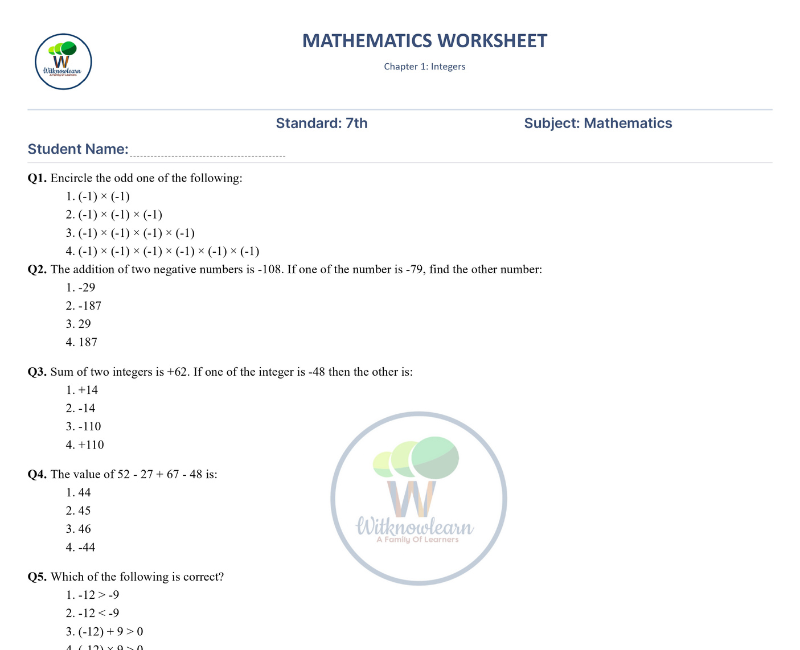
Practice sheet
Integers Class 7 Activities
Track a temperature, a submarine and a bank balance on the number line in the Integer Lab, then add with counters, multiply with hops and read a winter temperature log in the Virtual Lab. Earn up to 3 stars in every activity.
What are integers?
Integers are the whole numbers together with their negatives: …, −3, −2, −1, 0, 1, 2, 3, …. Positive integers (1, 2, 3, …) lie to the right of zero on a number line and negative integers (−1, −2, −3, …) lie to the left. Zero is neither positive nor negative. Integers describe quantities with a direction: a temperature of −6 °C, a depth of −40 m below sea level, a loss of ₹250, or a lift two floors below the ground. Every integer has an opposite, called its additive inverse; the additive inverse of 9 is −9 because 9 + (−9) = 0.
Comparing and ordering integers
On a number line, numbers increase from left to right. So every negative integer is smaller than zero and smaller than every positive integer. Among negatives, the one farther from zero is smaller: −12 is less than −5, even though 12 is greater than 5. Picturing the number line is the surest way to compare integers and to order a list from smallest to greatest.
Adding and subtracting integers
Adding a positive integer means moving right; adding a negative integer means moving left. When two integers have the same sign, add their sizes and keep the sign: (−8) + (−5) = −13. When the signs differ, subtract the smaller size from the larger and keep the sign of the larger: (−11) + 4 = −7. To subtract an integer, add its additive inverse: 6 − (−9) = 6 + 9 = 15, and −4 − 7 = −4 + (−7) = −11. Coloured counters make this clear: a red counter (−1) and a green counter (+1) together form a zero pair, which can be removed without changing the value.
Multiplying and dividing integers
The sign rules for multiplication and division are the same:
- positive × positive and negative × negative give a positive result, for example (−6) × (−4) = 24;
- positive × negative and negative × positive give a negative result, for example 7 × (−5) = −35;
- (−54) ÷ 9 = −6 and (−54) ÷ (−9) = 6;
- when several integers are multiplied, an even number of negative factors gives a positive product and an odd number gives a negative product.
Why is a negative times a negative positive? Look at the pattern (−4) × 2 = −8, (−4) × 1 = −4, (−4) × 0 = 0. Each time the second number goes down by 1, the product goes up by 4, so (−4) × (−1) = 4 and (−4) × (−2) = 8. Zero divided by any non-zero integer is 0, but division by zero is not defined.
Properties of integers
Integers are closed under addition, subtraction and multiplication: the result is always an integer. They are not closed under division, since (−7) ÷ 2 is not an integer. Addition and multiplication are commutative and associative, so the order and grouping can be changed: (−5) + 8 = 8 + (−5). Subtraction and division are neither. Multiplication distributes over addition and subtraction: (−3) × (10 + 2) = (−3) × 10 + (−3) × 2 = −36. Zero is the additive identity and 1 is the multiplicative identity. These properties make mental maths quicker, for example 98 × (−6) = 100 × (−6) − 2 × (−6) = −600 + 12 = −588.
Integers in daily life
Weather reports use integers for cold places, banks show an overdrawn account as a negative balance, maps give heights above and below sea level, and scoreboards in some quizzes give negative marks for wrong answers. Solving such problems means turning words into an integer expression and then applying the rules.
This Integers worksheet for Class 7 Maths brings the topic to life on WitKnowLearn with an online quiz, online activities and interactive games. Flip the fact cards, solve the Integer Lab cases, play the games, do the integer labs, take the challenges and then try three hands-on maths experiments in the Virtual Lab.
Integers Class 7 Maths Guide
Integers is one of the first big topics of Class 7 Maths. It covers the number line, comparing integers, addition and subtraction, multiplication and division with sign rules, and the properties of integers, together with word problems on temperature, height, money and scores. This guide explains each idea clearly for Class 7 students, parents and teachers. It goes with the Integers Class 7 worksheet on WitKnowLearn, which also has an online quiz, online activities, interactive games and a Virtual Lab on the same page.
What is there in this topic
- Positive and negative integers and zero
- Integers on the number line and ordering
- Addition and subtraction of integers
- Multiplication and division of integers
- Closure, commutative, associative and distributive properties
- Additive and multiplicative identity
- Word problems using integers
Learning objectives
- Represent and compare integers on a number line.
- Add, subtract, multiply and divide integers correctly.
- State and use the properties of integers.
- Write real-life situations as integer expressions.
Learning outcomes
After this page a student can:
- Predict the sign of a product or quotient before calculating.
- Use the distributive property for quick mental maths.
- Solve problems on temperature, depth, money and scores.
- Explain why division by zero is not defined.
Integers Class 7 resources on this page
| Resource | What it does |
|---|---|
| Integers Class 7 online quiz | 20 questions in three levels with a full answer review |
| Flip cards | Six cards on below zero, sea level, sign rules, division, properties and profit and loss |
| Integer Lab | Three number line cases: a temperature, a submarine and a bank balance |
| 5 interactive games | Sign sorter, minus twelve bubbles, property memory, number line zones and always true |
| 5 integer labs | Integer calculator, multiplication pattern, property detective, altitude scanner and bank accounts |
| 5 challenges | Marked out of 3 each with a total out of 15 |
| Virtual Lab | Three maths experiments: counters, number line hops and a temperature log |
| Practice sheet | 16 questions with answer boxes and a live score |
Sign rules at a glance
| Signs | × or ÷ result | Example |
|---|---|---|
| + and + | Positive | 8 × 3 = 24 |
| − and − | Positive | (−8) ÷ (−2) = 4 |
| + and − | Negative | 8 × (−3) = −24 |
| − and + | Negative | (−8) ÷ 2 = −4 |
Types of questions
- Comparing and ordering integers
- Addition and subtraction on the number line
- Sign rules for multiplication and division
- Properties of integers
- Missing number questions
- Word problems
- Assertion and reason
Solved examples
Common mistakes
| Mistake | Correct |
|---|---|
| Thinking −12 is greater than −5 | −12 is farther left, so it is smaller. |
| Writing 6 − (−9) = −3 | 6 − (−9) = 6 + 9 = 15. |
| Saying (−4) × (−5) = −20 | Two negatives give a positive: 20. |
| Writing 9 ÷ 0 = 0 | Division by zero is not defined. |
| Assuming a − b = b − a | Subtraction is not commutative. |
Daily life
Integers appear in weather reports, bank statements, maps of heights and depths, lift buttons, sports goal differences and quiz scores with negative marking.
Tips for parents and teachers
- Use red and green counters or buttons to model zero pairs.
- Draw a large number line on the floor and let children hop along it.
- Track the minimum temperature of a cold city for a week.
- Ask students to invent a word problem for each sign rule.
- Let students retry the challenges to earn 3 stars.
Related Class 7 Maths Worksheets
- Fractions and Decimals Class 7 Worksheet
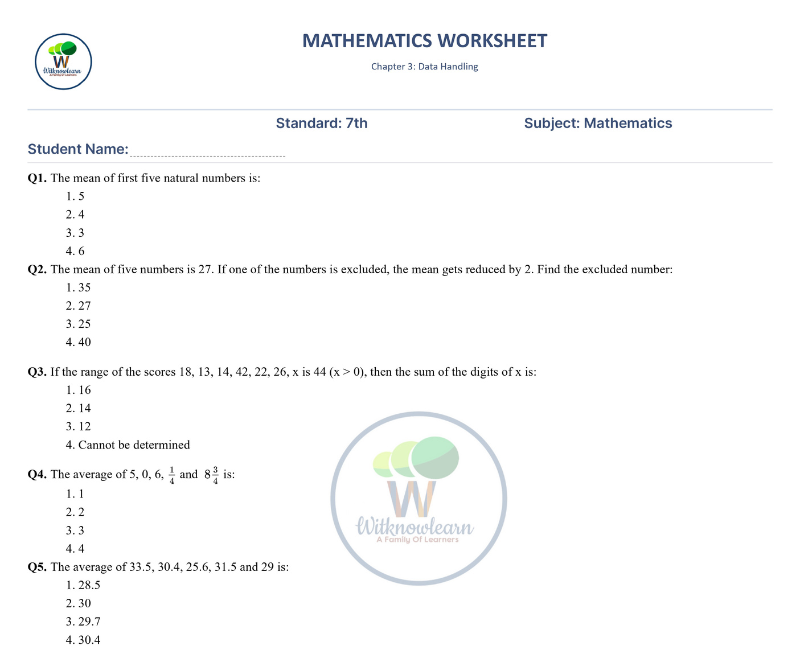
- Data Handling Class 7 Worksheet
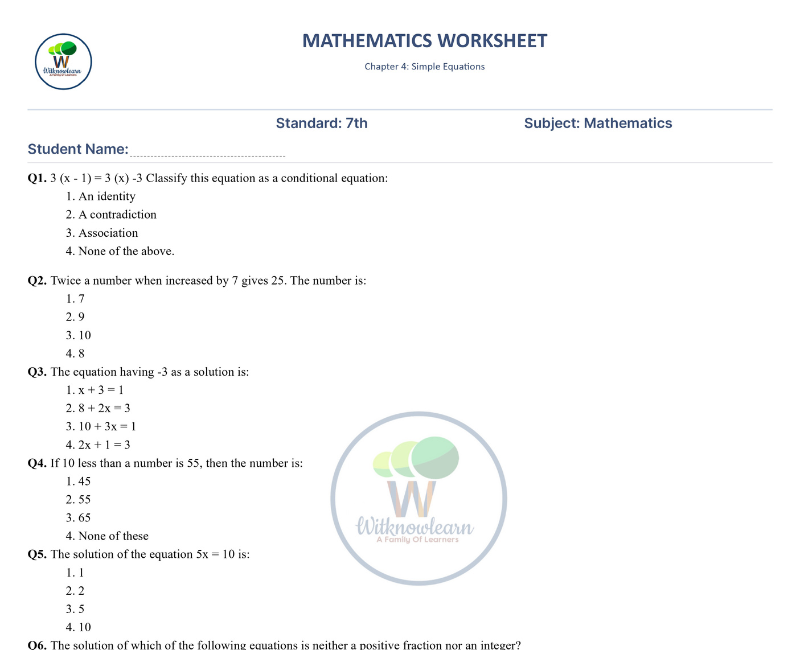
- Simple Equations Class 7 Worksheet
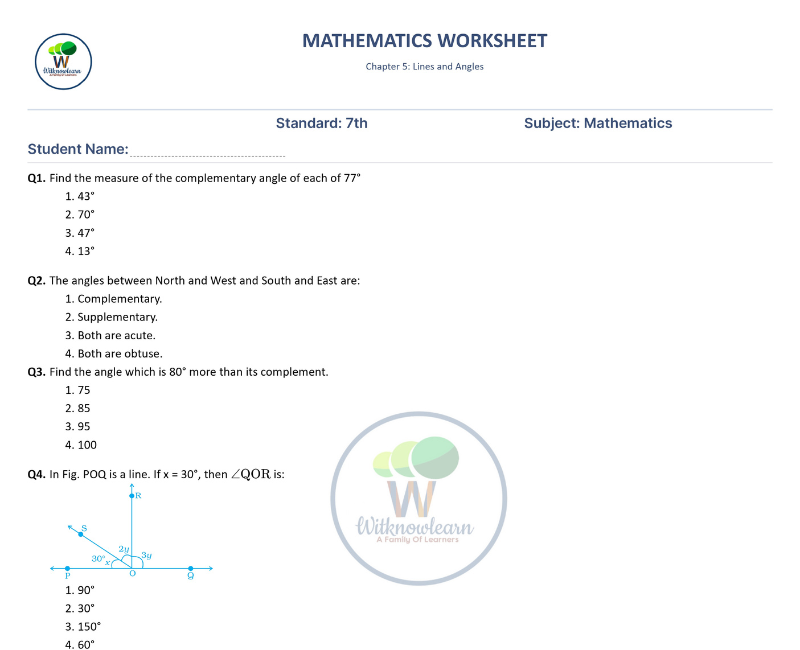
- Lines and Angles Class 7 Worksheet
- Triangle and Its Properties Class 7 Worksheet
- Comparing Quantities Class 7 Worksheet
- Rational Numbers Class 7 Worksheet
- Perimeter and Area Class 7 Worksheet
- Algebraic Expressions Class 7 Worksheet
- Exponents and Powers Class 7 Worksheet
- Symmetry Class 7 Worksheet
- Visualising Solid Shapes Class 7 Worksheet
Frequently Asked Questions
 Download