Class 7 Maths · Perimeter and Area Worksheet
Perimeter and Area Class 7 Worksheet with Online Quiz, Games and Activities
How much fence goes round a garden and how many tiles cover its floor? Find out with this Perimeter and Area worksheet for Class 7 Maths: take the Perimeter and Area Class 7 online quiz, paint shapes on a grid in hands-on activities, try three maths experiments in the Virtual Lab and play interactive games online.
Flip the cards and try the Area and Perimeter Grid Lab, then tap the Games, Labs, Challenges or Virtual Lab button.
Perimeter and Area Class 7 Online Quiz
20 questions · tap an answer to move on · full review at the end
Flip the cards, try the Area and Perimeter Grid Lab, then play the games, do the labs and take the challenges. Earn up to 3 stars in every activity.
Fact cards: tap a card to flip it
Area and Perimeter Grid Lab
Three shape puzzles to solve with your hands. Drag across the grid to paint squares until the area and perimeter are right, then press Check. A wrong choice shows what goes wrong, so you can try again.
Challenge marks: 0 / 15 (0 of 5 challenges done)
Finish all 5 challenges to see your comment.
Virtual Lab: do real experiments step by step
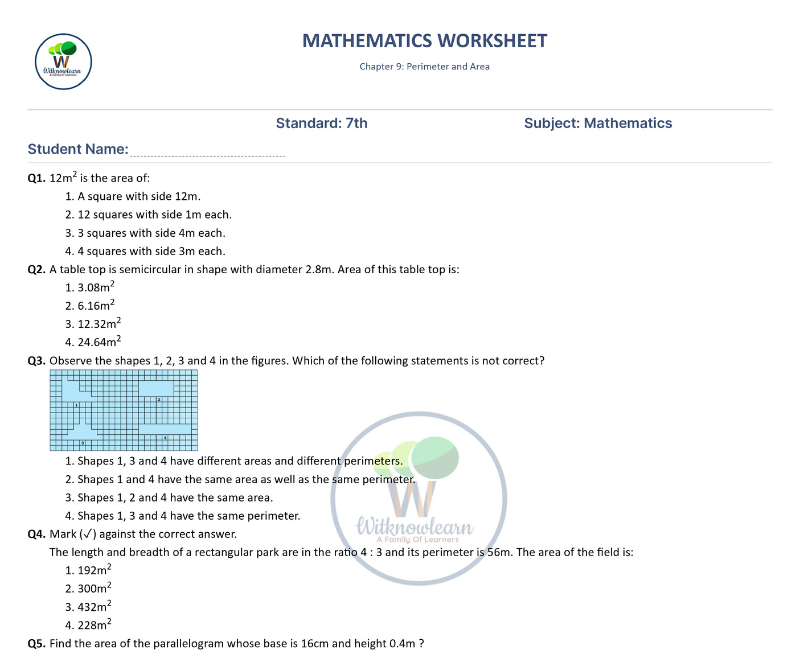
Practice sheet
Perimeter and Area Class 7 Activities
Paint squares on a grid to make shapes with the right area and perimeter in the Area and Perimeter Grid Lab, sort jobs, match formulas, stretch a fence, tile floors, cut ropes, slide a parallelogram and spin a wheel, then measure with string and squared paper in the Virtual Lab. Earn up to 3 stars in every activity.
What is perimeter?
The perimeter of a closed figure is the total length of its boundary, the distance all the way round. For a rectangle with length l and breadth b, the perimeter is 2 × (l + b). For a square of side s it is 4 × s, and for a triangle it is the sum of the three sides. Perimeter is a length, so it is measured in cm, m or km. A fence round a field, a border round a picture and a rope round a ground all need perimeter.
What is area?
The area of a closed figure is the surface it covers. Area is counted in unit squares, so it is measured in square units such as cm², m² or km². The area of a rectangle is length × breadth and the area of a square is side × side. Paint on a wall, carpet on a floor and tiles in a bathroom all need area.
Area of a parallelogram and a triangle
A parallelogram can be cut and moved to make a rectangle with the same base and height, so its area is base × height. A triangle is half of a parallelogram with the same base and height, so its area is 1/2 × base × height. The height is always measured at right angles to the base. A parallelogram with base 6 cm and height 4 cm has area 24 cm², and a triangle with base 8 cm and height 5 cm has area 20 cm².
Circles
The distance round a circle is its circumference. For a circle of radius r it is 2πr, where π is about 22/7 or 3.14. The ratio of the circumference to the diameter is the same for every circle and is called π. The area of a circle is πr². For a circle of radius 7 cm, the circumference is 2 × 22/7 × 7 = 44 cm and the area is 22/7 × 7 × 7 = 154 cm².
Units and conversion
Perimeter uses units of length and area uses square units. Since 1 m = 100 cm, 1 m² = 100 × 100 = 10 000 cm². Always give the answer in the right unit and change units before calculating if the sides are in different units. Larger land areas use the hectare, and 1 hectare is 10 000 m².
Composite shapes and problems
To find the area of an L-shaped figure, split it into rectangles, find each area and add. The same idea works for a path round a garden: find the area of the big shape and subtract the area of the small one. If a rectangle has perimeter 30 cm and length 9 cm, the breadth is 15 − 9 = 6 cm. Changing a shape can change its perimeter without changing its area, and the reverse.
This Perimeter and Area worksheet for Class 7 Maths brings the topic to life on WitKnowLearn with an online quiz, online activities and interactive games. Students paint, drag and slide shapes with their own hands, then try three maths experiments in the Virtual Lab.
Perimeter and Area Class 7 Maths Guide
Perimeter and Area is a key mensuration topic of Class 7 Maths. It covers the perimeter and area of rectangles, squares and triangles, the area of a parallelogram, the circumference and area of a circle, units and conversion and problems on composite shapes. This guide explains each idea clearly for Class 7 students, parents and teachers. It goes with the Perimeter and Area Class 7 worksheet on WitKnowLearn, which also has an online quiz, online activities, interactive games and a Virtual Lab on the same page.
What is there in this topic
- Perimeter of rectangles, squares and triangles
- Area of rectangles and squares
- Area of a parallelogram and a triangle
- Circumference and area of a circle
- Units and conversion
- Applications and composite shapes
Learning objectives
- Find the perimeter and area of basic shapes.
- Use the formulas for a parallelogram, a triangle and a circle.
- Choose between perimeter and area in real situations.
- Convert between units of length and area.
- Split composite shapes into simple ones.
Learning outcomes
After this page a student can solve everyday problems about fencing, tiling, painting and wheels using perimeter, area and circumference.
Key terms
| Term | Meaning |
|---|---|
| Perimeter | Distance round a closed figure |
| Area | Surface covered by a figure |
| Circumference | Perimeter of a circle |
| Radius | Centre to the edge of a circle |
| Diameter | Twice the radius |
| Height | Distance at right angles to the base |
Worked examples
Common mistakes
| Mistake | Correct |
|---|---|
| Writing area in cm instead of cm² | Area is always in square units. |
| Forgetting 1/2 in the triangle area | Area = 1/2 × base × height. |
| Using the slant side as the height | The height is at right angles to the base. |
| Mixing radius and diameter | Diameter = 2 × radius. |
| Adding only two sides for the perimeter | Add all the sides round the figure. |
Daily life
Fencing a farm, tiling a floor, painting a wall, wrapping a gift, cycling round a circular track and laying a path all use perimeter and area.
Tips for parents and teachers
- Use squared paper to count area.
- Measure a room with a tape and find its area.
- Wind a string round a tin to find the circumference.
- Cut a parallelogram and turn it into a rectangle.
- Let students retry the challenges to earn 3 stars.
Related Class 7 Maths Worksheets
- Integers Class 7 Worksheet
- Fractions and Decimals Class 7 Worksheet
- Data Handling Class 7 Worksheet
- Simple Equations Class 7 Worksheet
- Lines and Angles Class 7 Worksheet
- Triangle and Its Properties Class 7 Worksheet
- Comparing Quantities Class 7 Worksheet
- Rational Numbers Class 7 Worksheet
- Algebraic Expressions Class 7 Worksheet
- Exponents and Powers Class 7 Worksheet
- Symmetry Class 7 Worksheet
- Visualising Solid Shapes Class 7 Worksheet
Frequently Asked Questions
 Download