Class 7 Maths · Comparing Quantities Worksheet
Comparing Quantities Class 7 Worksheet with Online Quiz, Games and Activities
How much squash makes the strongest drink, and when does a shopkeeper make a profit? Find out with this Comparing Quantities worksheet for Class 7 Maths: take the Comparing Quantities Class 7 online quiz, paint percents on a hundred grid in hands-on activities, try three maths experiments in the Virtual Lab and play interactive games online.
Flip the cards and try the Percentage Grid Lab, then tap the Games, Labs, Challenges or Virtual Lab button.
Comparing Quantities Class 7 Online Quiz
20 questions · tap an answer to move on · full review at the end
Flip the cards, try the Percentage Grid Lab, then play the games, do the labs and take the challenges. Earn up to 3 stars in every activity.
Fact cards: tap a card to flip it
Percentage Grid Lab
Three percent puzzles to solve with your hands. Drag across the hundred grid to paint the squares, then press Check. A wrong choice shows what goes wrong, so you can try again.
Challenge marks: 0 / 15 (0 of 5 challenges done)
Finish all 5 challenges to see your comment.
Virtual Lab: do real experiments step by step
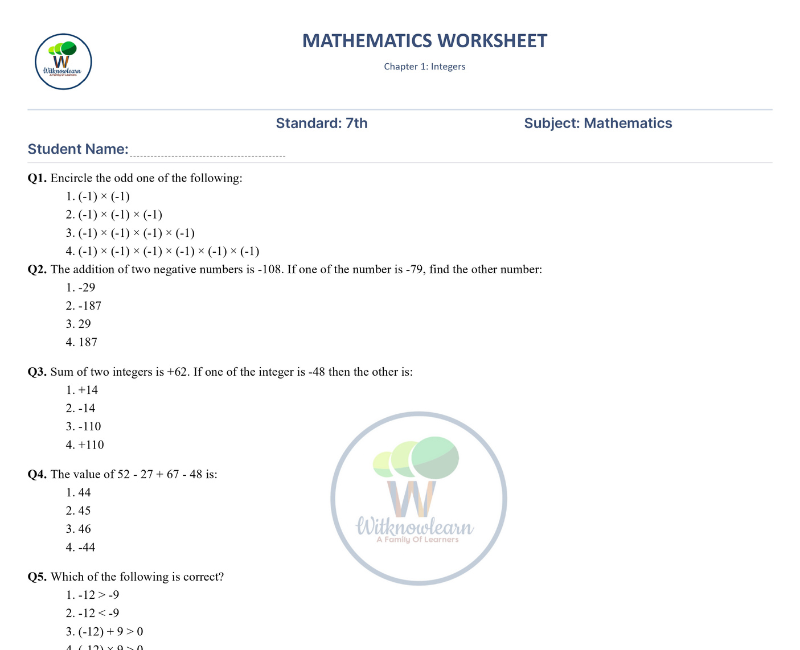
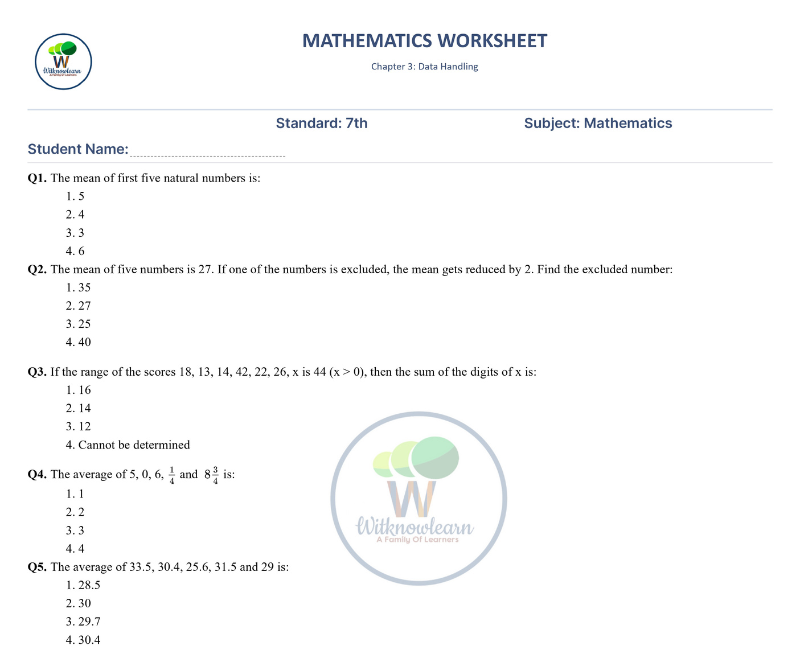
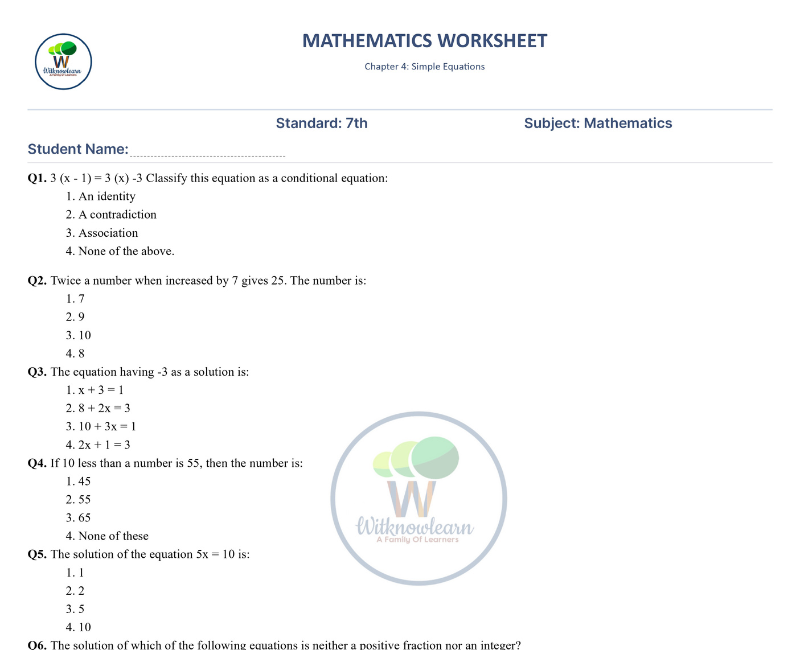
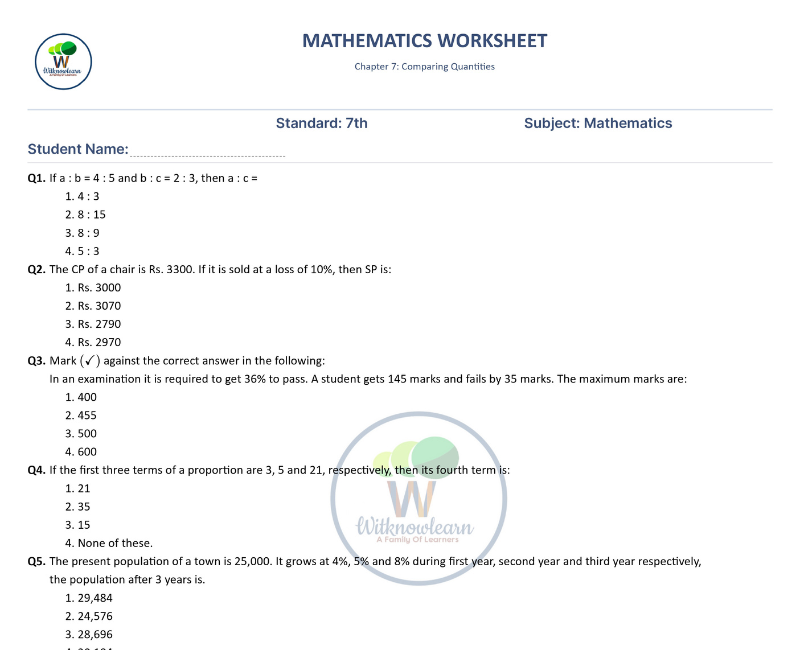
Practice sheet
Comparing Quantities Class 7 Activities
Paint squares on a hundred grid in the Percentage Grid Lab, mix juice in a ratio, share beads, scale a recipe, fill a conversion table, set selling prices and pin percents on a line, then mix squash and run a shop in the Virtual Lab. Earn up to 3 stars in every activity.
What is a ratio?
A ratio compares two quantities of the same kind by division. If a class has 12 girls and 18 boys, the ratio of girls to boys is 12 : 18. Dividing both terms by their common factor 6 gives the simplest form 2 : 3. Ratios that have the same simplest form are called equivalent ratios, so 2 : 3, 4 : 6 and 6 : 9 are all equivalent. Two equal ratios form a proportion, such as 2 : 3 = 4 : 6, and in a proportion the product of the extremes equals the product of the means.
Sharing in a ratio
To share an amount in a ratio, add the parts to find the total number of parts, divide the amount by the total to find one part, then multiply by each term. To share 20 beads in the ratio 3 : 2, the total is 5 parts, one part is 4 beads, so the shares are 12 and 8. The same method works for mixing squash and water, for dividing money and for scaling a recipe up or down.
Percentage
Per cent means out of 100, and the sign is %. So 35% means 35 out of 100, which is 35/100 or 0.35. To change a fraction to a percent, make the denominator 100 or multiply by 100: 3/5 = 60/100 = 60%. To change a decimal to a percent, multiply by 100: 0.08 = 8%. To find a percent of a number, multiply the number by the percent and divide by 100, so 30% of 20 is 6. A quantity can also be written as a percent of another, such as 6 out of 20 = 30%.
Profit and loss
The price at which an article is bought is the cost price (CP) and the price at which it is sold is the selling price (SP). If SP is more than CP there is a profit = SP − CP. If SP is less than CP there is a loss = CP − SP. If both are equal there is no profit and no loss. Profit percent = profit ÷ CP × 100 and loss percent = loss ÷ CP × 100, always on the cost price. An item that costs ₹50 and is sold for ₹60 gives a profit of ₹10, which is 20%.
Simple interest
When money is borrowed or deposited, extra money called interest is paid. The money borrowed is the principal (P), the interest for 100 rupees in one year is the rate (R) and the period is the time (T). Simple interest is SI = P × R × T ÷ 100, and the amount is principal plus interest. On ₹200 at 5% for 2 years, SI = 200 × 5 × 2 ÷ 100 = ₹20.
This Comparing Quantities worksheet for Class 7 Maths brings the topic to life on WitKnowLearn with an online quiz, online activities and interactive games. Students drag drops, beads and sliders with their own hands, then try three maths experiments in the Virtual Lab.
Comparing Quantities Class 7 Maths Guide
Comparing Quantities is a key topic of Class 7 Maths. It covers ratio, equivalent ratios and proportion, percentages, converting between fractions, decimals and percents, profit and loss and simple interest. This guide explains each idea clearly for Class 7 students, parents and teachers. It goes with the Comparing Quantities Class 7 worksheet on WitKnowLearn, which also has an online quiz, online activities, interactive games and a Virtual Lab on the same page.
What is there in this topic
- Ratio and equivalent ratios
- Proportion
- Percentage and its meaning
- Fractions, decimals and percents
- Profit and loss
- Simple interest
Learning objectives
- Write ratios in simplest form and find equivalent ratios.
- Share an amount in a given ratio.
- Convert between fractions, decimals and percents.
- Find profit, loss and their percents.
- Calculate simple interest.
Learning outcomes
After this page a student can compare quantities using ratios and percents, solve everyday problems on discounts, profit and loss, and find the simple interest on a sum of money.
Key terms
| Term | Meaning |
|---|---|
| Ratio | Comparison of two quantities by division |
| Proportion | Two equal ratios |
| Percent | Out of 100 |
| Cost price | Price at which an item is bought |
| Selling price | Price at which an item is sold |
| Principal | Money borrowed or deposited |
Worked examples
Common mistakes
| Mistake | Correct |
|---|---|
| Writing a ratio of different units without converting | Change both to the same unit first. |
| Dividing the amount by one term when sharing | Divide by the sum of all the terms. |
| Working out profit percent on the selling price | Always use the cost price. |
| Forgetting to divide by 100 in a percent of a number | Percent means out of 100. |
| Forgetting the time in simple interest | Multiply by the number of years. |
Daily life
Recipes, mixing paints, discounts in shops, marks in exams, bank deposits and loans all use ratios, percents and interest.
Tips for parents and teachers
- Use a hundred grid to show percents.
- Mix squash and water to see ratios.
- Play shop with play money for profit and loss.
- Compare prices on real shop tags.
- Let students retry the challenges to earn 3 stars.
Related Class 7 Maths Worksheets
- Integers Class 7 Worksheet
- Fractions and Decimals Class 7 Worksheet
- Data Handling Class 7 Worksheet
- Simple Equations Class 7 Worksheet
- Lines and Angles Class 7 Worksheet
- Triangle and Its Properties Class 7 Worksheet
- Rational Numbers Class 7 Worksheet
- Perimeter and Area Class 7 Worksheet
- Algebraic Expressions Class 7 Worksheet
- Exponents and Powers Class 7 Worksheet
- Symmetry Class 7 Worksheet
- Visualising Solid Shapes Class 7 Worksheet
Frequently Asked Questions
 Download