Class 7 Maths · Rational Numbers Worksheet
Rational Numbers Class 7 Worksheet with Online Quiz, Games and Activities
Where does −3/4 sit on the number line, and how many rational numbers hide between 0 and 1? Find out with this Rational Numbers worksheet for Class 7 Maths: take the Rational Numbers Class 7 online quiz, drag pins along the number line in hands-on activities, try three maths experiments in the Virtual Lab and play interactive games online.
Flip the cards and try the Number Line Lab, then tap the Games, Labs, Challenges or Virtual Lab button.
Rational Numbers Class 7 Online Quiz
20 questions · tap an answer to move on · full review at the end
Flip the cards, try the Number Line Lab, then play the games, do the labs and take the challenges. Earn up to 3 stars in every activity.
Fact cards: tap a card to flip it
Number Line Lab
Three number line puzzles to solve with your hands. Drag the red pin along the line to the rational number, then press Check. A wrong choice shows what goes wrong, so you can try again.
Challenge marks: 0 / 15 (0 of 5 challenges done)
Finish all 5 challenges to see your comment.
Virtual Lab: do real experiments step by step
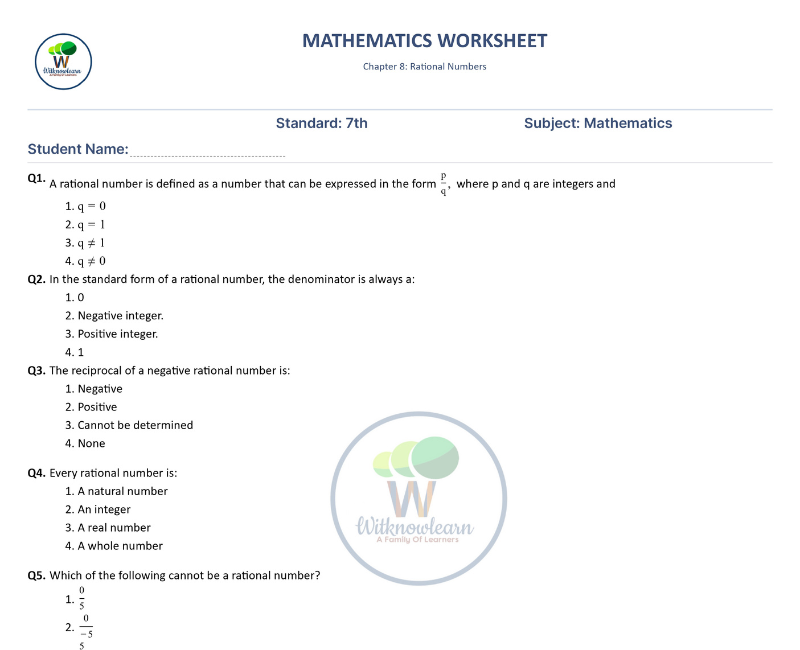
Practice sheet
Rational Numbers Class 7 Activities
Drag a pin along the number line in the Number Line Lab, sort positive and negative numbers, build equal rational numbers, order them, find the numbers in a gap and add by hopping on the line, then fold paper strips and walk on a number line in the Virtual Lab. Earn up to 3 stars in every activity.
What is a rational number?
A rational number is a number that can be written in the form p/q, where p and q are integers and q is not zero. The numbers 3/4, −5/7, 6/1 and 0/5 are all rational. Every integer n is rational because n = n/1, and every fraction is rational too. Zero is rational, but a fraction such as 5/0 means nothing, so the denominator can never be zero. The top number p is the numerator and the bottom number q is the denominator.
Positive and negative rational numbers
A rational number is positive if its numerator and denominator have the same sign, and negative if the signs are different. So 3/4 and −4/−9 are positive, while −2/5 and 5/−3 are negative. A negative sign on the bottom can always be moved to the top: 5/−3 = −5/3. Zero is neither positive nor negative.
Equivalent rational numbers and standard form
Multiplying or dividing the numerator and denominator by the same non-zero number gives an equivalent rational number, so 1/2 = 2/4 = 3/6. A rational number is in standard form when its denominator is positive and the numerator and denominator have no common factor except 1. To reduce −12/18, divide both by the greatest common factor 6 to get −2/3.
Rational numbers on the number line
Every rational number has a place on the number line. Positive numbers are on the right of zero and negative numbers are on the left. To mark −3/4, divide each unit into four equal parts and count three parts to the left of zero. The number line also shows order: of two rational numbers, the one further to the right is greater, so −1/2 is greater than −3/4. To compare numbers in a list, write them with the same denominator and compare the numerators.
Rational numbers between two rational numbers
Between any two rational numbers there are infinitely many more. To find one, take the mid-point: (a + b) ÷ 2. Between 0 and 1 lies 1/2, between 0 and 1/2 lies 1/4, and between 1/4 and 1/2 lies 3/8. The process can be repeated for ever.
Operations on rational numbers
To add rational numbers, write them with the same denominator and add the numerators: 1/2 + 1/4 = 2/4 + 1/4 = 3/4. To subtract, add the additive inverse. The additive inverse of a number is the number that gives zero when added to it, so the inverse of 3/4 is −3/4 and the inverse of −7 is 7. To multiply, multiply the numerators and the denominators, and to divide, multiply by the reciprocal. Rational numbers are closed under addition, subtraction and multiplication, and addition and multiplication are commutative and associative.
This Rational Numbers worksheet for Class 7 Maths brings the topic to life on WitKnowLearn with an online quiz, online activities and interactive games. Students drag pins, tiles and sliders with their own hands, then try three maths experiments in the Virtual Lab.
Rational Numbers Class 7 Maths Guide
Rational Numbers is a key topic of Class 7 Maths. It covers what a rational number is, positive and negative rational numbers, equivalent rational numbers and standard form, the number line, comparing and ordering, rational numbers between two numbers and the four operations. This guide explains each idea clearly for Class 7 students, parents and teachers. It goes with the Rational Numbers Class 7 worksheet on WitKnowLearn, which also has an online quiz, online activities, interactive games and a Virtual Lab on the same page.
What is there in this topic
- Meaning of a rational number
- Positive and negative rational numbers
- Equivalent rational numbers and standard form
- Rational numbers on the number line
- Comparing and ordering
- Rational numbers between two rational numbers
- Addition, subtraction, multiplication and division
Learning objectives
- Write a number in the form p/q and identify rational numbers.
- Find equivalent rational numbers and reduce to standard form.
- Mark and compare rational numbers on the number line.
- Find rational numbers between two numbers.
- Add, subtract, multiply and divide rational numbers.
Learning outcomes
After this page a student can place any rational number on the number line, put a list of rational numbers in order and solve simple problems using the four operations.
Key terms
| Term | Meaning |
|---|---|
| Rational number | A number p/q with q not zero |
| Numerator | The top number |
| Denominator | The bottom number |
| Standard form | Lowest terms with a positive denominator |
| Additive inverse | The number that adds with it to make zero |
| Reciprocal | The number that multiplies with it to make 1 |
Worked examples
Common mistakes
| Mistake | Correct |
|---|---|
| Saying 5/0 is a rational number | The denominator can never be zero. |
| Thinking −3/4 is greater than −1/2 | The number further right is greater, so −1/2 is greater. |
| Adding the denominators | Use a common denominator and add only the numerators. |
| Leaving a negative sign on the denominator | Standard form has a positive denominator. |
| Reducing with different numbers on top and bottom | Divide both by the same common factor. |
Daily life
Temperatures below zero, depths below sea level, bank balances, measuring in parts of a unit and sharing food all use rational numbers.
Tips for parents and teachers
- Draw a number line on the floor and walk along it.
- Fold paper strips to see equivalent fractions.
- Use a thermometer to show negative numbers.
- Ask students to find numbers between two points again and again.
- Let students retry the challenges to earn 3 stars.
Related Class 7 Maths Worksheets
- Integers Class 7 Worksheet
- Fractions and Decimals Class 7 Worksheet
- Data Handling Class 7 Worksheet
- Simple Equations Class 7 Worksheet
- Lines and Angles Class 7 Worksheet
- Triangle and Its Properties Class 7 Worksheet
- Comparing Quantities Class 7 Worksheet
- Perimeter and Area Class 7 Worksheet
- Algebraic Expressions Class 7 Worksheet
- Exponents and Powers Class 7 Worksheet
- Symmetry Class 7 Worksheet
- Visualising Solid Shapes Class 7 Worksheet
Frequently Asked Questions
 Download