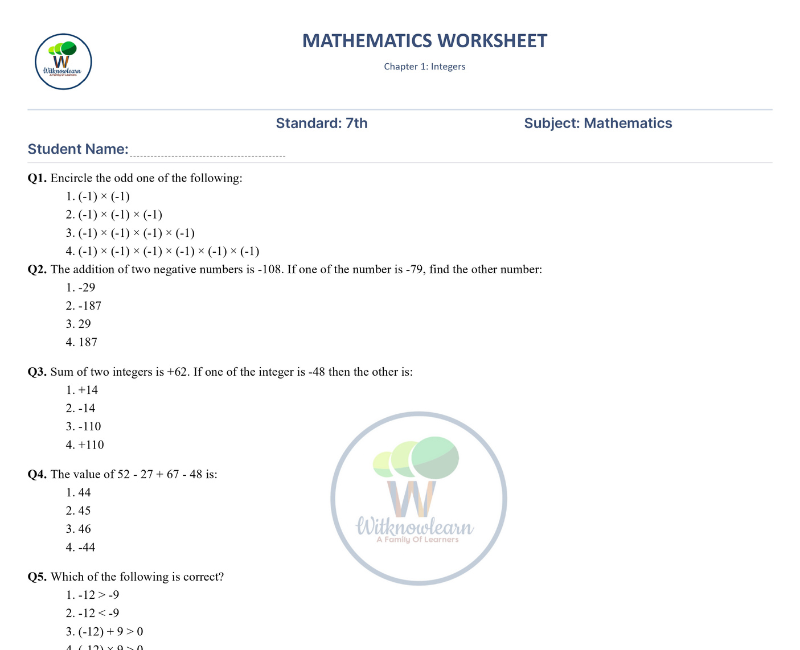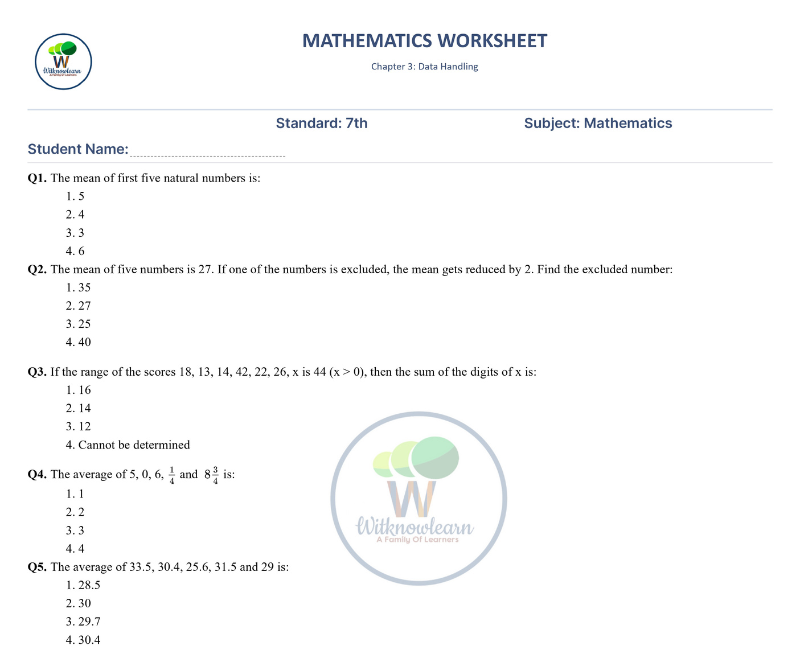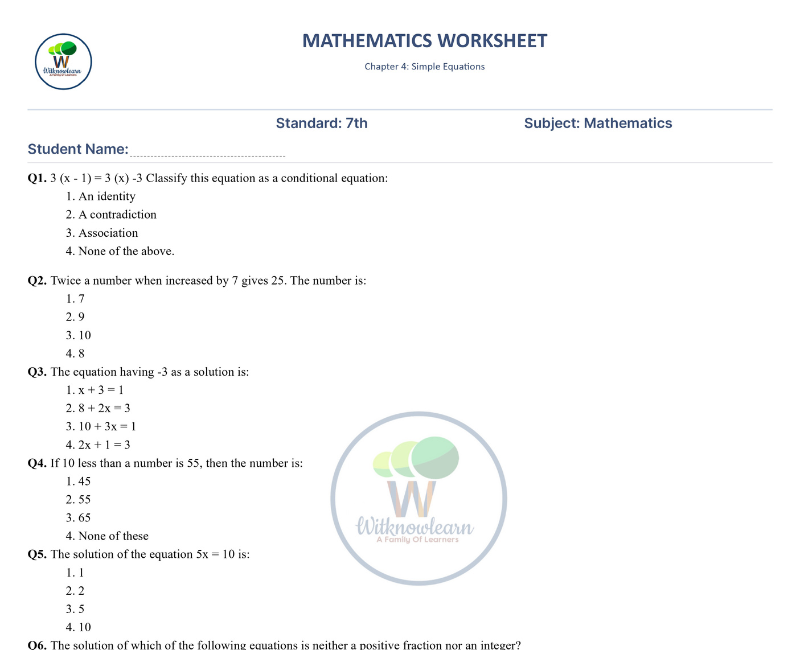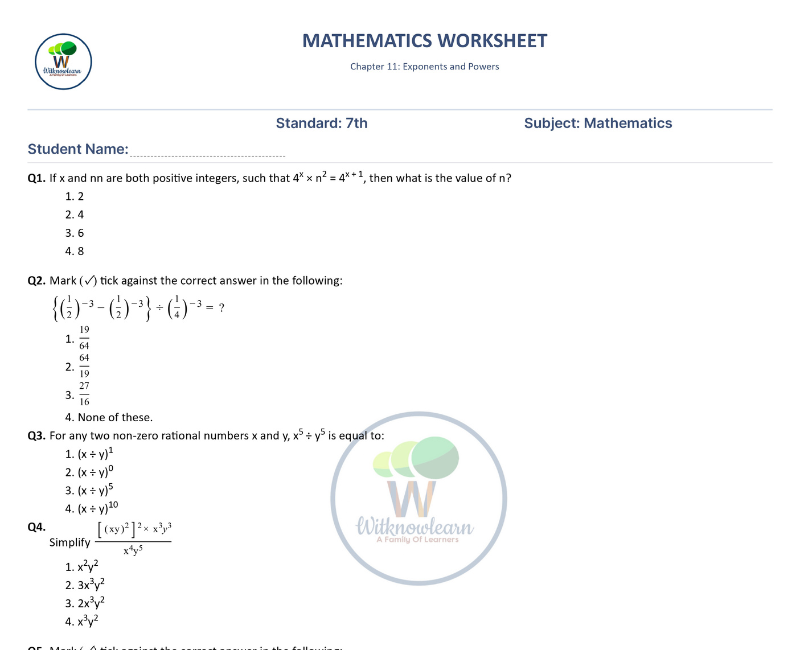
Class 7 Maths · Exponents and Powers Worksheet
Exponents and Powers Class 7 Worksheet with Online Quiz, Games and Activities
How many layers does a paper have after ten folds, and why is any number to the power zero equal to one? Find out with this Exponents and Powers worksheet for Class 7 Maths: take the Exponents and Powers Class 7 online quiz, drag base tiles in hands-on activities, try three maths experiments in the Virtual Lab and play interactive games online.
Flip the cards and try the Power Builder Lab, then tap the Games, Labs, Challenges or Virtual Lab button.
Exponents and Powers Class 7 Online Quiz
20 questions · tap an answer to move on · full review at the end
Flip the cards, try the Power Builder Lab, then play the games, do the labs and take the challenges. Earn up to 3 stars in every activity.
Fact cards: tap a card to flip it
Power Builder Lab
Three power puzzles to solve with your hands. Drag base tiles onto the mat to build each power, then press Check. A wrong choice shows what goes wrong, so you can try again.
Challenge marks: 0 / 15 (0 of 5 challenges done)
Finish all 5 challenges to see your comment.
Virtual Lab: do real experiments step by step
Practice sheet
Exponents and Powers Class 7 Activities
Drag base tiles onto the mat in the Power Builder Lab, match products to powers, sort the laws of exponents, slide the exponent to hit a target, discover why a power zero is 1, write numbers in standard form and count blocks, then fold paper and pass on messages in the Virtual Lab. Earn up to 3 stars in every activity.
What is a power?
A power is a short way to write repeated multiplication. Instead of 2 × 2 × 2 × 2 × 2 we write 2^5, which is read "2 to the power 5". The number being multiplied, 2, is the base and the small raised number, 5, is the exponent or index. It tells how many times the base is used. So 2^5 = 32 and 3^4 = 3 × 3 × 3 × 3 = 81. Squares and cubes are powers too: 5^2 is 5 squared and 4^3 is 4 cubed.
Laws of exponents
When the bases are the same, powers follow simple laws. To multiply powers, add the exponents: a^m × a^n = a^[m+n], so 2^3 × 2^4 = 2^7. To divide powers, subtract the exponents: a^m ÷ a^n = a^[m−n], so 5^6 ÷ 5^2 = 5^4. For a power of a power, multiply the exponents: (a^m)^n = a^[mn], so (3^2)^4 = 3^8. When the exponents are the same, a^m × b^m = (ab)^m, so 2^3 × 5^3 = 10^3.
Power zero and power one
Any non-zero number to the power 1 is the number itself, so 7^1 = 7. Any non-zero number to the power 0 is 1, so 7^0 = 1. This follows the pattern 2^3 = 8, 2^2 = 4, 2^1 = 2, 2^0 = 1, where each step divides by the base. It also follows the law of division, since 5^3 ÷ 5^3 = 5^0 and anything divided by itself is 1.
Comparing powers
To compare powers, work out their values. 2^5 = 32 and 5^2 = 25, so 2^5 is greater. Notice that 2^3 = 8 is not the same as 3^2 = 9: swapping the base and the exponent changes the value. A power with a larger base or exponent is not always bigger, so always check by working it out.
Powers of 10 and standard form
Powers of 10 are easy: 10^2 = 100, 10^3 = 1000 and 10^4 = 10 000. The exponent tells the number of zeros. This helps to write very large numbers in standard form, also called scientific notation, as a number between 1 and 10 multiplied by a power of 10. So 4000 = 4 × 10^3, 50 000 = 5 × 10^4 and 7 200 000 = 7.2 × 10^6. The distance from the Earth to the Sun, about 150 000 000 km, is 1.5 × 10^8 km.
Prime factorisation with powers
Powers make prime factorisation short. 72 = 2 × 2 × 2 × 3 × 3 = 2^3 × 3^2, and 100 = 2^2 × 5^2. Writing a number as a product of prime powers helps to find its factors and to compare numbers.
This Exponents and Powers worksheet for Class 7 Maths brings the topic to life on WitKnowLearn with an online quiz, online activities and interactive games. Students drag tiles, slide exponents and count blocks with their own hands, then try three maths experiments in the Virtual Lab.
Exponents and Powers Class 7 Maths Guide
Exponents and Powers is a key topic of Class 7 Maths. It covers the meaning of base and exponent, the laws of exponents, the powers zero and one, comparing powers, powers of 10 and writing large numbers in standard form. This guide explains each idea clearly for Class 7 students, parents and teachers. It goes with the Exponents and Powers Class 7 worksheet on WitKnowLearn, which also has an online quiz, online activities, interactive games and a Virtual Lab on the same page.
What is there in this topic
- Base and exponent
- Squares, cubes and higher powers
- Laws of exponents
- Power zero
- Powers of 10
- Standard form of large numbers
Learning objectives
- Write repeated multiplication as a power.
- Find the value of a power.
- Apply the laws of exponents.
- Compare powers.
- Write numbers in standard form.
Learning outcomes
After this page a student can simplify expressions with powers using the laws of exponents and write very large numbers in standard form.
Key terms
| Term | Meaning |
|---|---|
| Base | The number being multiplied |
| Exponent | How many times the base is used |
| Power | A number written as base^exponent |
| Standard form | A number from 1 to 10 times a power of 10 |
| Index | Another name for exponent |
| Squared and cubed | Powers 2 and 3 |
Worked examples
Common mistakes
| Mistake | Correct |
|---|---|
| Thinking 2^3 means 2 × 3 | 2^3 = 2 × 2 × 2 = 8. |
| Multiplying the exponents when multiplying powers | Add the exponents: a^m × a^n = a^[m+n]. |
| Saying 5^0 = 0 | Any non-zero number to the power 0 is 1. |
| Using the laws with different bases | The laws need the same base. |
| Confusing 2^3 with 3^2 | 2^3 = 8 but 3^2 = 9. |
Daily life
Computer storage, the spread of news, population growth, distances in space and the sizes of tiny cells are written with powers and standard form.
Tips for parents and teachers
- Fold paper to show doubling.
- Use blocks to build squares and cubes.
- Ask how many people hear a message if each tells three friends.
- Write big numbers from the news in standard form.
- Let students retry the challenges to earn 3 stars.
Related Class 7 Maths Worksheets
- Integers Class 7 Worksheet
- Fractions and Decimals Class 7 Worksheet
- Data Handling Class 7 Worksheet
- Simple Equations Class 7 Worksheet
- Lines and Angles Class 7 Worksheet
- Triangle and Its Properties Class 7 Worksheet
- Comparing Quantities Class 7 Worksheet
- Rational Numbers Class 7 Worksheet
- Perimeter and Area Class 7 Worksheet
- Algebraic Expressions Class 7 Worksheet
- Symmetry Class 7 Worksheet
- Visualising Solid Shapes Class 7 Worksheet
Frequently Asked Questions
 Download