Class 6 Mathematics • Ganita Prakash • Chapter 1
Patterns in Mathematics Class 6 Worksheet with Answers
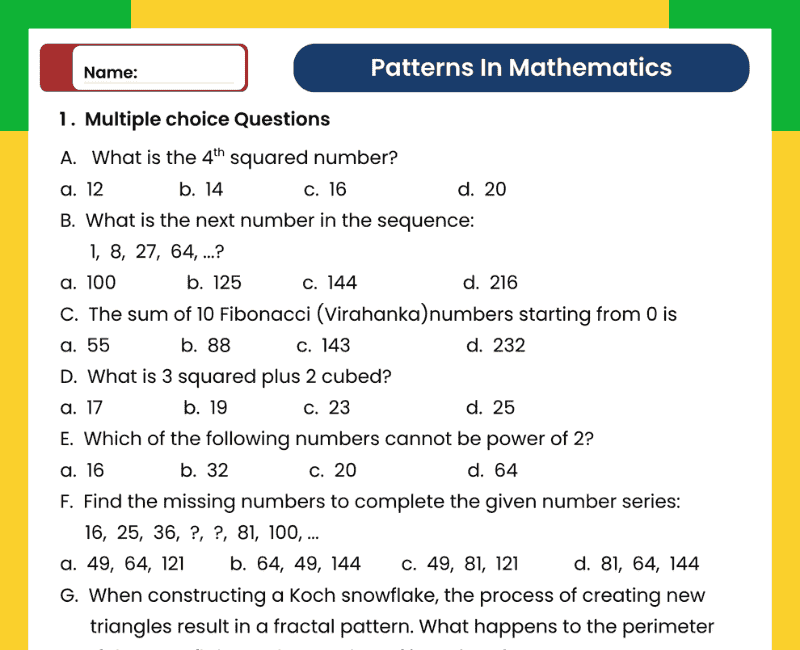
Explore how numbers and shapes follow rules with the Patterns in Mathematics Class 6 worksheet with answers from WitKnowLearn. Use this resource alongside Chapter 1 of the NCERT Ganita Prakash textbook to practise observing, comparing and explaining mathematical patterns.
A pattern question asks students to look beyond a single number or picture. What stays the same? What changes? How does one stage lead to the next? Thinking about these questions helps students continue a sequence and explain the reasoning behind their answer.
What Are Patterns in Mathematics?
A mathematical pattern is an arrangement that follows a rule or shows a relationship. It may involve numbers, shapes, objects or repeated actions. Some patterns repeat a fixed group, while others grow or change at each stage.
For example, 2, 4, 6, 8 follows the rule “add 2.” A row of alternating circles and squares follows a repeating shape rule. Recognising these relationships is the starting point for solving pattern questions.
- Observe the given numbers or figures carefully.
- Compare consecutive terms or stages.
- Identify a rule that fits the given examples.
- Use the rule to continue the pattern.
- Explain the answer using words, numbers or drawings.
Number Patterns: Look for the Rule
Begin a number-pattern question by comparing neighbouring terms. The sequence may increase by a fixed amount, decrease by a fixed amount or change through multiplication. Check the proposed rule against every given term.
Example: 5, 10, 15, 20, …
The difference between consecutive terms is 5.
Following the rule “add 5,” the next term is 25.
Example: 3, 6, 12, 24, …
Each term is twice the previous term.
Following the rule “multiply by 2,” the next term is 48.
These are additional revision examples. When attempting the worksheet, use the rule indicated by the question and explain why it fits the sequence.
Odd Numbers, Even Numbers and Their Patterns
The positive odd numbers begin 1, 3, 5, 7, 9, while the positive even numbers begin 2, 4, 6, 8, 10. Both sequences increase by 2, but they start at different numbers.
Odd-number pattern: 1, 3, 5, 7, 9, …
Even-number pattern: 2, 4, 6, 8, 10, …
Students can represent these numbers using counters arranged in pairs. Even numbers form complete pairs. Odd numbers leave one counter unpaired. Connecting the sequence to a picture makes the rule easier to describe.
Square Numbers and Triangular Numbers
Some number sequences can be represented by arrangements of dots. Square numbers form square arrays with the same number of rows and columns. Triangular numbers can be arranged in rows that grow by one dot at a time.
Square numbers:
1 × 1 = 1
2 × 2 = 4
3 × 3 = 9
4 × 4 = 16
The sequence begins 1, 4, 9, 16, 25, …
Triangular numbers:
1 = 1
1 + 2 = 3
1 + 2 + 3 = 6
1 + 2 + 3 + 4 = 10
The sequence begins 1, 3, 6, 10, 15, …
Draw the dot arrangements and compare consecutive stages. Ask how many dots have been added and where the new dots appear. This links number patterns with visual reasoning.
Shape Patterns and Growing Figures
A shape pattern may repeat, turn or grow. Look at the type of shape, its position, its orientation and the number of objects used. More than one feature may change, so inspect the complete arrangement.
In a repeating pattern, identify the smallest group that repeats. In a growing pattern, compare the number of objects at each stage and describe how the new stage is constructed.
Useful questions to ask:
- Which part repeats?
- How many objects are added each time?
- Does the figure turn or change position?
- Can the next stage be drawn using the same rule?
Connections Between Number Sequences
Pattern exploration also involves comparing different sequences. For example, adding consecutive positive odd numbers produces square numbers. Drawing dots in an expanding square helps explain this relationship.
1 = 1
1 + 3 = 4
1 + 3 + 5 = 9
1 + 3 + 5 + 7 = 16
Instead of memorising only the results, explain how each new group of dots extends the previous square. A drawing can support the calculation and make the relationship visible.
How to Use the Worksheet with Answers
Use the preview and download option on this page, following its access instructions. Attempt each question independently before comparing your response with the provided answer.
- Read the sequence or inspect the figures carefully.
- Write the change between consecutive terms or stages.
- State the rule you are using.
- Continue the pattern or complete the requested drawing.
- Check the answer and review your reasoning.
Avoid choosing a rule after looking at only two terms. Check that it works throughout the given sequence. A finite list can sometimes fit more than one rule, so use the question's context and explain the rule you have chosen.
Teachers can use selected questions for classroom discussion, homework or revision. Parents can encourage students to explain an answer aloud or represent it with dots and drawings. Focus on the reasoning as well as the final term.
Explore All Other Class 6 Ganita Prakash Worksheets
Continue your chapter-wise revision with these Class 6 Maths worksheets from WitKnowLearn. Select a box to open the related worksheet page.
→ Chapter 2: Lines and AnglesRevise points, lines, rays, line segments and types of angles. → Chapter 3: Number Play
Explore number arrangements, digit patterns and mathematical reasoning. → Chapter 4: Data Handling and Presentation
Practise organising information and interpreting pictographs and bar graphs. → Chapter 5: Prime Time
Revise factors, multiples, prime numbers and prime factorisation. → Chapter 6: Perimeter and Area
Practise boundary lengths and the areas of squares and rectangles. → Chapter 7: Fractions
Practise representing, comparing and working with fractions. → Chapter 8: Playing with Constructions
Explore geometric drawing using a ruler and compass. → Chapter 9: Symmetry
Investigate lines of symmetry and rotational symmetry in figures. → Chapter 10: The Other Side of Zero
Explore positive and negative numbers through number lines and everyday situations.
Frequently Asked Questions
What is a mathematical pattern?
It is an arrangement of numbers, shapes or objects that follows a rule or shows a relationship. Patterns may repeat, grow or change.
How do I find the rule in a number sequence?
Compare consecutive terms and check for changes such as addition, subtraction or multiplication. Test your rule against all the given terms.
What are square numbers?
Square numbers are obtained by multiplying a whole number by itself. The positive square numbers begin 1, 4, 9, 16 and 25.
What are triangular numbers?
They can be represented by triangular arrangements of dots. Adding 1, then 2, then 3 and so on produces 1, 3, 6, 10 and 15.
What is the difference between repeating and growing patterns?
A repeating pattern repeats a fixed group. A growing pattern changes in size or number of objects according to a rule.
How are odd numbers connected to square numbers?
Adding the first consecutive positive odd numbers produces square numbers. For example, 1 + 3 + 5 = 9 and 1 + 3 + 5 + 7 = 16.
Can drawings help solve pattern questions?
Yes. Dot arrangements and sketches help show how a pattern grows and make it easier to explain the relationship between stages.
How should I use the worksheet answers?
Attempt the questions first, then compare your answers. If a response differs, review the rule and your calculations before correcting it.
 Download