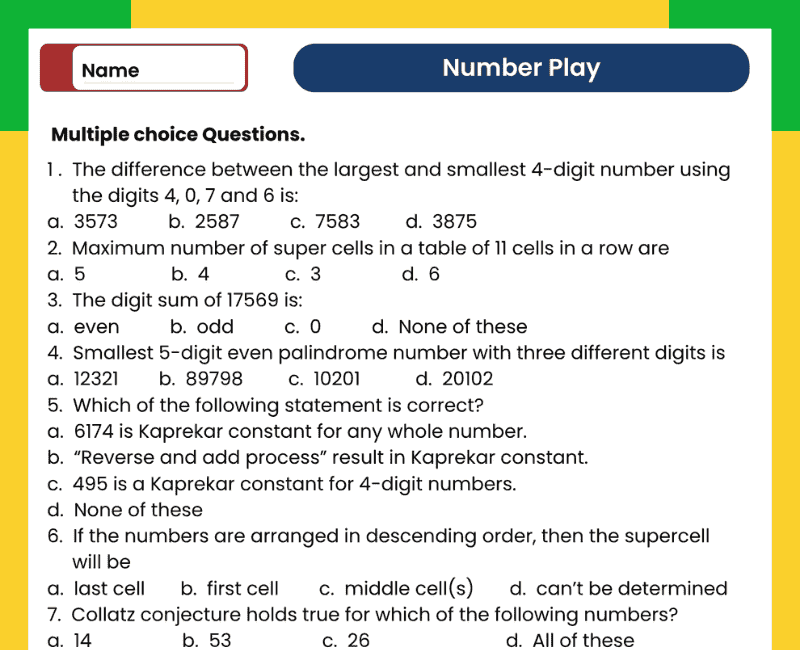
Number Play Class 6 Worksheet with Answers
Practise NCERT Class 6 Maths Chapter 3 – Number Play with this Number Play Class 6 worksheet with answers. Use this resource alongside the Class 6 Ganita Prakash textbook to strengthen number sense, practise calculations and explain your reasoning.
Number Play encourages students to ask questions: What changes when we rearrange digits? Can different numbers have the same digit sum? Which numbers look the same when read backwards? The revision examples below help students approach these ideas before attempting the worksheet.
Look Closely, Compare and Explain
A number can represent a quantity, a position, a measurement or information about an arrangement. Before calculating, read the situation and identify what each number represents. In comparison puzzles, check the relevant neighbours rather than comparing every number in the entire arrangement.
Practise describing your method in a sentence. An explanation such as “I compared this number with the cells beside it” makes your answer easier to check and helps you notice whether you followed the given rule.
Supercells: Find the Local Winners
A supercell contains a number greater than every neighbouring number specified by the arrangement. In a single row, compare the cells immediately to its left and right. An end cell has only one neighbour. In a rectangular grid, compare the neighbouring cells immediately above, below, left and right; diagonal cells are not included in this rule.
The cells containing 360 and 480 are supercells. Each number is greater than both of its immediate neighbours. Notice that a supercell does not have to contain the largest number in the whole row.
Playing with Digits and Digit Sums
The digit sum is found by adding the digits of a number. For example, the digit sum of 427 is 4 + 2 + 7 = 13. The numbers 427 and 742 have different values but the same digit sum because rearranging digits does not change their total.
When forming the smallest or largest number from given digits, pay attention to place value. Using 0, 3 and 8 once each, the largest three-digit number is 830 and the smallest is 308. A three-digit number cannot begin with zero.
Digit-counting puzzles need care too. If a question asks how many times a digit appears, count each occurrence. The number 77 contains two occurrences of the digit 7.
Palindromic Numbers and Reverse-and-Add Practice
A palindromic number reads the same in both directions. Examples include 44, 232 and 4554. Compare digits from the two ends and move towards the centre to check a longer number.
Start with 57. Reverse its digits to get 75, then calculate 57 + 75 = 132. This is not a palindrome. Repeat: 132 + 231 = 363. Now the result reads the same forwards and backwards.
Write each step neatly and check the result before continuing. Keep rearranging digits, reversing digits and adding numbers distinct: each instruction asks you to do something different.
Explore Kaprekar’s Number: 6174
For the four-digit Kaprekar routine, choose a four-digit number with at least two different digits. Arrange its digits in descending and ascending order, then subtract the smaller arrangement from the larger. Repeat using the result, retaining four digit positions and adding leading zeros when necessary.
5432 − 2345 = 3087
8730 − 0378 = 8352
8532 − 2358 = 6174
At 6174, the routine gives 7641 − 1467 = 6174 again. Check both digit arrangements at every step; a small sorting error changes the calculation.
Number Lines, Patterns and Estimation
On a number line, first find the value represented by each equal interval. If consecutive labelled marks are 2400 and 2500 with five equal intervals between them, each interval represents 20. Use that scale to identify the remaining positions.
For a number pattern, test your proposed rule against every given term. In 6, 12, 24, 48, doubling gives a possible next term of 96. Explain the rule instead of writing only the next number.
Estimation helps you judge whether an exact answer is reasonable. Rounding 198 to 200 and 403 to 400 gives an estimated sum of 600. The exact sum is 601. Label an estimate clearly so it is not mistaken for an exact calculation.
How to Practise Class 6 Chapter 3 Maths – Number Play
Attempt each question independently before checking the answers. Underline conditions such as “without repetition”, “three-digit number” or “greater than every neighbour”. Show intermediate calculations and explain any pattern you use.
After checking, revisit incorrect answers and identify the cause: a missed condition, an arithmetic error or a misunderstood rule. Teachers can ask students to compare methods, while parents can encourage children to explain their reasoning aloud. The examples on this page provide additional revision practice alongside the worksheet and textbook.
Explore More Class 6 Maths Worksheets
Continue your Ganita Prakash practice with worksheets for the other nine chapters.
→ Chapter 1: Patterns in MathematicsExplore number sequences, shape patterns and mathematical relationships. → Chapter 2: Lines and Angles
Practise lines, rays, line segments and measuring angles. → Chapter 4: Data Handling and Presentation
Organise information and interpret pictographs and bar graphs. → Chapter 5: Prime Time
Work with factors, multiples, prime numbers and prime factorisation. → Chapter 6: Perimeter and Area
Calculate boundary lengths and the areas of squares and rectangles. → Chapter 7: Fractions
Build understanding of fractional parts, equivalence and comparison. → Chapter 8: Playing with Constructions
Practise geometric constructions using a ruler and compass. → Chapter 9: Symmetry
Explore reflection symmetry and rotational symmetry in shapes. → Chapter 10: The Other Side of Zero
Explore positive and negative numbers and their positions on a number line.
Frequently Asked Questions About Number Play
1. Which chapter is Number Play in Class 6 Maths?
Number Play is Chapter 3 of the NCERT Ganita Prakash Class 6 Mathematics textbook. It develops number sense through comparisons, digit activities, patterns and puzzles.
2. What is a supercell?
A supercell contains a number greater than all its relevant neighbouring numbers. In a row, check immediate left and right neighbours. In a grid, check the immediate neighbours above, below, left and right.
3. How do I find the digit sum of a number?
Add its individual digits. For 5068, the digit sum is 5 + 0 + 6 + 8 = 19. A digit sum is different from the value of the original number.
4. What is a palindromic number?
It is a number that reads the same forwards and backwards, such as 343 or 6226. Check matching digits from the two ends towards the centre.
5. Why are leading zeros used in the Kaprekar routine?
The four-digit routine keeps four digit positions at each step. If rearranging produces 378, write it as 0378 so that the zero remains part of the digit arrangement.
6. How is estimation different from an exact answer?
An estimate is an approximate result, often found using rounded numbers. An exact answer comes from calculating with the original values. Estimation is useful for checking whether a result is sensible.
7. How should I use the Number Play worksheet answers?
Complete your attempt first, then compare answers and methods. Correct mistakes and explain the rule you used, especially in puzzles where reasoning matters as much as the final number.
8. Are Number Play and Prime Time the same chapter?
No. Number Play is Chapter 3 and explores number arrangements, digit patterns and puzzles. Prime Time is Chapter 5 and focuses on factors, multiples, prime numbers and related ideas.
9. Why is 6174 called Kaprekar’s constant?
The four-digit Kaprekar routine reaches 6174 for starting numbers with at least two different digits, retaining leading zeros when needed. Once there, 7641 − 1467 gives 6174 again. Numbers with all four digits identical are excluded because the first subtraction gives zero.
10. What is the Collatz rule in Number Play?
Start with a positive integer. If it is even, divide it by 2. If it is odd, multiply it by 3 and add 1. Repeat. For example, 6 → 3 → 10 → 5 → 16 → 8 → 4 → 2 → 1. The conjecture that every positive starting integer eventually reaches 1 remains unproved.
11. Can zero be the first digit when forming the smallest number?
Not when the question requires a number with that many digits. To form the smallest three-digit number using 0, 4 and 7 once each, put the smallest non-zero digit first, then arrange the remaining digits in ascending order: 407.
12. How can clock times show palindromic patterns?
Using an HH:MM display and ignoring the colon, 12:21 gives the palindromic digit sequence 1221. Keep the display format consistent: including or omitting leading zeros can change the pattern you see.
 Download