Symmetry Class 6 Worksheet with Answers
Explore matching halves, mirror images and turning patterns with this Symmetry Class 6 worksheet with answers. Use this resource alongside NCERT Class 6 Maths Chapter 9 – Symmetry in the Ganita Prakash textbook to practise line symmetry and rotational symmetry.
Symmetry appears in geometric shapes, decorative patterns and carefully designed objects. The revision examples below help students studying Class 6 Chapter 9 Maths explain why a figure is symmetrical instead of judging only by appearance. Attempt the worksheet independently, then use the answers to check your observations and reasoning.
Line Symmetry: Check Whether the Halves Match
A figure has line symmetry when reflection across a line maps the complete figure onto itself. This line is called a line of symmetry or an axis of symmetry. Folding a paper figure along this line makes the two halves overlap exactly.
A line that divides a shape into equal areas is not necessarily a line of symmetry. Matching requires corresponding edges, corners and details to coincide. Test possible vertical, horizontal and slanting lines; a symmetry line need not be upright.
Count Lines of Symmetry Carefully
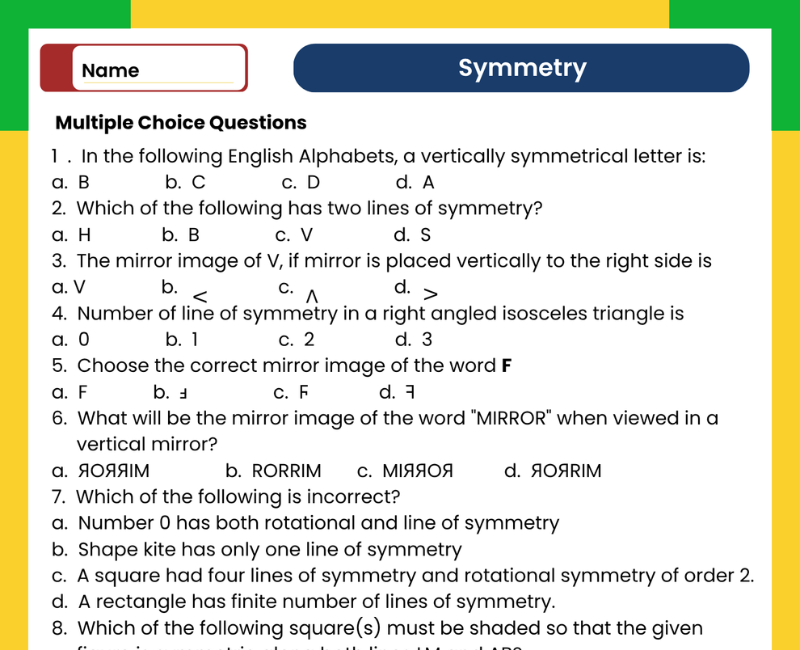
An unmarked square has four lines of symmetry: two through the midpoints of opposite sides and two along its diagonals. A non-square rectangle has two, through the midpoints of opposite sides. Its diagonals are not symmetry lines.
An equilateral triangle has three symmetry lines. An isosceles triangle that is not equilateral has one, and a scalene triangle has none. A circle has infinitely many symmetry lines because every line through its centre is one.
Always inspect the complete figure. Colouring, lettering or an extra mark can reduce the symmetry of an otherwise symmetrical outline.
Complete a Mirror Image on a Grid
To complete a figure across a given symmetry line, place each reflected point at the same perpendicular distance on the opposite side of the line. A point lying on the symmetry line remains in the same position.
If a corner lies three grid squares to the left of a vertical symmetry line, its reflected corner lies three squares to the right, in the same row. Repeat for the other corners and join the reflected points in the correct order.
Count distances from the symmetry line, not from the edge of the page. Check that both the outline and any internal details have been reflected.
Rotational Symmetry: Turn and Compare
A figure has rotational symmetry when a turn of less than 360° about a fixed centre makes it coincide with its starting position. Keep the centre fixed while imagining or tracing the turn.
An unmarked square matches after turns of 90°, 180°, 270° and 360°. A non-square rectangle matches after 180° and 360°, but not after 90°. Every figure returns to its starting position after a full turn; that alone does not show non-trivial rotational symmetry.
Order and Angle of Rotational Symmetry
The order of rotational symmetry counts matching positions during one full turn, including the match at 360° and excluding the initial position at 0°. A square has order 4, a non-square rectangle has order 2 and an equilateral triangle has order 3.
Smallest angle of rotation = 360° ÷ Order
For an unmarked regular hexagon:
360° ÷ 6 = 60°
A figure with only the full-turn match has order 1. A circle is a special case: it matches after a turn through any angle and has infinitely many rotational symmetries.
Reflection and Rotation Are Different Tests
Line symmetry checks a reflection; rotational symmetry checks a turn. A figure can have both, only one type or neither. An isosceles triangle that is not equilateral has a symmetry line but no rotational match before a full turn.
A suitably designed pinwheel can match after rotation without having any line of symmetry. Check the actual drawing because unequal blades, colours or other details can change the result. Do not assume that a figure with no symmetry line must also lack rotational symmetry.
Practise Symmetry Through Paper Activities
Fold a paper square and test its possible symmetry lines. Draw half a design on squared paper and complete its reflection. For rotation, trace a shape, mark its centre and turn the tracing while comparing it with the original.
These activities help students explain the matching process. Natural objects such as leaves or butterflies may show approximate symmetry, while mathematical diagrams are checked for exact matching. For alphabet questions, inspect the printed letter itself because symmetry depends on the font and shape.
How to Use the Class 6 Symmetry Worksheet
Read whether a question asks for a symmetry line, the number of lines, rotational order or the smallest rotation angle. Mark lines neatly with a ruler, show reflected points accurately and explain how you tested a rotational match.
Common errors include counting rectangle diagonals as symmetry lines, ignoring coloured details and counting both 0° and 360° as separate rotational matches. Attempt the questions first, then compare your method with the answers. Use this worksheet alongside the NCERT Ganita Prakash Chapter 9 exercises for regular revision.
More NCERT Class 6 Ganita Prakash Worksheets
Continue your practice with worksheets for the other nine chapters.
→ Chapter 1: Patterns in MathematicsView the Class 6 worksheet with answers. → Chapter 2: Lines and Angles
View the Class 6 worksheet with answers. → Chapter 3: Number Play
View the Class 6 worksheet with answers. → Chapter 4: Data Handling and Presentation
View the Class 6 worksheet with answers. → Chapter 5: Prime Time
View the Class 6 worksheet with answers. → Chapter 6: Perimeter and Area
View the Class 6 worksheet with answers. → Chapter 7: Fractions
View the Class 6 worksheet with answers. → Chapter 8: Playing with Constructions
View the Class 6 worksheet with answers. → Chapter 10: The Other Side of Zero
View the Class 6 worksheet with answers.
Symmetry Class 6 Frequently Asked Questions
1. Which chapter is Symmetry in NCERT Class 6 Maths?
Symmetry is Chapter 9 of the NCERT Class 6 Maths Ganita Prakash textbook. It explores line symmetry and rotational symmetry through figures and activities.
2. What is a line of symmetry?
It is a line across which reflection maps a figure onto itself. Folding along it makes corresponding parts overlap exactly.
3. How many lines of symmetry does a square have?
An unmarked square has four: two diagonals and two lines through the midpoints of opposite sides.
4. Are the diagonals of a rectangle lines of symmetry?
Not for a non-square rectangle. It has two symmetry lines through the midpoints of opposite sides. A square is the special case in which the diagonals are symmetry lines too.
5. How many lines of symmetry does a triangle have?
An equilateral triangle has three. A non-equilateral isosceles triangle has one. A scalene triangle has none.
6. What is rotational symmetry?
A figure has rotational symmetry when it matches its original position after a turn of less than 360° around a fixed centre.
7. What is the order of rotational symmetry of a square?
An unmarked square has order 4. It matches at 90°, 180°, 270° and 360° during one full turn.
8. How do I find the smallest angle of rotation?
For finite rotational order, divide 360° by the order. A figure of order 3 has smallest rotation angle 120°.
9. Can a figure have rotational symmetry but no line symmetry?
Yes. Some pinwheel designs have rotational symmetry without reflection symmetry. Check the full design, including its colours and details.
10. Does every figure have rotational symmetry?
Every figure matches after a full 360° turn. Figures with no smaller matching turn have order 1; they do not have non-trivial rotational symmetry.
11. How many lines of symmetry does a circle have?
An unmarked circle has infinitely many. Every line through its centre is a line of symmetry.
12. Can colours or letters change a figure's symmetry?
Yes. The complete figure must match after reflection or rotation. Different colours, an off-centre mark or lettering can remove symmetries present in the outline alone.
 Download