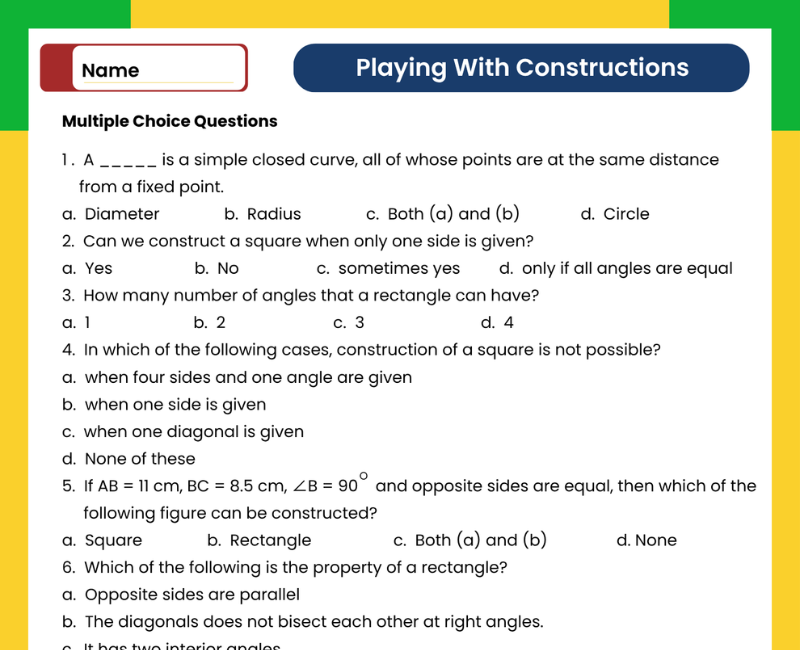
Playing with Constructions Class 6 Worksheet with Answers
Explore how careful measurements turn a drawing into an accurate geometric figure with this Playing with Constructions Class 6 worksheet with answers. Use this resource alongside NCERT Class 6 Maths Chapter 8 – Playing with Constructions in the Ganita Prakash textbook.
This chapter connects geometry with practical drawing. Students investigate circles, use a compass to draw arcs, construct squares and rectangles, and locate points using distance conditions. The revision examples below provide additional guidance for Class 6 Chapter 8 Maths practice. Keep your ruler, compass, pencil and protractor ready, and check each construction against its required properties.
Plan Your Construction Before Drawing
Begin by identifying the measurements and conditions given in the question. A rough sketch helps you decide which side to draw first, where a right angle is needed and which distance can be marked with a compass.
A ruler helps draw straight segments and measure lengths. A compass draws circles and arcs and transfers a fixed distance. A protractor helps mark or check angles when the question permits it. Use light pencil lines for supporting work and label points clearly. Follow any instrument restrictions stated in the question.
Circles, Centres and Radii
A circle consists of points at a fixed distance from a fixed point. The fixed point is its centre, and the fixed distance is its radius. A compass keeps this distance constant while its pencil moves around the centre.
- Mark a centre O.
- Set the compass opening to 3 cm using a ruler.
- Keep the compass point fixed at O and rotate the pencil to draw the circle.
- Mark any point P on the circle and check that OP measures 3 cm.
A point inside this circle is less than 3 cm from O, while a point outside it is more than 3 cm away. The diameter passes through the centre and has length twice the radius.
Use Arcs to Make Curved Designs
An arc is part of a circle. You do not always need to draw a complete circle when only a curved section or an intersection is required. Choosing a suitable centre and radius helps you create repeated curves accurately.
For a semicircle with a diameter of 6 cm, mark the midpoint of the diameter as the centre and use a radius of 3 cm. Keep the compass opening unchanged when drawing matching arcs. If two curves should be identical, check their radii and the positions of their centres rather than relying only on appearance.
Recognise Squares and Rectangles by Their Properties
A rectangle has four right angles and opposite sides equal. A square has four right angles and all four sides equal. These properties remain true when a figure is tilted or rotated.
Four equal sides alone do not guarantee a square: the angles must also be 90°. A square is a special rectangle because it satisfies the rectangle's properties and additionally has all sides equal. Check lengths and angles after constructing the figure.
Practise Constructing a Rectangle
Try constructing rectangle ABCD with length 6 cm and breadth 4 cm. The steps below describe a method using perpendicular lines; construct or mark the right angles with the instruments allowed in your task.
- Draw AB = 6 cm.
- Draw perpendicular rays to AB at A and B, on the same side of AB.
- Mark D on the ray at A so that AD = 4 cm.
- Mark C on the ray at B so that BC = 4 cm.
- Join C to D and check the completed rectangle.
Verify that AB = CD, AD = BC and all four angles are right angles. For a square, use the same length for each side. Record the construction steps so your method can be followed and checked.
Explore Diagonals and Distance Conditions
A diagonal joins opposite vertices. In rectangle ABCD, the diagonals are AC and BD. Both rectangles and squares have equal diagonals, and their diagonals bisect each other. A square's diagonals are also perpendicular; a rectangle's diagonals need not be perpendicular.
If a rectangle is specified by one side and a diagonal, both measurements help locate a missing vertex. For example, draw AB = 4 cm and a perpendicular ray at B. An arc centred at A with radius 6 cm intersects this ray at C. This gives BC perpendicular to AB and AC = 6 cm. Complete the rectangle using perpendicular lines through A and C, then check its properties.
Locate Points Equidistant from Two Given Points
Equidistant means at equal distances. Compass arcs help locate a point that must satisfy two distance conditions at once.
Draw PQ = 4 cm. With P as centre, draw an arc of radius 3 cm. With Q as centre, draw another arc of radius 3 cm to intersect the first at R. Join RP and RQ. Since R lies on both arcs, RP = RQ = 3 cm.
If arcs are drawn above and below PQ, there are two intersection points for these measurements. Choose the point that matches the position required by the question. Check both distances before completing the remaining figure.
How to Use the Chapter 8 Worksheet
Attempt each task independently before checking the answers. Keep useful construction arcs visible, label every required vertex and write a short sequence of steps. Avoid changing the compass opening when transferring an equal length.
Check measurements, angles and the required relationships. A figure that looks correct may still have unequal sides or an incorrect radius. Teachers can ask students to explain why an arc locates a particular point, while parents can encourage careful instrument use and a final measurement check.
Use this Playing with Constructions worksheet alongside the NCERT Class 6 Ganita Prakash Chapter 8 exercises. The examples on this page are supplementary revision activities to help students connect each drawing step with a geometric reason.
More NCERT Class 6 Ganita Prakash Worksheets
Explore worksheets for the other nine Class 6 Maths chapters.
→ Chapter 1: Patterns in MathematicsExplore number sequences and shape patterns. → Chapter 2: Lines and Angles
Revise rays, segments and angle measurement. → Chapter 3: Number Play
Explore digit sums, supercells and palindromes. → Chapter 4: Data Handling and Presentation
Organise information and interpret graphs. → Chapter 5: Prime Time
Practise factors, multiples and prime factorisation. → Chapter 6: Perimeter and Area
Calculate boundary lengths and areas. → Chapter 7: Fractions
Practise equivalent fractions, comparisons, addition and subtraction. → Chapter 9: Symmetry
Explore reflection and rotational symmetry. → Chapter 10: The Other Side of Zero
Understand positive and negative numbers.
Playing with Constructions Class 6 FAQs
1. Which chapter is Playing with Constructions in Class 6 Maths?
Playing with Constructions is Chapter 8 of the NCERT Class 6 Maths Ganita Prakash textbook. It explores geometric drawing, circles, squares, rectangles and distance-based constructions.
2. Which instruments are useful for construction practice?
A ruler, compass, pencil and protractor are useful. Follow the question's instructions about permitted instruments, especially if it specifies a ruler-and-compass construction.
3. What is the difference between a radius and a diameter?
A radius joins the centre to a point on the circle. A diameter joins two points on the circle and passes through its centre. The diameter is twice the radius.
4. What is an arc?
An arc is part of a circle. A compass can draw an arc using a fixed centre and radius without completing the whole circle.
5. How do I check whether my construction is a square?
Check that all four sides are equal and all four angles are 90°. Equal sides alone are not sufficient because a non-square rhombus also has four equal sides.
6. Is a square also a rectangle?
Yes. A square has four right angles and equal opposite sides, so it meets the definition of a rectangle. It additionally has all four sides equal.
7. Does rotating a square change its shape?
No. Rotating a square changes its orientation, but its side lengths and angles remain unchanged. It is still a square.
8. What is a diagonal of a rectangle?
A diagonal is a segment joining opposite vertices. A rectangle has two diagonals, which are equal in length and bisect each other.
9. Can I construct a rectangle using one side and a diagonal?
Yes, provided the diagonal is longer than the given side. Draw the side, construct a perpendicular at one endpoint and use a compass arc from the other endpoint to locate the opposite vertex at the required diagonal distance.
10. What does equidistant mean?
Equidistant means at equal distances. If RP = RQ, point R is equidistant from P and Q. Equal-radius arcs centred at P and Q can locate such points where the arcs intersect.
11. Why should I keep construction arcs visible?
Supporting arcs show how you located points and transferred distances. Draw them lightly and retain the useful ones so your construction method can be checked.
12. How should I use the worksheet answers?
Attempt each construction first. Then compare the steps and check the required lengths, angles and relationships. A correct figure may have a different orientation from the answer diagram.
 Download