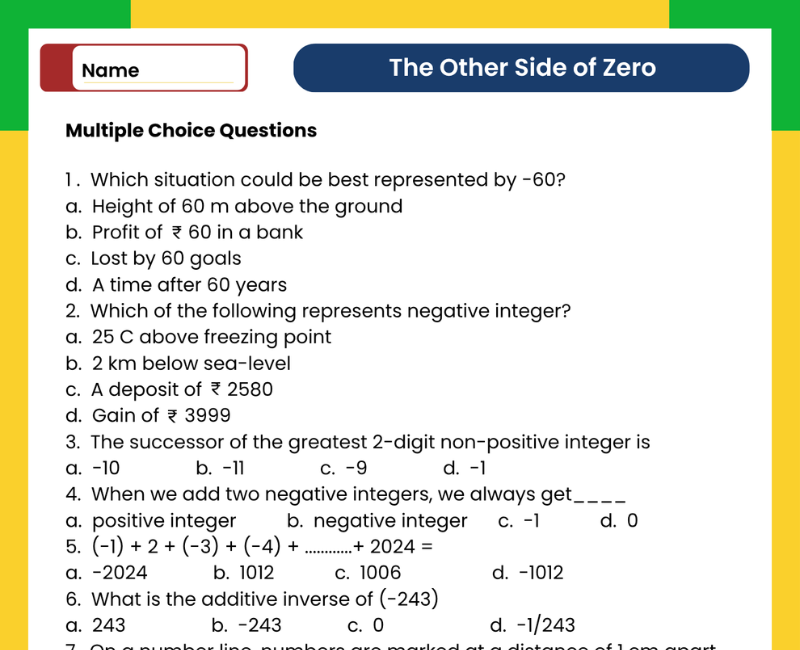
The Other Side of Zero Class 6 Worksheet with Answers
Discover how numbers extend below zero with The Other Side of Zero Class 6 worksheet with answers. Use this resource alongside NCERT Class 6 Maths Chapter 10 – The Other Side of Zero in the Ganita Prakash textbook to practise positive and negative integers, number-line comparisons, addition and subtraction.
Negative numbers help describe temperatures below zero, basement floors and positions below sea level. The revision examples below provide additional practice for Class 6 Chapter 10 Maths. Read each situation, identify the reference point and explain what the sign of the number means before calculating.
Integers: Numbers on Both Sides of Zero
Integers include negative whole numbers, zero and positive whole numbers: …, −3, −2, −1, 0, 1, 2, 3, …. Positive integers are greater than zero, while negative integers are less than zero. Zero is neither positive nor negative.
Fractions such as 1/2 are not integers. A positive integer may be written with or without a plus sign: +5 and 5 mean the same number. For negative integers, retain the minus sign because −5 and 5 represent different values.
Locate and Compare Integers on a Number Line
On a standard horizontal number line, values increase as you move right and decrease as you move left. Positive integers lie to the right of zero and negative integers to its left. Use equal intervals between consecutive integers.
−2 > −7 because −2 lies farther to the right.
−4 < 0 because −4 lies to the left of zero.
Ascending order: −6, −1, 0, 3, 8.
Do not compare negative integers by ignoring their signs. Although 7 is greater than 2, −7 is smaller than −2.
Opposite Integers and Additive Inverses
Opposite integers lie at equal distances from zero on opposite sides of the number line. For example, 6 and −6 are opposites, and each is six units from zero.
The opposite of an integer is also called its additive inverse because adding the two gives zero: 6 + (−6) = 0. Zero is its own additive inverse. Distance from zero is non-negative: −8 is eight units away, not “minus eight units” away.
Add Integers Using Movement
For addition on a number line, start at the first integer. Adding a positive integer means moving right; adding a negative integer means moving left. The destination gives the sum.
−3 + 5 = 2
Start at −3 and move five units right.
4 + (−6) = −2
Start at 4 and move six units left.
When both integers are negative, the result is negative: −4 + (−3) = −7. Adding opposite integers gives zero. Use movement or a model to understand these results rather than memorising signs without context.
Subtract Integers by Adding the Opposite
Subtracting an integer is equivalent to adding its additive inverse. Keep the first number unchanged and replace the subtraction with addition of the opposite of the second number.
3 − (−4)
= 3 + 4
= 7
−2 − 5
= −2 + (−5)
= −7
Brackets make negative numbers easier to read. In 3 − (−4), the first minus sign indicates subtraction and the second belongs to the negative number −4.
Understand Zero Pairs with Tokens
Use two types of counters to represent +1 and −1. One positive counter and one negative counter form a zero pair because their combined value is zero.
For +3 + (−5), combine three positive counters with five negative counters. Cancel three zero pairs; two negative counters remain, giving −2. Adding or removing a complete zero pair does not change a collection's value. This model helps explain why subtracting a negative quantity can increase the result.
Apply Integers to Temperatures and Floors
If the ground floor is labelled 0, a basement level can be represented by −1 and a floor above ground by +1. Starting at floor −2 and moving up five floors gives −2 + 5 = 3, so the destination is floor 3.
If the temperature is −4°C and rises by 7°C, the new temperature is 3°C. If it then falls by 5°C, it becomes −2°C. Identify whether the situation describes a position, a change or a difference. The distance between −4 and 3 on a number line is seven units, while the change from 3 to −4 is −7.
How to Practise NCERT Class 6 Maths Chapter 10
Attempt the worksheet before checking the answers. Draw a number line when needed, show intermediate steps and retain brackets around negative integers in calculations. For word problems, state the reference level and include units such as °C or metres.
Check common mistakes: reversing the order of negative integers, dropping a minus sign, treating zero as positive and assuming subtraction always makes a number smaller. Subtracting −3 actually adds 3.
Teachers and parents can use labelled floor diagrams or positive and negative counters for revision. Use this worksheet alongside the NCERT Class 6 Ganita Prakash Chapter 10 exercises. The examples on this page are supplementary activities for understanding integer operations.
More NCERT Class 6 Ganita Prakash Worksheets
Continue your revision with worksheets for the other nine chapters.
→ Chapter 1: Patterns in MathematicsView the Class 6 worksheet with answers. → Chapter 2: Lines and Angles
View the Class 6 worksheet with answers. → Chapter 3: Number Play
View the Class 6 worksheet with answers. → Chapter 4: Data Handling and Presentation
View the Class 6 worksheet with answers. → Chapter 5: Prime Time
View the Class 6 worksheet with answers. → Chapter 6: Perimeter and Area
View the Class 6 worksheet with answers. → Chapter 7: Fractions
View the Class 6 worksheet with answers. → Chapter 8: Playing with Constructions
View the Class 6 worksheet with answers. → Chapter 9: Symmetry
View the Class 6 worksheet with answers.
The Other Side of Zero Class 6 FAQs
1. Which chapter is The Other Side of Zero in NCERT Class 6 Maths?
It is Chapter 10 of the NCERT Class 6 Maths Ganita Prakash textbook. The chapter introduces negative numbers and develops understanding of integers and their operations.
2. What are integers?
Integers include negative whole numbers, zero and positive whole numbers. Examples are −9, −1, 0, 4 and 12. The fraction 1/2 is not an integer.
3. Is zero positive or negative?
Zero is neither positive nor negative. It separates positive and negative integers on the number line.
4. Which is greater: −3 or −8?
−3 is greater because it lies to the right of −8 on the number line. Among negative integers, the one nearer zero is greater.
5. What is the smallest negative integer?
There is no smallest negative integer. For any negative integer, subtracting 1 gives an even smaller integer. The greatest negative integer is −1.
6. What is the additive inverse of an integer?
It is the number that gives zero when added to the original integer. The additive inverse of −7 is 7, and the additive inverse of 0 is 0.
7. How do I add two negative integers?
Add their distances from zero and give the result a negative sign. For example, −5 + (−4) = −9. On a number line, start at −5 and move four units left.
8. How do I add a positive integer and a negative integer?
Find the difference between their distances from zero and use the sign of the integer farther from zero. For example, 8 + (−11) = −3. Equal opposite integers sum to zero.
9. Why does subtracting a negative integer increase the result?
Subtracting a number means adding its opposite. Therefore, 2 − (−5) becomes 2 + 5 = 7.
10. What is a zero pair in the token model?
A zero pair consists of one +1 token and one −1 token. Their total is zero, so adding or removing a complete pair does not change the value.
11. Does subtraction of integers always give a smaller number?
No. Subtracting a positive integer decreases the value, subtracting a negative integer increases it, and subtracting zero leaves it unchanged.
12. How do I find the distance between two integers?
Subtract the smaller integer from the larger. The distance between −5 and 2 is 2 − (−5) = 7 units. Distance is non-negative.
13. Where are negative numbers used in everyday life?
They can describe temperatures below zero, positions below sea level and basement floors when ground level is zero. A negative sign indicates the direction or position relative to the chosen reference.
 Download