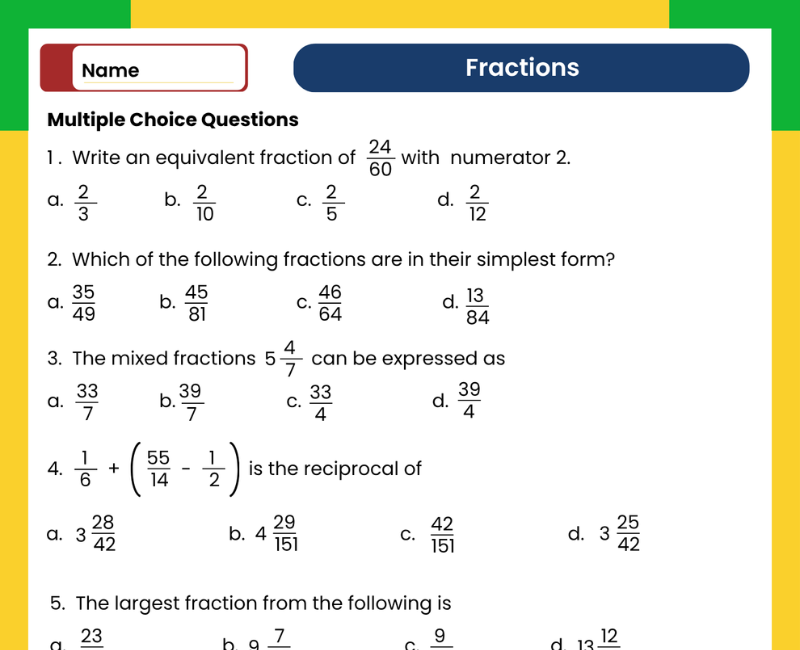
Fractions Class 6 Worksheet with Answers
Build a clear understanding of fractional quantities with this Fractions Class 6 worksheet with answers. Use this practice resource alongside NCERT Class 6 Maths Chapter 7 – Fractions in the Ganita Prakash textbook. Practise recognising equal parts, understanding fractional units, comparing fractions and working with addition and subtraction.
Fractions appear in sharing food, measuring lengths and describing parts of a collection. The examples below provide additional revision for students studying Class 6 Chapter 7 Maths. Read the explanation, attempt each example independently and then use the worksheet answers to review your method.
Understand the Whole and Its Equal Parts
A fraction describes a quantity in relation to a chosen whole. If a strip is divided into five equal parts, each part is 1/5 of the strip. Three such parts represent 3/5. Equal-sized parts are essential when interpreting a fraction model.
In 3/5, the denominator 5 identifies the number of equal parts in one whole, while the numerator 3 counts how many of those parts are taken. Before comparing shaded diagrams, check that the wholes are the same size. Half of a large sheet need not have the same area as half of a small sheet.
Unit Fractions, Proper Fractions and Mixed Numbers
A unit fraction has numerator 1, such as 1/3 or 1/8. For the same whole, dividing it into more equal parts makes each part smaller, so 1/8 is less than 1/3.
A proper fraction, such as 4/7, has a numerator smaller than its denominator and represents less than one whole. An improper fraction, such as 9/4, has a numerator greater than or equal to its denominator. A mixed number combines a whole number and a proper fraction.
9/4 = 8/4 + 1/4
9/4 = 2 + 1/4
9/4 = 2¼
To convert 2¼ back to an improper fraction, calculate 2 × 4 + 1 = 9 and retain the denominator 4.
Fractions on a Number Line
A fraction is a number with a definite position on the number line. To locate 3/4, divide the interval from 0 to 1 into four equal intervals and count three intervals from zero. Count the spaces between marks rather than counting the marks themselves.
Fractions can also lie beyond 1. The number 5/4 is one quarter beyond 1, so its position is the same as 1¼. Number lines help students connect fraction notation with magnitude and recognise equivalent fractions as the same point.
Equivalent Fractions and Simplest Form
Equivalent fractions have the same value even though their numerators and denominators differ. Multiply or divide both the numerator and denominator by the same non-zero number to obtain an equivalent fraction.
2/3 = 4/6 = 8/12
12/18 = 2/3, after dividing both numbers by 6.
A fraction is in simplest form when the numerator and denominator have no common factor greater than 1. Changing only the numerator or only the denominator usually changes the value, so apply the operation to both.
Comparing and Ordering Fractions
For fractions with the same denominator, compare the numerators: 5/9 > 2/9. The parts have the same size, and five parts are more than two.
For positive fractions with the same numerator, the fraction with the smaller denominator is greater: 3/4 > 3/7. Each quarter is larger than each seventh of the same whole.
For unlike fractions, use equivalent fractions with a common denominator. To compare 2/3 and 3/4, write 2/3 = 8/12 and 3/4 = 9/12. Therefore, 2/3 < 3/4. Use the same method to arrange a group of fractions in ascending or descending order.
Adding and Subtracting Fractions
When fractional units are the same, add or subtract the numerators and keep the denominator unchanged. For example, 2/7 + 3/7 = 5/7. Seven identifies the size of the parts; the calculation combines two sevenths and three sevenths.
For unlike denominators, first rewrite the fractions using a common denominator. Do not add the denominators.
1/3 + 1/4
= 4/12 + 3/12
= 7/12
5/6 − 1/4
= 10/12 − 3/12
= 7/12
Apply Fractions to Everyday Problems
Read a word problem carefully and identify the whole, the units and the operation needed. If a ribbon measures 3/4 metre and 1/4 metre is cut off, the remaining length is 3/4 − 1/4 = 1/2 metre.
For parts of a collection, equal groups can help. If 12 counters are shared into four equal groups, each group contains three counters. Therefore, 1/4 of the collection is 3 counters. Draw a strip, group objects or use a number line when a problem is difficult to visualise.
How to Use the Class 6 Fractions Worksheet
Attempt the questions before looking at the answers. Show equivalent fractions when using a common denominator, write calculations on separate lines and simplify the final fraction where appropriate. For measurement problems, include the unit.
Check common errors: unequal parts in diagrams, counting number-line marks instead of intervals, adding denominators and changing only one part of a fraction when making an equivalent fraction. Explain why your answer is reasonable—for example, adding two positive quantities should give more than either quantity alone.
Teachers can use paper strips and fraction walls for visual practice. Parents can encourage students to describe the meaning of each fraction rather than memorising rules alone. Use this worksheet alongside the NCERT Ganita Prakash Chapter 7 exercises for regular revision.
More NCERT Class 6 Ganita Prakash Worksheets
Continue your revision with worksheets for the other nine chapters.
→ Chapter 1: Patterns in MathematicsExplore number sequences and shape patterns. → Chapter 2: Lines and Angles
Practise lines, rays, segments and angle measurement. → Chapter 3: Number Play
Explore digit sums, supercells and palindromic numbers. → Chapter 4: Data Handling and Presentation
Organise data and interpret pictographs and bar graphs. → Chapter 5: Prime Time
Practise factors, multiples and prime factorisation. → Chapter 6: Perimeter and Area
Calculate boundary lengths and areas of squares and rectangles. → Chapter 8: Playing with Constructions
Develop geometric construction skills. → Chapter 9: Symmetry
Explore reflection and rotational symmetry. → Chapter 10: The Other Side of Zero
Understand positive and negative numbers.
Fractions Class 6 Frequently Asked Questions
1. Which chapter is Fractions in NCERT Class 6 Maths?
Fractions is Chapter 7 of the NCERT Ganita Prakash Class 6 Mathematics textbook. It develops understanding of fractional quantities, equivalence, comparison, addition and subtraction.
2. What are the numerator and denominator of a fraction?
The denominator identifies how many equal parts make one whole, and the numerator counts how many such parts are taken. In 4/9, the numerator is 4 and the denominator is 9.
3. What is a unit fraction?
A unit fraction has numerator 1, such as 1/2, 1/5 or 1/12. It represents one fractional unit of the chosen whole.
4. What is the difference between proper and improper fractions?
A proper fraction has a numerator smaller than its denominator. An improper fraction has a numerator greater than or equal to its denominator. Examples are 3/5 and 7/5 respectively.
5. How do I convert a mixed number into an improper fraction?
Multiply the whole number by the denominator, add the numerator and keep the denominator. For 3⅖, calculate 3 × 5 + 2 = 17, giving 17/5.
6. How do I find equivalent fractions?
Multiply or divide the numerator and denominator by the same non-zero number. For example, multiplying both parts of 3/4 by 2 gives 6/8.
7. How do I simplify a fraction?
Divide the numerator and denominator by their highest common factor. For 15/20, divide both by 5 to obtain 3/4.
8. How can I compare fractions with different denominators?
Rewrite them as equivalent fractions with a common denominator, then compare the numerators. For example, 3/5 = 9/15 and 2/3 = 10/15, so 3/5 is smaller.
9. Why do we need a common denominator when adding fractions?
A common denominator makes the fractional units the same size. Once the units match, their counts can be added or subtracted.
10. Do we add denominators when adding fractions?
No. For like fractions, add the numerators and retain the common denominator. Thus, 1/5 + 2/5 = 3/5, not 3/10.
11. How do I show a fraction on a number line?
Divide each whole-number interval into the number of equal parts given by the denominator. Starting at zero, count the number of intervals given by the numerator.
12. How should I check my Fractions worksheet answers?
Compare the method as well as the final answer. Check equivalent fractions, arithmetic, simplest form and units. Different-looking fractions can still be equivalent, so simplify before deciding an answer is incorrect.
 Download