Class 6 Mathematics • Ganita Prakash • Chapter 5
Prime Time Class 6 Worksheet with Answers
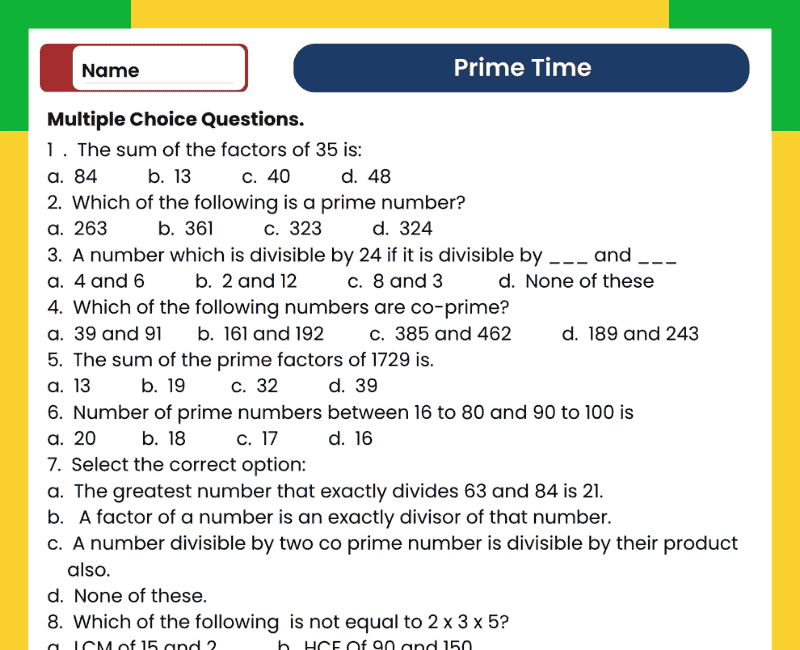
Practise the relationships between numbers with the Prime Time Class 6 worksheet with answers from WitKnowLearn. This resource supports revision of prime and composite numbers, factors, multiples and the reasoning used to compare numbers. Use it alongside the Prime Time chapter in the NCERT Ganita Prakash textbook.
Before attempting a question, identify what it asks: factors, multiples, prime factors or a divisibility check. Write your reasoning clearly, attempt the work independently and then compare your response with the provided answers. The revision examples below offer additional guidance.
What Do Students Learn in Prime Time?
Prime Time explores how whole numbers can be grouped, divided and expressed as products. It connects common factors and common multiples with prime numbers, co-prime numbers, prime factorisation and divisibility tests. Understanding these ideas helps students explain why a number divides another exactly.
- Identify factors and multiples of a given number.
- Find common factors and common multiples.
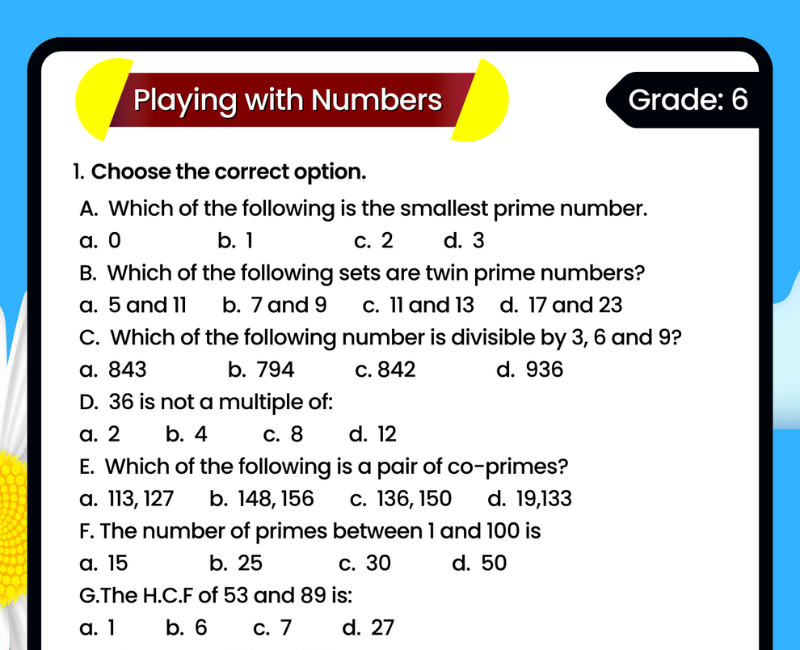
- Distinguish prime numbers from composite numbers.
- Check whether two numbers are co-prime.
- Express a number as a product of prime factors.
- Use divisibility tests to make efficient number checks.
Factors and Multiples: Know the Difference
A factor divides a number exactly, leaving no remainder. A multiple is obtained by multiplying that number by a whole number. Keeping these meanings separate makes Prime Time questions easier to interpret.
Factors of 12: 1, 2, 3, 4, 6 and 12.
First five positive multiples of 12: 12, 24, 36, 48 and 60.
When listing factors, use pairs such as 1 × 12, 2 × 6 and 3 × 4. When listing multiples, continue multiplying by 1, 2, 3 and so on. A positive whole number has finitely many positive factors but infinitely many positive multiples.
Prime and Composite Numbers
A prime number is a whole number greater than 1 with exactly two positive factors: 1 and itself. A composite number is a whole number greater than 1 with more than two positive factors.
Prime example: 13 has only the factors 1 and 13, so it is prime.
Composite example: 15 has the factors 1, 3, 5 and 15, so it is composite.
Remember that 1 is neither prime nor composite. Also, 2 is the only even prime number. Being odd does not automatically make a number prime: 9, 15 and 21 are odd composite numbers.
Common Factors and Co-Prime Numbers
Common factors divide both numbers exactly. Two positive integers are co-prime when their only common positive factor is 1. Check the complete factor lists or compare their prime factorisations before deciding.
Consider 8 and 15:
Factors of 8: 1, 2, 4 and 8.
Factors of 15: 1, 3, 5 and 15.
Their only common factor is 1, so 8 and 15 are co-prime.
Co-prime numbers do not have to be prime individually. In this example, both 8 and 15 are composite. This distinction is useful when explaining answers in Class 6 Prime Time practice.
Prime Factorisation: Break Numbers into Prime Factors
Prime factorisation expresses a whole number greater than 1 as a product of primes. Use a factor tree or repeated division, continuing until every factor in the final product is prime.
Example: prime factorisation of 60
60 = 6 × 10
60 = 2 × 3 × 2 × 5
60 = 2² × 3 × 5
Multiply the final factors to check that they reproduce the original number. Do not stop at 6 × 10, because 6 and 10 are composite. Keep repeated prime factors: removing one of the two factors of 2 changes the product.
Divisibility Tests for Quick Revision
Divisibility tests help students check whether a number can be divided exactly without performing the full division. Practise applying the rule and stating the evidence for your answer.
- By 2: the last digit is 0, 2, 4, 6 or 8.
- By 4: the number formed by the last two digits is divisible by 4.
- By 5: the last digit is 0 or 5.
- By 8: the number formed by the last three digits is divisible by 8.
- By 10: the last digit is 0.
For example, 316 is divisible by 4 because its last two digits form 16, which is divisible by 4. Writing this explanation shows how the test was used.
How to Practise with the Worksheet and Answers
Use the worksheet preview and the download option on this page to access the resource. Read each instruction carefully and show factor lists, multiplication checks or prime-factor working wherever needed.
- Revise the meaning of the concept before starting.
- Attempt a manageable group of questions independently.
- Compare your responses with the provided answers.
- Identify the reason for an incorrect response.
- Correct the working and try a similar example.
Teachers can use selected questions for classroom practice or revision. Parents can ask students to explain why a number is prime or how they found a common factor. A clear explanation is more useful than guessing the answer from its appearance.
Explore All Other Class 6 Ganita Prakash Worksheets
Continue your revision with chapter-wise Class 6 Maths worksheets from WitKnowLearn. Select a chapter below to open its worksheet page.
→ Chapter 1: Patterns in MathematicsExplore number sequences, shape patterns and the rules that connect them. → Chapter 2: Lines and Angles
Revise points, lines, rays, line segments and different types of angles. → Chapter 3: Number Play
Explore number arrangements, digit patterns and mathematical reasoning. → Chapter 4: Data Handling and Presentation
Practise organising information and interpreting pictographs and bar graphs. → Chapter 6: Perimeter and Area
Work with boundary lengths and the areas of squares, rectangles and other simple figures. → Chapter 7: Fractions
Practise representing, comparing and working with fractions. → Chapter 8: Playing with Constructions
Explore geometric drawing using a ruler and compass. → Chapter 9: Symmetry
Investigate lines of symmetry and rotational symmetry in figures. → Chapter 10: The Other Side of Zero
Explore positive and negative numbers through number lines and everyday situations.
Frequently Asked Questions
What is Prime Time in Class 6 Maths?
Prime Time is Chapter 5 in Ganita Prakash. It covers factors, multiples, prime and composite numbers, co-prime numbers, prime factorisation and divisibility tests.
Is 1 a prime number?
No. A prime number has exactly two positive factors. The number 1 has only one, so it is neither prime nor composite.
Why is 2 the only even prime number?
Its only positive factors are 1 and 2. Every even number greater than 2 also has 2 as a factor, making it composite.
What is the difference between factors and multiples?
A factor divides a number exactly. A multiple is obtained by multiplying the number by a whole number. For example, 3 is a factor of 12, and 12 is a multiple of 3.
Can two composite numbers be co-prime?
Yes. For example, 8 and 15 are composite, but their only common positive factor is 1, so they are co-prime.
What is prime factorisation?
It expresses a whole number greater than 1 as a product of prime numbers. For example, 30 = 2 × 3 × 5.
Are all odd numbers prime?
No. Odd numbers such as 9, 15 and 21 are composite because they have factors other than 1 and themselves.
How should I use the worksheet answers?
Attempt the questions first, then check your responses. For an incorrect answer, review the definition or calculation, correct your working and practise again.
 Download