Class 6 Mathematics • Ganita Prakash • Chapter 6
Perimeter and Area Class 6 Worksheet with Answers
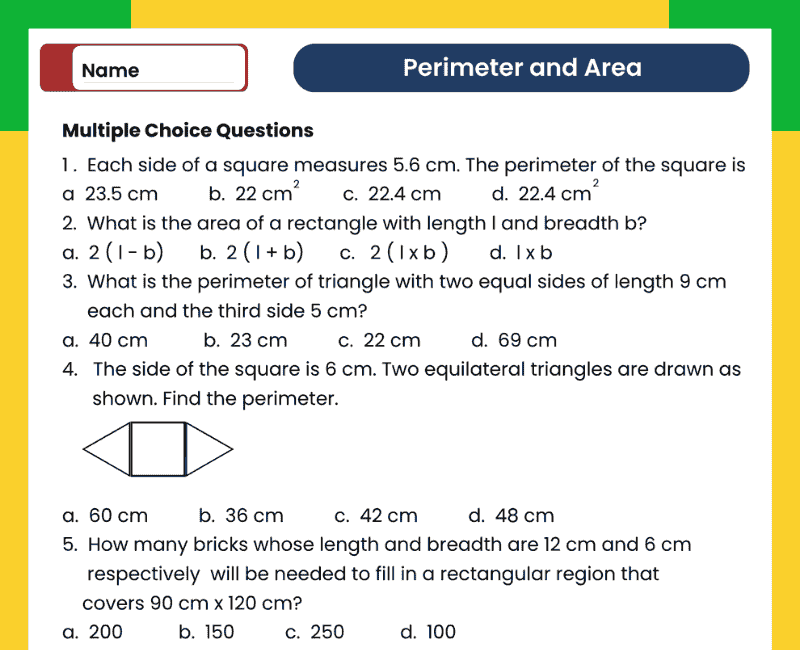
Understand the difference between measuring a boundary and measuring a surface with the Perimeter and Area Class 6 worksheet with answers from WitKnowLearn. Use this resource alongside Chapter 6 of the NCERT Ganita Prakash textbook for practice and revision.
Before choosing a formula, decide what the question asks. Is it the distance around a shape, or the space inside it? This simple check helps students select the correct method, show clear working and write the answer with suitable units.
What Is the Difference Between Perimeter and Area?
Perimeter is the total length of the boundary of a closed figure. Area measures the surface enclosed by that boundary. A shape can have a long boundary without covering a large surface, so these measurements should not be confused.
Think about a garden: the length of fencing needed around it relates to perimeter.
The amount of ground covered by the garden relates to area.
Perimeter is written in length units such as centimetres or metres. Area is written in square units such as square centimetres or square metres: cm² or m².
Perimeter of Squares, Rectangles and Other Polygons
To find the perimeter of a polygon, add the lengths of all its sides. For a square, all four sides are equal. For a rectangle, opposite sides are equal, allowing a shorter calculation.
Square: Perimeter = 4 × side
Rectangle: Perimeter = 2 × (length + breadth)
Other polygons: Perimeter = sum of all side lengths
For an irregular figure, follow the boundary carefully and include each outside side once. Do not add an internal line unless it forms part of the boundary being measured. Marking the sides as you count can help avoid omissions.
Area of Squares and Rectangles
Area can be understood by counting equal unit squares that cover a surface without gaps or overlaps. In a rectangle, the squares form rows and columns. Multiplying the length by the breadth gives the total area when both measurements use the same unit.
Rectangle: Area = length × breadth
Square: Area = side × side
A rectangle measuring 7 cm by 3 cm covers 21 square centimetres. Writing 21 cm would describe a length, so the correct area unit is cm².
Worked Example: One Rectangle, Two Measurements
Consider a rectangle with a length of 9 cm and a breadth of 4 cm. Its perimeter and area require different calculations because they measure different things.
Finding the perimeter:
Perimeter = 2 × (length + breadth)
Perimeter = 2 × (9 + 4)
Perimeter = 2 × 13
Perimeter = 26 cm
Finding the area:
Area = length × breadth
Area = 9 × 4
Area = 36 cm²
These examples are additional revision support. Use the same habit of writing the formula, substituting the measurements and checking the unit when attempting the worksheet.
Can Shapes Have the Same Perimeter but Different Areas?
Yes. Comparing shapes helps students understand why perimeter and area must be considered separately. Equal boundary lengths do not always enclose equal areas.
Rectangle A: 6 cm × 4 cm
Perimeter = 20 cm
Area = 24 cm²
Rectangle B: 8 cm × 2 cm
Perimeter = 20 cm
Area = 16 cm²
Both rectangles have a perimeter of 20 cm, but their areas are different. Drawing them on squared paper makes the comparison easier to see.
Common Mistakes to Avoid
- Using the wrong formula: identify whether the problem asks for a boundary length or a surface measurement.
- Forgetting two sides of a rectangle: length + breadth alone is only half its perimeter.
- Mixing measurement units: express the given lengths in the same unit before calculating.
- Writing a length unit for area: use cm² or m² where appropriate.
- Counting internal edges: for perimeter, follow the outside boundary of the figure specified in the question.
How to Use the Worksheet with Answers
Open the worksheet preview and use the download option on this page, following its access instructions. Read the question carefully, note the measurements and decide which calculation is needed.
- Write the given measurements with their units.
- Choose the perimeter or area formula.
- Substitute the values and show each calculation.
- Write the final answer with the correct unit.
- Compare your response with the provided answer.
Teachers can select questions for classwork or revision. Parents can ask students to explain the difference between a fence around a field and the surface of the field. When an answer is incorrect, review the choice of formula and units as well as the arithmetic.
Explore All Other Class 6 Ganita Prakash Worksheets
Continue your revision with these chapter-wise Class 6 Maths worksheets from WitKnowLearn. Select a chapter to open its worksheet page.
→ Chapter 1: Patterns in MathematicsExplore number sequences, shape patterns and the rules that connect them. → Chapter 2: Lines and Angles
Revise points, lines, rays, line segments and types of angles. → Chapter 3: Number Play
Explore number arrangements, digit patterns and mathematical reasoning. → Chapter 4: Data Handling and Presentation
Practise organising information and interpreting pictographs and bar graphs. → Chapter 5: Prime Time
Revise factors, multiples, prime numbers and prime factorisation. → Chapter 7: Fractions
Practise representing, comparing and working with fractions. → Chapter 8: Playing with Constructions
Explore geometric drawing using a ruler and compass. → Chapter 9: Symmetry
Investigate lines of symmetry and rotational symmetry in figures. → Chapter 10: The Other Side of Zero
Explore positive and negative numbers through number lines and everyday situations.
Frequently Asked Questions
What is the difference between perimeter and area?
Perimeter is the length of a closed figure's boundary. Area measures the surface enclosed by that boundary.
What is the perimeter formula for a rectangle?
Perimeter = 2 × (length + breadth). This adds the lengths of all four sides.
How do you find the area of a rectangle?
Multiply its length by its breadth, using the same unit for both measurements. Write the result in square units.
What are the perimeter and area formulas for a square?
Perimeter = 4 × side. Area = side × side.
Why is area measured in square units?
Area measures how many unit squares cover a surface. A square with sides of 1 cm has an area of 1 cm².
Can two shapes have the same perimeter but different areas?
Yes. Rectangles measuring 6 cm × 4 cm and 8 cm × 2 cm both have a perimeter of 20 cm. Their areas are 24 cm² and 16 cm² respectively.
How do you find the perimeter of an irregular polygon?
Add the lengths of all sides along its boundary. Include each boundary side once.
How should students use the worksheet answers?
Attempt the questions first, then compare the answers. Check the formula, calculations and units before correcting any mistakes.
 Download