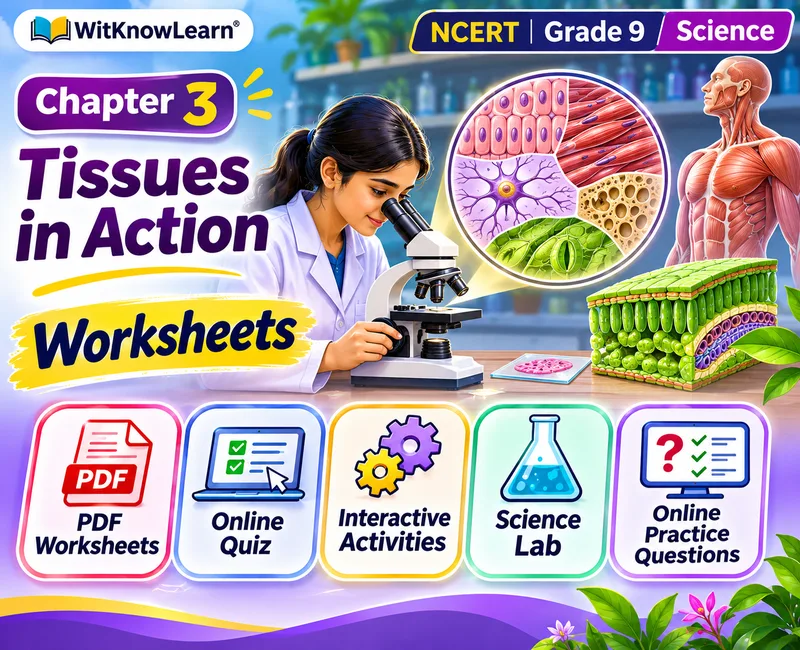
Class 9 Science · NCERT Exploration · Chapter 3
Tissues in Action Class 9 Worksheet with Online Quiz, Games and Activities
Why does a pruned plant turn bushy, and what pulls your forearm up when you bend your elbow? Find out with this Tissues in Action worksheet for Class 9 Science, NCERT Exploration Chapter 3: take the Tissues in Action Class 9 online quiz, run three experiments in the Virtual Lab and play the activities and interactive games online.
Flip the cards and try the Tissue Response Lab, then tap the Games, Labs, Challenges or Virtual Lab island.
Tissues in Action Class 9 Online Quiz
20 questions · tap an answer to move on · full review at the end
Flip the cards, try the Tissue Response Lab, then play the games, do the labs and take the challenges. Earn up to 3 stars in every activity.
Fact cards: tap a card to flip it
Tissue Response Lab
Three real-life cases depend on how tissues work. In each one, predict which choice will work, drag it onto the picture and watch what happens. A wrong choice shows what goes wrong, so you can try again.
Challenge marks: 0 / 15 (0 of 5 challenges done)
Finish all 5 challenges to see your comment.
Virtual Lab: do real experiments step by step
Practice sheet
Tissues in Action Class 9 Activities
Predict results in the Tissue Response Lab, bend an elbow in the lever lab, match joints and trace water up a stem in the Virtual Lab. Earn up to 3 stars in every activity.
From one cell to a working body
"Tissues in Action" is Chapter 3 of the new NCERT Class 9 Science textbook Exploration. Every multicellular life starts as one cell that divides again and again. Slowly the new cells form skin for protection, muscles for movement, bones for support and nerves for control. The chapter calls this one of nature’s greatest engineering marvels. Cells of a similar kind that work together for one job form a tissue. Tissues build organs, organs build organ systems and organ systems make the organism. An amoeba does everything inside a single cell, but in a large body the work is shared. This division of labour makes the body efficient enough to carry out complex life processes.
Why plant and animal tissues differ
Most plants stay rooted in one place. Their cell walls make them rigid, they make their own food by photosynthesis and many of their parts keep growing all their lives. Animals move around, their cells have no walls and they digest food taken from outside. These different lifestyles explain why plants and animals have different tissues.
Meristems: the growth zones of plants
Plants grow wherever they have meristematic tissue, made of small cells with thin walls, a large nucleus, dense cytoplasm, no vacuoles and almost no spaces between them. The apical meristem at root and shoot tips adds length; cutting off a root tip stops that root from growing longer. The lateral meristem, a ring of dividing cells in dicot stems, adds girth and leaves behind the annual rings we count to find a tree’s age. The intercalary meristem at the base of internodes lets grass and hedges grow back after they are cut. As new cells lose the ability to divide and take up a special job, they become permanent tissue through differentiation.
Permanent tissues in plants
- Epidermis is a single layer of tightly packed cells covered by a waxy cuticle of cutin. It carries root hairs for absorption and stomata for gas exchange and transpiration. In older trees, cork cambium forms the dead, waterproof cork of the bark.
- Parenchyma is living and thin-walled. It stores food, makes food in green parts and forms air spaces in aquatic plants.
- Collenchyma has corners thickened with pectin, which gives flexible support to young stems and tendrils.
- Sclerenchyma has thick walls hardened with lignin. Most of its cells are dead, and it forms the hard parts of nuts, seed coats and husks.
- Xylem (tracheids, vessels, xylem parenchyma and fibres) carries water and minerals upward. Phloem (sieve tubes, companion cells, phloem parenchyma and fibres) carries food. Because each is built from several cell types, they are called complex permanent tissues.
All these tissues are grouped into three tissue systems: dermal, ground and vascular.
The four animal tissues
Epithelial tissue covers the body and lines organs, with its closely packed cells shaped for exchange, protection, secretion, sensing or absorption. Connective tissue joins and supports the body. Blood has a fluid matrix with RBCs, WBCs and platelets in plasma; bone has a hard matrix of calcium and phosphorus; cartilage is soft and cushioning; tendons link muscle to bone and ligaments link bone to bone. Muscular tissue comes in three types. Skeletal muscle is striated and voluntary, smooth muscle is spindle-shaped and involuntary, and cardiac muscle is branched and never tires. Nervous tissue is made of neurons. Dendrites receive a signal, the cell body processes it and the axon carries it on to other cells.
Bones, joints and movement
Together, bones, muscles, joints, cartilage, tendons and ligaments make the musculoskeletal system, which the nervous system controls. A muscle contracts, its tendon pulls a bone and the bone moves at a joint. The shoulder is a ball and socket joint, the elbow and knee are hinge joints, the neck turns on a pivot joint and the skull bones are held by fixed joints. The backbone is a column of vertebrae cushioned by cartilage discs. Twelve pairs of ribs form a flexible cage that protects the heart and lungs and moves with every breath.
Tissues and human welfare
In 1958 F. C. Steward grew whole carrot plants from single phloem cells, which showed that plant cells can be totipotent. Sipra Guha Mukherjee and S. C. Maheshwari produced complete plants by anther culture. Stem cells in bone marrow help treat leukaemia and thalassaemia. The crown gall bacterium, Agrobacterium, is now used to put useful genes into crops. Yoga, good posture and good food keep our own tissues healthy.
This Tissues in Action worksheet for Class 9 Science turns the chapter into active learning on WitKnowLearn with an online quiz, online activities and interactive games. Flip the fact cards, predict results in the Tissue Response Lab, play the games, do the tissue labs, take the challenges and then try the stem, leaf and bone experiments in the Virtual Lab.
Tissues in Action Class 9 Science Guide
Tissues in Action is Chapter 3 of the NCERT Class 9 Science textbook Exploration. It explains the levels of organisation and the division of labour, meristematic and permanent tissues in plants, the four types of animal tissues, and the musculoskeletal and skeletal systems with their joints. This guide explains each idea clearly for Class 9 students, parents and teachers. It goes with the Tissues in Action Class 9 worksheet on WitKnowLearn, which also has an online quiz, online activities, interactive games and a Virtual Lab on the same page.
What is there in this chapter
- Levels of organisation and the division of labour
- Why plant and animal tissues differ
- Apical, lateral and intercalary meristems
- Protective, supporting and conducting permanent tissues
- Epithelial, connective, muscular and nervous tissues
- Musculoskeletal system, joints, backbone and rib cage
- Totipotency, tissue culture and Agrobacterium
Learning objectives
- Relate the structure of each tissue to its function.
- Explain how plants grow in length, in girth and after cutting.
- Compare the three types of muscle tissue.
- Describe how muscles, tendons and joints produce movement.
Learning outcomes
After this page a student can:
- Identify plant and animal tissues from their features.
- Plan a fair test with a control, such as tracing water in a stem.
- Name the joint that allows a given movement.
- Apply tissue ideas to gardening, first aid and health.
Tissues in Action Class 9 resources on this page
| Resource | What it does |
|---|---|
| Tissues in Action Class 9 online quiz | 20 questions in three levels with a full answer review |
| Flip cards | Six cards on division of labour, meristems, support, conduction, connective tissue and control |
| Tissue Response Lab | Three cause-and-effect cases: a bushy plant, a drooping cut stem and a twisted ankle |
| 5 interactive games | Meristematic or permanent, living cell bubbles, tissue location memory, which animal tissue and voluntary or involuntary |
| 5 tissue labs | Plant tissue jobs, elbow lever, joint finder, muscle slides and blood components |
| 5 challenges | Marked out of 3 each with a total out of 15 |
| Virtual Lab | Three full experiments on tracing water in a stem, leaf surfaces and transpiration, and what makes bone hard |
| Practice sheet | 16 questions with answer boxes and a live score |
Simple permanent tissues at a glance
| Tissue | Cells | Wall | Main role |
|---|---|---|---|
| Parenchyma | Living | Thin | Storage, photosynthesis, buoyancy |
| Collenchyma | Living | Corners thickened with pectin | Flexible support |
| Sclerenchyma | Mostly dead | Thick, lignified | Hard, strong support |
Types of questions
- Structure and function of tissues
- Experiment and data-based questions
- Plant growth and meristems
- Muscle comparison
- Joints and movements
- Assertion and reason
- Case studies on tissue culture
Solved examples
Common mistakes
| Mistake | Correct |
|---|---|
| Mixing up tendons and ligaments | Tendon: muscle to bone. Ligament: bone to bone. |
| Saying xylem carries food | Xylem carries water and minerals; phloem carries food. |
| Thinking all xylem cells are living | Only xylem parenchyma is living. |
| Calling cardiac muscle voluntary | Cardiac muscle is involuntary and never tires. |
| Thinking roots grow along their whole length | Roots grow in length only at the tip. |
Daily life
Pruning hedges, mowing lawns, counting tree rings, giving first aid for a sprain and doing yoga are all tissue science in action. Tissue culture helps produce disease-free plants in large numbers, and bone marrow transplants save lives.
Tips for parents and teachers
- Place a white flower or a leafy stem in coloured water and watch the veins change colour.
- Feel your own joints and classify each movement.
- Examine permanent slides of the three muscle types.
- Discuss first aid for sprains and the role of ligaments.
- Let students retry the challenges to earn 3 stars.
Related Class 9 Science Worksheets
- Exploration Class 9 Science Worksheet
- Matter in Our Surroundings Class 9 Worksheet
- Is Matter Around Us Pure Class 9 Worksheet
- Atoms and Molecules Class 9 Worksheet
- Structure of the Atom Class 9 Worksheet
- The Fundamental Unit of Life Class 9 Worksheet
- Motion Class 9 Worksheet
- Force and Laws of Motion Class 9 Worksheet
- Gravitation Class 9 Worksheet
- Work and Energy Class 9 Worksheet
- Sound Class 9 Worksheet
- Improvement in Food Resources Class 9 Worksheet
Frequently Asked Questions
 Download