Class 9 Science · NCERT Exploration · Chapter 12
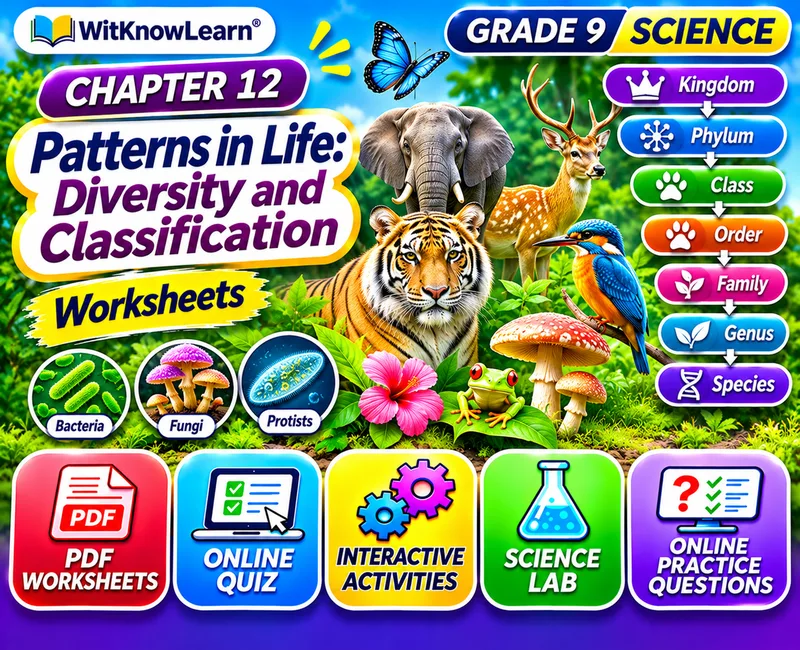
Patterns in Life: Diversity and Classification Class 9 Worksheet with Online Quiz, Games and Activities
Why do mangroves save lives in a cyclone, and how can one name be understood by scientists everywhere? Find out with this Patterns in Life: Diversity and Classification worksheet for Class 9 Science, NCERT Exploration Chapter 12: take the Patterns in Life: Diversity and Classification Class 9 online quiz, run three experiments in the Virtual Lab and play the activities and interactive games online.
Flip the cards and try the Classification Lab, then tap the Games, Labs, Challenges or Virtual Lab island.
Patterns in Life: Diversity and Classification Class 9 Online Quiz
20 questions · tap an answer to move on · full review at the end
Flip the cards, try the Classification Lab, then play the games, do the labs and take the challenges. Earn up to 3 stars in every activity.
Fact cards: tap a card to flip it
Classification Lab
Three real-life cases depend on biodiversity and classification. In each one, predict which choice will work, drag it onto the picture and watch what happens. A wrong choice shows what goes wrong, so you can try again.
Challenge marks: 0 / 15 (0 of 5 challenges done)
Finish all 5 challenges to see your comment.
Virtual Lab: do real experiments step by step
Practice sheet
Patterns in Life: Diversity and Classification Class 9 Activities
Save crops with natural predators, shield a coastal village with mangroves and name a tree for the whole world in the Classification Lab, then build a leaf key, explore pond water and make a spore print in the Virtual Lab. Earn up to 3 stars in every activity.
Why biodiversity matters
"Patterns in Life: Diversity and Classification" is Chapter 12 of the new NCERT Class 9 Science textbook Exploration. Life exists in countless forms, from microscopic bacteria to giant trees, and from the snow-clad Himalayas to the coral reefs of the Andaman Sea. This huge variety of living organisms is called biodiversity. Microscopic algae release much of the oxygen we breathe, fungi and bacteria turn dead leaves into manure, and bees, birds and bats pollinate flowers. Farmers have long conserved diverse crop varieties because diversity reduces the risk of crop failure.
India as a biodiversity hotspot
India has mountains, deserts, rainforests, plateaus and long coastlines, so it supports a vast range of life. Some species, called endemic species, are found naturally nowhere else: the Nilgiri tahr, the lion-tailed macaque, the pitcher plant Nepenthes khasiana and Neelakurinji are examples. Regions rich in endemic species that have lost much of their habitat are biodiversity hotspots; the Western Ghats, Indo-Burma, the Himalayas and Sundaland include parts of India. Biodiversity also protects us. Villages with more mangroves suffered less damage in the 1999 Odisha super cyclone, and rich forest diversity in the Western Ghats acts as a barrier against tick-borne Kyasanur Forest Disease. Sacred groves and the ancient Sangam Tinai grouping of landscapes show that Indian communities have long understood and protected nature.
Why and how we classify
To study millions of species, scientists group organisms by shared features and evolutionary relationships. Early systems split life into two kingdoms; later, R. H. Whittaker proposed five kingdoms based on cell type, number of cells, mode of nutrition and ecological role.
- Monera: prokaryotes such as bacteria and cyanobacteria. Cyanobacteria were among the first organisms to produce oxygen. Rhizobium fixes nitrogen, bacteria in cattle dung give biogas, and Ram Bux Singh is called the Father of Modern Biogas.
- Protista: single-celled eukaryotes such as Amoeba, Paramecium and Euglena.
- Fungi: heterotrophic eukaryotes with chitin walls, such as yeast, Aspergillus and mushrooms. They decompose dead matter and give us enzymes and antibiotics.
- Plantae: multicellular autotrophs in five groups, Thallophyta (algae), Bryophyta (mosses), Pteridophyta (ferns), Gymnosperms (naked seeds, as in pine) and Angiosperms (seeds inside fruits).
- Animalia: multicellular heterotrophs, from sponges, cnidarians, flatworms, roundworms, annelids, arthropods, molluscs and echinoderms to chordates.
Patterns in the animal kingdom
Moving from sponges to echinoderms, animal bodies show increasing complexity. Sponges have pores and a cellular level of organisation. Roundworms have a more efficient tube-like body with two openings, a mouth and an anus. Earthworms have ring-like segments, while arthropods such as insects, spiders and crabs have jointed legs and a hard external skeleton; they form the largest group of animals. Starfish have spiny skin and tube feet.
Vertebrates, naming and new ideas
Chordates with a backbone are vertebrates, grouped into fish, amphibians, reptiles, birds and mammals according to body covering, breathing and reproduction. The floating phumdis of Loktak Lake in Manipur are home to the endangered Sangai, the dancing deer. To avoid confusion between local names, Carolus Linnaeus introduced binomial nomenclature: each species has a two-part Latin name, genus then species, such as Mangifera indica for mango. Organisms are arranged in a hierarchy from kingdom, phylum and class down to order, family, genus and species. Viruses are not placed in any kingdom because they lack cells and become active only inside a host. Comparing DNA led Carl Woese in 1977 to propose three domains: Bacteria, Archaea and Eukarya.
This Patterns in Life: Diversity and Classification worksheet for Class 9 Science brings the chapter to life on WitKnowLearn with an online quiz, online activities and interactive games. Flip the fact cards, solve the Classification Lab cases, play the games, do the classification labs, take the challenges and then build a leaf key, explore pond water and make a spore print in the Virtual Lab.
Patterns in Life: Diversity and Classification Class 9 Science Guide
Patterns in Life: Diversity and Classification is Chapter 12 of the NCERT Class 9 Science textbook Exploration. It covers biodiversity, India as a biodiversity hotspot, endemic species, the need for classification, Whittaker’s five kingdoms, the groups of plants and animals, vertebrate classes, binomial nomenclature, the classification hierarchy and the three domains of life. This guide explains each idea clearly for Class 9 students, parents and teachers. It goes with the Diversity and Classification Class 9 worksheet on WitKnowLearn, which also has an online quiz, online activities, interactive games and a Virtual Lab on the same page.
What is there in this chapter
- Biodiversity and its importance
- Endemic species and biodiversity hotspots
- History of classification systems
- Monera, Protista, Fungi, Plantae and Animalia
- Plant groups from algae to flowering plants
- Invertebrate phyla and vertebrate classes
- Binomial nomenclature, hierarchy and three domains
Learning objectives
- Explain why biodiversity matters to people and ecosystems.
- Classify organisms using cell type, body organisation and nutrition.
- Distinguish the five plant groups and the main animal phyla.
- Write and interpret scientific names.
Learning outcomes
After this page a student can:
- Place an unfamiliar organism in the right kingdom from its features.
- Use a simple identification key.
- Explain how biodiversity protects crops, coasts and health.
- Explain why viruses lie outside the five kingdoms.
Diversity and Classification Class 9 resources on this page
| Resource | What it does |
|---|---|
| Patterns in Life: Diversity and Classification Class 9 online quiz | 20 questions in three levels with a full answer review |
| Flip cards | Six cards on life everywhere, sorting life, fungi, the plant ladder, backbones and scientific names |
| Classification Lab | Three cause-and-effect cases: natural pest control, a mangrove shield and naming a tree for the world |
| 5 interactive games | Monera or Protista, backbone bubbles, biodiversity memory, plant group sort and plant or fungus |
| 5 classification labs | Five kingdoms, classification ladder, animal phyla, identification key and vertebrate class finder |
| 5 challenges | Marked out of 3 each with a total out of 15 |
| Virtual Lab | Three full experiments: a leaf key, life in pond water and a mushroom spore print |
| Practice sheet | 16 questions with answer boxes and a live score |
The five kingdoms at a glance
| Kingdom | Cell type | Cells | Nutrition |
|---|---|---|---|
| Monera | Prokaryotic | Mostly one | Autotrophic or heterotrophic |
| Protista | Eukaryotic | One | Autotrophic or heterotrophic |
| Fungi | Eukaryotic, chitin wall | Mostly many | Heterotrophic (absorb food) |
| Plantae | Eukaryotic, cellulose wall | Many | Autotrophic |
| Animalia | Eukaryotic, no wall | Many | Heterotrophic |
Types of questions
- Biodiversity and hotspots
- Features of the five kingdoms
- Plant groups
- Animal phyla and vertebrate classes
- Binomial names and hierarchy
- Data and percentage questions
- Assertion and reason and case studies
Solved examples
Common mistakes
| Mistake | Correct |
|---|---|
| Calling mushrooms plants | Mushrooms are fungi; they cannot photosynthesise. |
| Writing the species name with a capital | Only the genus starts with a capital letter. |
| Thinking spiders are insects | Spiders have eight legs and are arachnids. |
| Placing viruses in Monera | Viruses have no cells and are not in any kingdom. |
| Calling a bat a bird | Bats are mammals. |
Daily life
Curd, biogas, antibiotics, bread, timber and medicines all come from the variety of life. Protecting mangroves, sacred groves and wetlands keeps people safe and keeps species alive.
Tips for parents and teachers
- Collect and sort leaves on a nature walk.
- Look at pond water or moss with a hand lens.
- Make a simple key for objects in the classroom.
- Find the scientific names of five plants at home.
- Let students retry the challenges to earn 3 stars.
Related Class 9 Science Worksheets
- Exploration Class 9 Science Worksheet
- Matter in Our Surroundings Class 9 Worksheet
- Motion Class 9 Worksheet
- Structure of the Atom Class 9 Worksheet
- Work and Energy Class 9 Worksheet
- The Fundamental Unit of Life Class 9 Worksheet
- Tissues Class 9 Worksheet
- Is Matter Around Us Pure Class 9 Worksheet
- Gravitation Class 9 Worksheet
- Force and Laws of Motion Class 9 Worksheet
- Atoms and Molecules Class 9 Worksheet
- Improvement in Food Resources Class 9 Worksheet
Frequently Asked Questions
 Download