Class 9 Science · NCERT Exploration · Chapter 2
Cell: The Building Block of Life Class 9 Online Quiz, Games and Activities
Why does a raisin swell in water, and how does a protein leave a cell? Find out with this Cell: The Building Block of Life worksheet for Class 9 Science (NCERT Exploration, Chapter 2): take the Cell: The Building Block of Life Class 9 online quiz, run three experiments in the Virtual Lab and play the activities and interactive games online.
Flip the cards and try the Osmosis Lab, then tap the Games, Labs, Challenges or Virtual Lab island.
Cell: The Building Block of Life Class 9 Online Quiz
20 questions · tap an answer to move on · full review at the end
The organisms that live in the hot springs of Puga Valley in Ladakh are mostly:
Flip the cards, try the Osmosis Lab, then play the games, do the labs and take the challenges. Earn up to 3 stars in every activity.
Fact cards: tap a card to flip it
Osmosis Lab
Three real-life cases depend on osmosis. In each one, predict which choice will work, drag it onto the picture and watch what happens to the cells. A wrong choice shows what goes wrong, so you can try again.
🧪 Case 1 of 3 · 🍇 The dry raisin: A raisin has lost most of its water. Which liquid will make its cells take water back in? Drag a choice onto the picture to test it.
The result will appear here.
- 🧪Case 1: 🍇 The dry raisin
Predict which choice works. - ⬜Case 2: 🏥 The hospital drip
Waiting… - ⬜Case 3: 🌱 Too much fertiliser
Waiting… - ⬜What did we find?
Solve all 3 cases to unlock.
Challenge marks: 0 / 15 (0 of 5 challenges done)
Finish all 5 challenges to see your comment.
Virtual Lab: do real experiments step by step
The Naked Egg Osmosis Test
🎯 Aim
To show that a cell membrane is selectively permeable, using a shell-less egg as a giant single cell.
📘 Learning objectives
- Remove the shell of an egg without breaking its membrane.
- Measure the change in mass in a hypotonic and a hypertonic liquid.
- Explain the change using osmosis.
🧰 Materials needed
⚠️ Safety first
Handle raw eggs gently and wash your hands with soap afterwards. Do not taste any of the liquids.
🔬 Procedure: do each step yourself
- Soak Egg A in vinegar to dissolve its shell.
- Soak Egg B in vinegar to dissolve its shell.
- Weigh Egg A.
- Weigh Egg B.
- Place Egg A in distilled water for a day.
- Place Egg B in thick sugar syrup for a day.
- Weigh Egg A again.
- Weigh Egg B again.
Step 1: Soak Egg A in vinegar to dissolve its shell.
📋 Observation table: fill in what you saw
| Egg | Change in mass |
|---|---|
| Egg A (distilled water) | |
| Egg B (sugar syrup) |
✍️ Conclusion
What is the best explanation of the results?
🏁 Learning outcomes
After this experiment I can:
- ✅ remove an eggshell with acid and keep the membrane
- ✅ compare mass changes in hypotonic and hypertonic liquids
- ✅ explain why the egg membrane is selectively permeable
🎉 Lab report complete!
Finding Starch Stores in Leucoplasts
🎯 Aim
To find which plant tissues store starch in their colourless plastids.
📘 Learning objectives
- Use iodine solution as a test for starch.
- Observe starch grains under the microscope.
- Link stored starch to leucoplasts.
🧰 Materials needed
⚠️ Safety first
Iodine stains skin and clothes. Use a dropper and wipe spills at once. Carry the microscope with both hands.
🔬 Procedure: do each step yourself
- Add a drop of iodine to the potato slide.
- Add a drop of iodine to the onion slide.
- Add a drop of iodine to the banana slide.
- Observe the potato slide under the microscope.
- Observe the onion slide.
- Observe the banana slide.
Step 1: Add a drop of iodine to the potato slide.
📋 Observation table: fill in what you saw
| Slide | What you saw |
|---|---|
| Potato | |
| Onion | |
| Raw banana |
✍️ Conclusion
What does the test show about potato cells?
🏁 Learning outcomes
After this experiment I can:
- ✅ test plant cells for starch with iodine
- ✅ identify starch grains under a microscope
- ✅ connect leucoplasts with food storage
🎉 Lab report complete!
Do New Yeast Cells Come from Old Ones?
🎯 Aim
To observe yeast cells multiplying and relate it to the idea that all cells arise from pre-existing cells.
📘 Learning objectives
- Set up yeast with and without food.
- Count cells after a fixed time.
- Link cell division to the Cell Theory.
🧰 Materials needed
⚠️ Safety first
Use only lukewarm water. Wash the flasks after use; never drink the mixture.
🔬 Procedure: do each step yourself
- Add a pinch of yeast to Flask A (sugar water).
- Add the same pinch of yeast to Flask B (plain water).
- Count the cells in one microscope view of Flask A.
- Count the cells in one view of Flask B.
- Keep Flask A warm for 2 hours.
- Keep Flask B warm for 2 hours.
- Count the cells in Flask A again.
- Count the cells in Flask B again.
Step 1: Add a pinch of yeast to Flask A (sugar water).
📋 Observation table: fill in what you saw
| Flask | After 2 hours |
|---|---|
| A (sugar water) | |
| B (plain water) |
✍️ Conclusion
What can you conclude?
🏁 Learning outcomes
After this experiment I can:
- ✅ set up a controlled experiment with yeast
- ✅ count cells and compare two conditions
- ✅ explain cell multiplication using the Cell Theory
🎉 Lab report complete!
Practice sheet
Type your answers in the boxes. For word answers write in small letters. Press Check when you finish.
AName the cell part
BWrite yes or no
CComplete the sentence
DWrite the number
Cell: The Building Block of Life Class 9 Activities
Predict osmosis in the Osmosis Lab, run the cell factory, estimate cell sizes and do three full experiments in the Virtual Lab. Earn up to 3 stars in every activity.
Where does a cell come from?
"Cell: The Building Block of Life" is Chapter 2 of the new NCERT Class 9 Science textbook Exploration. It opens in the hot springs of Puga Valley in Ladakh, where water stays close to its boiling point even in freezing weather. Heat-loving unicellular bacteria called thermophiles live there. Researchers from the Birbal Sahni Institute of Palaeosciences, Lucknow, found calcium carbonate forming quickly around these springs. Deposits like these may have shielded early organic molecules and even helped the first protective membrane to form. That membrane is what turns a soup of chemicals into a cell.
Every organism is made of cells. Bacteria and yeast are unicellular; plants, fish, birds and humans are multicellular. Similar cells form tissues, tissues form organs and organs work together as organ systems, yet the cell remains the basic unit of structure and function.
Seeing the invisible
From about 25 cm away, our eyes cannot separate two points closer than about 0.1 mm. This limit of resolution means most cells stay hidden from the unaided eye. Robert Hooke solved this in 1665 with a microscope of his own design and coined the word "cell". A school light microscope multiplies the power of the eyepiece and the objective: a 10X eyepiece with a 40X objective gives 400X. You can even estimate a cell’s real size by dividing the width of the field of view (in µm) by the number of cells that fit across it. Electron microscopes use a beam of electrons and show details at the nanometre scale. Good microscopes balance three things: resolution, contrast and magnification.
The membrane and the wall
The plasma membrane is only 7–10 nm thick. The fluid-mosaic model describes it as a lipid bilayer with proteins set in it like tiles; the molecules can slide, flip and rotate, and the proteins act as gatekeepers. Because the membrane is selectively permeable, water moves through it by osmosis, from a dilute to a concentrated solution. Solutions outside a cell can be isotonic, hypotonic or hypertonic, and each has a different effect on the cell. Diffusion, by contrast, is the movement of particles from higher to lower concentration and needs no membrane at all.
Plants, fungi and bacteria also have a cell wall. In plants it is made of cellulose, a chain of glucose units that our diet uses as roughage. The wall is rigid but fully permeable. In a strong sugar solution a plant cell loses water, but the wall keeps its shape while the membrane pulls inward. An animal cell has no wall, so it simply shrinks.
Prokaryotic and eukaryotic cells
Bacteria are prokaryotic: they are 1–10 µm in size, keep a single circular DNA in a region called the nucleoid and have no membrane-bound organelles. Plant and animal cells are eukaryotic: they are 10–100 µm across, with a true nucleus and many organelles. A cytoskeleton of fine fibres supports them, and starch grains or crystals may sit in the cytoplasm as cell inclusions. Viruses, viroids and prions are not cells at all.
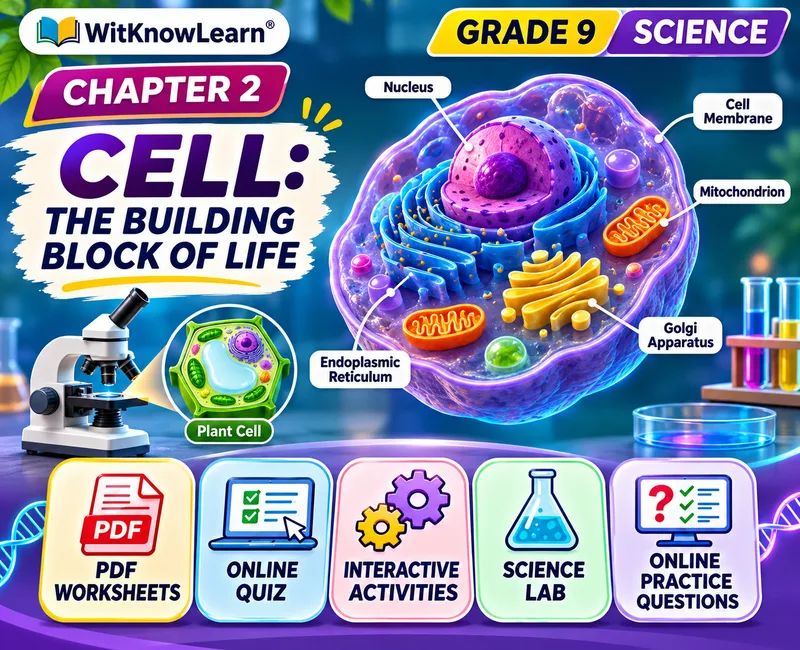
A cell is a tiny factory
- Nucleus: a double membrane with pores, a nucleolus that makes ribosomal subunits, and chromatin that coils into chromosomes before division. Genes are the working segments of DNA.
- Ribosomes make proteins. Rough ER carries ribosomes and makes proteins; smooth ER makes lipids and hormones.
- Golgi apparatus: the post office that modifies, sorts and packs materials into vesicles. Camillo Golgi first saw it in 1898.
- Lysosomes: sacs of enzymes that clean up waste and worn-out parts.
- Mitochondria: their folded inner membranes (cristae) release energy from food as ATP.
- Plastids: chloroplasts make food, chromoplasts give fruits and flowers their colours and leucoplasts store starch, oils or proteins. Mitochondria and plastids have their own DNA and ribosomes.
- Vacuoles: the large central vacuole of a plant cell stores cell sap and keeps the cell firm.
Cells divide, and cells die
We grow and heal because cells divide. Mitosis makes two genetically identical daughter cells for growth, repair and asexual reproduction. Meiosis takes place only in reproductive organs and gives four gametes with half the chromosome number, which creates variety. Errors in mitosis can lead to tumours, while errors in meiosis can cause genetic disorders. Normal cells show contact inhibition; cancer cells lose it. Programmed cell death removes cells in a planned way, which is how our fingers separate in the embryo.
The Cell Theory took shape through the work of Schleiden (1838) and Schwann (1839), and Virchow added in 1855 that all cells come from pre-existing cells. Haberlandt’s idea of totipotency led to plant tissue culture, and in 2010 Craig Venter’s team showed that synthetic DNA can run a living cell.
This Cell: The Building Block of Life worksheet for Class 9 Science brings the chapter alive on WitKnowLearn with an online quiz, online activities and interactive games. Flip the fact cards, predict results in the Osmosis Lab, play the games, do the cell labs, take the challenges and then try the egg, starch and yeast experiments in the Virtual Lab.
Cell: The Building Block of Life Class 9 Science Guide
Cell: The Building Block of Life is Chapter 2 of the NCERT Class 9 Science textbook Exploration. It covers how we study cells with microscopes, the cell membrane and osmosis, the cell wall, prokaryotic and eukaryotic cells, the cell organelles, mitosis and meiosis, and the Cell Theory. This guide explains each idea clearly for Class 9 students, parents and teachers. It goes with the Cell: The Building Block of Life Class 9 worksheet on WitKnowLearn, which also has an online quiz, online activities, interactive games and a Virtual Lab on the same page.
What is there in this chapter
- Origin of cells and the Puga Valley hot springs
- Limit of resolution, light and electron microscopes
- Estimating cell size and total magnification
- Cell membrane, fluid-mosaic model and osmosis
- Cell wall and its permeability
- Prokaryotic and eukaryotic cells
- Cell organelles and their functions
- Mitosis, meiosis, cell theory and cell death
Learning objectives
- Explain why microscopes are needed to study cells.
- Predict what happens to a cell in isotonic, hypotonic and hypertonic solutions.
- Relate the structure of each organelle to its function.
- Compare mitosis with meiosis.
Learning outcomes
After this page a student can:
- Calculate total magnification and estimate the real size of a cell.
- Explain osmosis using everyday examples such as pickles and wilting plants.
- Trace the route of a secreted protein through the cell.
- State the Cell Theory and the scientists behind it.
Cell: The Building Block of Life Class 9 resources on this page
| Resource | What it does |
|---|---|
| Cell: The Building Block of Life Class 9 online quiz | 20 questions in three levels with a full answer review |
| Flip cards | Six cards on microscopes, the membrane, the cell wall, organelles, plastids and division |
| Osmosis Lab | Three cause-and-effect cases: a dry raisin, a hospital drip and an over-fertilised plant |
| 5 interactive games | Prokaryotic or eukaryotic, double membrane bubbles, scientists memory, iso-hypo-hyper and mitosis or meiosis |
| 5 cell labs | Organelle factory, magnification, plastid sorter, cell size estimator and stain and spot |
| 5 challenges | Marked out of 3 each with a total out of 15 |
| Virtual Lab | Three full experiments (the naked egg, starch in leucoplasts and multiplying yeast), each with an aim, objectives, procedure, observation table, conclusion and outcomes |
| Practice sheet | 16 questions with answer boxes and a live score |
Key comparisons at a glance
| Feature | Prokaryotic cell | Eukaryotic cell |
|---|---|---|
| Genetic material | Nucleoid, no membrane | Nucleus with a double membrane |
| Size | 1–10 µm | 10–100 µm |
| Membrane-bound organelles | Absent | Present |
| Example | Bacteria | Plant, animal and fungal cells |
Types of questions
- Numerical: magnification and cell size
- Osmosis and tonicity predictions
- Organelle structure and function
- Prokaryotic versus eukaryotic cells
- Mitosis versus meiosis
- Experiment-based and case-based questions
- Assertion and reason
Solved examples
Common mistakes
| Mistake | Correct |
|---|---|
| Calling the cell wall selectively permeable | The cell wall is permeable; the membrane is selectively permeable. |
| Thinking salt moves into a cell in osmosis | Only water moves across the membrane. |
| Adding the lens powers | Multiply the eyepiece power by the objective power. |
| Saying meiosis makes two cells | Meiosis makes four cells with half the chromosomes. |
| Calling viruses the smallest cells | Viruses are acellular, not cells. |
Daily life
Osmosis explains why pickles and murabbas keep for months, why limp vegetables become crisp in cold water and why too much fertiliser makes plants wilt. Cell division explains how a cut heals, and cell culture is used to make vaccines and medicines.
Tips for parents and teachers
- Do the naked egg experiment at home with vinegar and syrup.
- Ask students to draw and label a plant cell and an animal cell side by side.
- Practise magnification sums with different lens combinations.
- Make a model of the protein export route with clay.
- Let students retry the challenges to earn 3 stars.
Related Class 9 Science Worksheets
- Exploration Class 9 Science Worksheet
- Matter in Our Surroundings Class 9 Worksheet
- Is Matter Around Us Pure Class 9 Worksheet
- Atoms and Molecules Class 9 Worksheet
- Structure of the Atom Class 9 Worksheet
- Tissues Class 9 Worksheet
- Motion Class 9 Worksheet
- Force and Laws of Motion Class 9 Worksheet
- Gravitation Class 9 Worksheet
- Work and Energy Class 9 Worksheet
- Sound Class 9 Worksheet
- Improvement in Food Resources Class 9 Worksheet
Frequently Asked Questions
What is Cell: The Building Block of Life Class 9 about?
It is Chapter 2 of the NCERT Class 9 Science textbook Exploration. It explains how cells are studied with microscopes, the cell membrane and osmosis, the cell wall, prokaryotic and eukaryotic cells, cell organelles, mitosis, meiosis and the Cell Theory.
What is the difference between osmosis and diffusion?
Diffusion is the net movement of particles from a higher to a lower concentration and can happen without a membrane. Osmosis is the diffusion of water across a selectively permeable membrane.
What are isotonic, hypotonic and hypertonic solutions?
Compared with the inside of the cell, an isotonic solution has equal solute, a hypotonic solution has less solute (water enters the cell) and a hypertonic solution has more solute (water leaves the cell).
How do we calculate the total magnification of a microscope?
Multiply the magnifying power of the eyepiece by that of the objective lens. A 10X eyepiece with a 40X objective gives 400X.
Which organelles contain their own DNA?
The nucleus, mitochondria and plastids such as chloroplasts. Mitochondria and plastids also have their own ribosomes.
What is the difference between mitosis and meiosis?
Mitosis gives two identical daughter cells with the same chromosome number and is used for growth and repair. Meiosis gives four gametes with half the chromosome number and occurs only in reproductive organs.
What is in the Virtual Lab?
Three full experiments: the naked egg osmosis test, the iodine test for starch stored in leucoplasts, and yeast cells multiplying in sugar water. Each has an aim, objectives, materials, safety notes, procedure, observation table, conclusion and outcomes.
Does this page have Cell: The Building Block of Life Class 9 questions and answers?
Yes. The 20-question Cell: The Building Block of Life Class 9 online quiz shows the correct answer and a reason for every question at the end, and the practice sheet has a Show answers button for all 16 questions.
Which class and book is this worksheet for?
It is made for Class 9 Science students using the new NCERT textbook Exploration, Chapter 2 Cell: The Building Block of Life.
What can students do on this page?
On WitKnowLearn they get an online quiz, online activities and interactive games: an Osmosis Lab, five cell labs, a Virtual Lab with three experiments, sorting games and marked challenges, all on the screen.
Can students use these activities on a phone?
Yes. All drag activities work with a finger on phones and tablets and with a mouse on computers. Tapping also works, and the practice sheet takes typed answers.
What is included on this page?
A 20-question online quiz with review, flip cards, the Osmosis Lab, 5 interactive games, 5 cell labs, 5 marked challenges, a Virtual Lab with 3 experiments, a 16-question practice sheet, a complete guide, 12 related Class 9 Science worksheets and these FAQs.
 Download