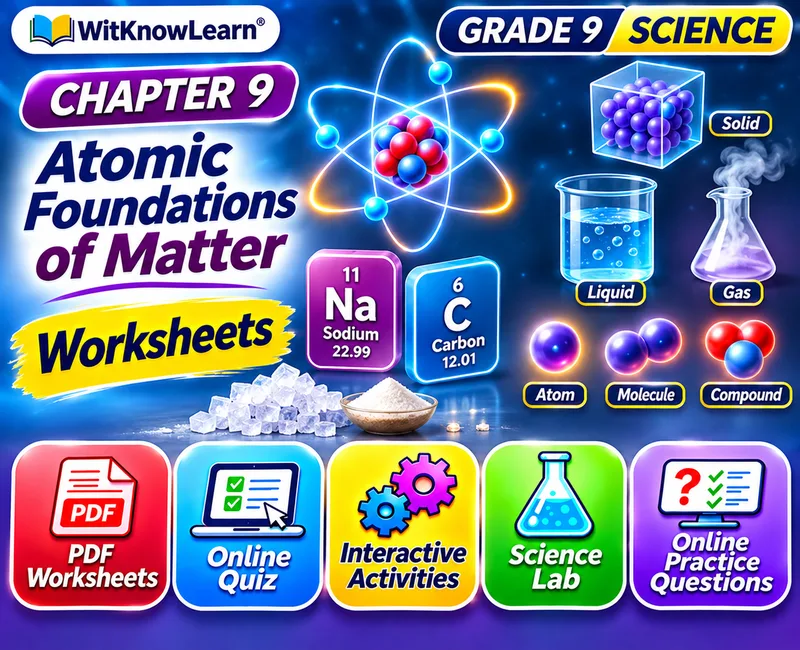
Class 9 Science · NCERT Exploration · Chapter 9
Atomic Foundations of Matter Class 9 Worksheet with Online Quiz, Games and Activities
Is water from every source the same, and why does salt water conduct electricity while sugar water does not? Find out with this Atomic Foundations of Matter worksheet for Class 9 Science, NCERT Exploration Chapter 9: take the Atomic Foundations of Matter Class 9 online quiz, run three experiments in the Virtual Lab and play the activities and interactive games online.
Flip the cards and try the Bonding Lab, then tap the Games, Labs, Challenges or Virtual Lab island.
Atomic Foundations of Matter Class 9 Online Quiz
20 questions · tap an answer to move on · full review at the end
Pure water collected from rain, a river or a tap is, chemically:
Flip the cards, try the Bonding Lab, then play the games, do the labs and take the challenges. Earn up to 3 stars in every activity.
Fact cards: tap a card to flip it
Bonding Lab
Three chemistry cases depend on how atoms combine. In each one, predict which choice will work, drag it onto the picture and watch what happens. A wrong choice shows what goes wrong, so you can try again.
🧪 Case 1 of 3 · 🕯️ Where did the wax go?: A candle on a balance seems to get lighter as it burns. How can you show that mass is really conserved? Drag a choice onto the picture to test it.
The result will appear here.
- 🧪Case 1: 🕯️ Where did the wax go?
Predict which choice works. - ⬜Case 2: 💡 Lighting the bulb
Waiting… - ⬜Case 3: 🧪 Writing a formula
Waiting… - ⬜What did we find?
Solve all 3 cases to unlock.
Challenge marks: 0 / 15 (0 of 5 challenges done)
Finish all 5 challenges to see your comment.
Virtual Lab: do real experiments step by step
Why Does Burning Steel Wool Get Heavier?
🎯 Aim
To show that mass is conserved when steel wool burns, once the oxygen that combines is counted.
📘 Learning objectives
- Weigh steel wool before and after burning.
- Explain the change in mass.
- Apply the law of conservation of mass.
🧰 Materials needed
⚠️ Safety first
Do this only under teacher supervision on a heat-proof tray, away from paper. Do not touch the hot steel wool.
🔬 Procedure: do each step yourself
- Weigh the steel wool on the tray.
- Touch the battery to the steel wool so it glows and burns.
- Weigh the burnt steel wool.
Step 1: Weigh the steel wool on the tray.
📋 Observation table: fill in what you saw
| Sample | Mass |
|---|---|
| Before burning | |
| After burning |
✍️ Conclusion
Where did the extra 0.6 g come from?
🏁 Learning outcomes
After this experiment I can:
- ✅ measure mass before and after a reaction
- ✅ explain an apparent gain in mass
- ✅ apply the law of conservation of mass
🎉 Lab report complete!
Splitting Water into Its Elements
🎯 Aim
To decompose water by electrolysis and compare the volumes of gases produced.
📘 Learning objectives
- Pass electricity through slightly salted water.
- Collect the gases at the two electrodes.
- Relate the volume ratio to the formula H₂O.
🧰 Materials needed
⚠️ Safety first
Use only a low-voltage battery. Keep a lit splint away until a teacher tests the gas.
🔬 Procedure: do each step yourself
- Switch on the current through the water.
- Read the gas volume at the negative electrode.
- Read the gas volume at the positive electrode.
Step 1: Switch on the current through the water.
📋 Observation table: fill in what you saw
| Electrode | Gas and volume |
|---|---|
| Negative | |
| Positive |
✍️ Conclusion
What does the 2 : 1 volume ratio tell us?
🏁 Learning outcomes
After this experiment I can:
- ✅ decompose a compound into elements
- ✅ measure gas volumes
- ✅ link composition to a chemical formula
🎉 Lab report complete!
Which Liquids Conduct Electricity?
🎯 Aim
To test household liquids for electrical conductivity and link it to the presence of ions.
📘 Learning objectives
- Build a simple bulb-and-battery tester.
- Test three household liquids.
- Explain the results using ions.
🧰 Materials needed
⚠️ Safety first
Use only a low-voltage battery and never test mains electricity.
🔬 Procedure: do each step yourself
- Dip the tester into lemon juice.
- Dip the tester into distilled water.
- Dip the tester into salt water.
Step 1: Dip the tester into lemon juice.
📋 Observation table: fill in what you saw
| Liquid | LED |
|---|---|
| Lemon juice | |
| Distilled water | |
| Salt water |
✍️ Conclusion
What decides whether a liquid conducts?
🏁 Learning outcomes
After this experiment I can:
- ✅ build a conductivity tester
- ✅ compare liquids fairly
- ✅ relate conductivity to ions
🎉 Lab report complete!
Practice sheet
Type your answers in the boxes. For word answers write in small letters. Press Check when you finish.
AName it
BWrite yes or no
CComplete the sentence
DWrite the number
Atomic Foundations of Matter Class 9 Activities
Prove mass is conserved, light a bulb with ions and build formulas in the Bonding Lab, explore the fixed ratio of carbon dioxide and split water in the Virtual Lab. Earn up to 3 stars in every activity.
Are all samples of water the same?
"Atomic Foundations of Matter" is Chapter 9 of the new NCERT Class 9 Science textbook Exploration. It starts with three questions. Is water from different sources chemically the same? Why is oxygen sometimes written as O and sometimes as O₂? Why does salt water conduct electricity while sugar water does not? To answer them, the chapter uses the atom of Chapter 8 to explain how atoms combine.
Laws of chemical combination
The Law of Conservation of Mass, proposed by Antoine Lavoisier (the Father of Modern Chemistry), states that mass is neither created nor destroyed in a chemical reaction: the total mass of the reactants equals the total mass of the products. The Law of Definite Proportions, proposed by Joseph Proust, states that a compound always contains the same elements combined in a fixed ratio by mass, wherever it comes from. In water, for example, hydrogen and oxygen are always in the ratio 1 : 8 by mass. In carbon dioxide, carbon and oxygen are always 3 : 8.
Dalton’s atomic theory
In 1808 John Dalton explained these laws with a set of postulates. All matter is made of tiny atoms that take part in reactions and cannot be created or destroyed. Atoms of one element are identical in mass and properties, while those of different elements differ. Atoms combine in simple whole-number ratios to form compounds. Later discoveries showed that atoms do have smaller parts, but Dalton’s ideas laid the foundation of modern chemistry.
Molecules and covalent bonds
A molecule is an electrically neutral group of atoms that can exist on its own and shows all the properties of the substance. Molecules can be of elements (O₂, N₂, P₄, S₈) or of compounds (H₂O, CO₂). The number of atoms in a molecule is its atomicity. Non-metal atoms complete their octets by sharing electrons, forming covalent bonds. Chlorine shares one pair (Cl—Cl), oxygen shares two pairs (O=O) and nitrogen shares three (N≡N). Covalent compounds are named with prefixes such as mono-, di-, tri- and tetra-, for example carbon monoxide, carbon dioxide and phosphorus trichloride.
Ions and ionic bonds
When a metal meets a non-metal, electrons are transferred. The metal loses electrons to become a positive cation (Na⁺, Mg²⁺, Al³⁺), and the non-metal gains them to become a negative anion (Cl⁻, O²⁻, S²⁻). The strong attraction between oppositely charged ions is an ionic bond. Some ions, called polyatomic ions, contain several atoms, such as OH⁻, NO₃⁻, CO₃²⁻, SO₄²⁻ and NH₄⁺.
Writing formulas and finding masses
A compound must be electrically neutral. To write a formula, we criss-cross the valencies of the ions, simplify the ratio and use brackets for more than one polyatomic ion. That gives MgCl₂, Al₂O₃ and Ca(NO₃)₂. The molecular mass is the sum of the atomic masses in a molecule, such as H₂O = 18 u. For ionic compounds, which have no separate molecules, we use the formula unit mass, such as NaCl = 58.5 u.
Properties of ionic and covalent compounds
Ionic compounds such as salt and copper sulfate are usually hard solids that dissolve in water. They conduct electricity when dissolved or molten, because their ions can then move. Covalent compounds such as sugar, camphor and naphthalene do not form ions. They do not conduct electricity, and many dissolve better in kerosene or petrol than in water.
This Atomic Foundations of Matter worksheet for Class 9 Science brings chemistry to life on WitKnowLearn with an online quiz, online activities and interactive games. Flip the fact cards, solve the Bonding Lab cases, play the games, do the bonding labs, take the challenges and then burn steel wool, split water and test conductivity in the Virtual Lab.
Atomic Foundations of Matter Class 9 Science Guide
Atomic Foundations of Matter is Chapter 9 of the NCERT Class 9 Science textbook Exploration. It covers the laws of conservation of mass and definite proportions, Dalton’s atomic theory, molecules and atomicity, covalent and ionic bonding, naming compounds, writing chemical formulas, molecular and formula unit mass, and the properties of ionic and covalent compounds. This guide explains each idea clearly for Class 9 students, parents and teachers. It goes with the Atomic Foundations of Matter Class 9 worksheet on WitKnowLearn, which also has an online quiz, online activities, interactive games and a Virtual Lab on the same page.
What is there in this chapter
- Law of conservation of mass and law of definite proportions
- Dalton’s atomic theory
- Molecules of elements and compounds; atomicity
- Covalent bonds and naming of covalent compounds
- Ions, ionic bonds and polyatomic ions
- Writing chemical formulas
- Molecular mass, formula unit mass and properties of compounds
Learning objectives
- Verify the laws of chemical combination with data.
- Explain covalent and ionic bonding using electrons.
- Write correct names and formulas of compounds.
- Calculate molecular and formula unit masses.
Learning outcomes
After this page a student can:
- Use the criss-cross method confidently.
- Predict whether a compound is ionic or covalent.
- Explain why ionic solutions conduct electricity.
- Solve problems on mass ratios.
Atomic Foundations of Matter Class 9 resources on this page
| Resource | What it does |
|---|---|
| Atomic Foundations of Matter Class 9 online quiz | 20 questions in three levels with a full answer review |
| Flip cards | Six cards on water, conservation, Dalton, sharing, transfer and conductivity |
| Bonding Lab | Three cause-and-effect cases: a burning candle, lighting a bulb and writing a formula |
| 5 interactive games | Ionic or covalent, element molecule bubbles, name and formula memory, atomicity sort and cation or anion |
| 5 bonding labs | Laws and bonds, fixed ratio, formula builder, molecular mass and conductivity tester |
| 5 challenges | Marked out of 3 each with a total out of 15 |
| Virtual Lab | Three full experiments: burning steel wool, electrolysis of water and conductivity of household liquids |
| Practice sheet | 16 questions with answer boxes and a live score |
Ionic and covalent compounds at a glance
| Property | Ionic | Covalent |
|---|---|---|
| Formed by | Transfer of electrons | Sharing of electrons |
| Usually between | Metal and non-metal | Non-metals |
| Made of | Ions in a lattice | Molecules |
| Conductivity | When molten or dissolved | Generally none |
| Examples | NaCl, MgO, CuSO₄ | H₂O, CH₄, sugar |
Types of questions
- Verifying conservation of mass
- Mass ratio problems
- Electron-dot and bonding questions
- Naming and writing formulas
- Molecular and formula unit mass
- Properties of compounds
- Assertion and reason
Solved examples
Common mistakes
| Mistake | Correct |
|---|---|
| Forgetting brackets: CaNO₃₂ | Ca(NO₃)₂ |
| Calling NaCl a molecule | NaCl is a formula unit of an ionic lattice. |
| Writing “monooxide” | Monoxide. |
| Ignoring gases when checking mass | Count all reactants and products, including gases. |
| Saying covalent compounds conduct when dissolved | Only ionic solutions conduct well. |
Daily life
Cooking salt, baking soda, fertilisers, medicines and batteries are all ionic or covalent compounds with fixed formulas. Knowing the formulas helps chemists make exact amounts without waste.
Tips for parents and teachers
- Use coloured beads to model ionic and covalent bonds.
- Make ion flash cards and practise the criss-cross method.
- Read ingredient labels to spot chemical names.
- Test simple liquids for conductivity with a safe low-voltage kit.
- Use the free 3D interactive periodic table to check valencies before writing formulas.
- Let students retry the challenges to earn 3 stars.
Related Class 9 Science Worksheets
- Exploration Class 9 Science Worksheet
- Matter in Our Surroundings Class 9 Worksheet
- Motion Class 9 Worksheet
- Structure of the Atom Class 9 Worksheet
- Work and Energy Class 9 Worksheet
- The Fundamental Unit of Life Class 9 Worksheet
- Tissues Class 9 Worksheet
- Is Matter Around Us Pure Class 9 Worksheet
- Gravitation Class 9 Worksheet
- Force and Laws of Motion Class 9 Worksheet
- Sound Class 9 Worksheet
- Improvement in Food Resources Class 9 Worksheet
Frequently Asked Questions
What is Atomic Foundations of Matter Class 9 about?
It is Chapter 9 of the NCERT Class 9 Science textbook Exploration. It explains the laws of chemical combination, Dalton’s atomic theory, molecules, covalent and ionic bonds, naming compounds, writing formulas, molecular mass and the properties of ionic and covalent compounds.
What are the laws of chemical combination?
The law of conservation of mass says mass is neither created nor destroyed in a chemical reaction. The law of definite proportions says a compound always contains its elements in a fixed ratio by mass.
What is the difference between a covalent and an ionic bond?
A covalent bond forms when atoms share electron pairs, usually between non-metals. An ionic bond is the attraction between oppositely charged ions formed when a metal transfers electrons to a non-metal.
How do you write a chemical formula?
Write the symbols with their valencies, criss-cross the valencies as subscripts, simplify the ratio and put brackets around polyatomic ions when there is more than one.
What is the difference between molecular mass and formula unit mass?
Molecular mass is the sum of atomic masses in one molecule of a covalent substance. Formula unit mass is used for ionic compounds, which are made of ions rather than separate molecules.
Why does salt solution conduct electricity but sugar solution does not?
Salt is ionic and splits into free-moving ions in water, which carry current. Sugar is covalent and dissolves as neutral molecules, so there are no ions.
What is in the Virtual Lab?
Three full experiments: burning steel wool on a balance, splitting water by electrolysis and testing household liquids for conductivity. Each has an aim, objectives, materials, safety notes, procedure, observation table, conclusion and outcomes.
Does this page have Atomic Foundations of Matter Class 9 questions and answers?
Yes. The 20-question Atomic Foundations of Matter Class 9 online quiz shows the correct answer and a reason for every question at the end, and the practice sheet has a Show answers button for all 16 questions.
Which class and book is this worksheet for?
It is made for Class 9 Science students using the new NCERT textbook Exploration, Chapter 9 Atomic Foundations of Matter.
What can students do on this page?
On WitKnowLearn they get an online quiz, online activities and interactive games: a Bonding Lab, five bonding labs, a Virtual Lab with three experiments, sorting games and marked challenges, all on the screen.
Can students use these activities on a phone?
Yes. All drag activities work with a finger on phones and tablets and with a mouse on computers. Tapping also works, and the practice sheet takes typed answers.
What is included on this page?
A 20-question online quiz with review, flip cards, the Bonding Lab, 5 interactive games, 5 bonding labs, 5 marked challenges, a Virtual Lab with 3 experiments, a 16-question practice sheet, a complete guide, 12 related Class 9 Science worksheets and these FAQs.
 Download