Class 9 Science · NCERT Exploration · Chapter 8
Journey Inside the Atom Class 9 Worksheet with Online Quiz, Games and Activities
Are atoms really the smallest particles, and why don’t electrons fall into the nucleus? Find out with this Journey Inside the Atom worksheet for Class 9 Science, NCERT Exploration Chapter 8: take the Journey Inside the Atom Class 9 online quiz, run three model experiments in the Virtual Lab and play the activities and interactive games online.
Flip the cards and try the Atom Lab, then tap the Games, Labs, Challenges or Virtual Lab island.
Journey Inside the Atom Class 9 Online Quiz
20 questions · tap an answer to move on · full review at the end
Flip the cards, try the Atom Lab, then play the games, do the labs and take the challenges. Earn up to 3 stars in every activity.
Fact cards: tap a card to flip it
Atom Lab
Three cases depend on how atoms are built. In each one, predict which choice will work, drag it onto the picture and watch what happens. A wrong choice shows what goes wrong, so you can try again.
Challenge marks: 0 / 15 (0 of 5 challenges done)
Finish all 5 challenges to see your comment.
Virtual Lab: do real experiments step by step
Practice sheet
Journey Inside the Atom Class 9 Activities
Probe gold atoms, help sodium reach an octet and choose a medical isotope in the Atom Lab, fill shells from hydrogen to calcium and model isotopes with beans in the Virtual Lab. Earn up to 3 stars in every activity.
From bricks to atoms
"Journey Inside the Atom" is Chapter 8 of the new NCERT Class 9 Science textbook Exploration. Its opening picture compares a house built of bricks with a human body built of organs, tissues and cells. Both are made, in the end, of atoms. The chapter asks three questions. Are atoms really indivisible? Why don’t electrons fall into the nucleus? And why did scientists keep changing their models of the atom?
An old idea rediscovered
More than 2000 years ago, Acharya Kanada in India suggested that dividing matter again and again would lead to the smallest particles, which he called parmanu. Leucippus and Democritus had similar ideas in Greece. Much later, John Dalton treated atoms as indivisible and in 1803 introduced the first symbols for elements. Today we know about 118 elements, some of them made only in laboratories.
Models of the atom
- J. J. Thomson studied cathode rays and discovered the electron, the first subatomic particle, which is present in every element. His “plum pudding” model pictured electrons spread through a sphere of positive charge. He won the 1906 Nobel Prize and led the Cavendish Laboratory.
- Ernest Rutherford fired positive alpha particles at a very thin gold foil. Most passed straight through, a few were deflected and a very few bounced back. He concluded that an atom is mostly empty space with a tiny, dense, positive nucleus at its centre. His model could not explain why orbiting electrons do not lose energy and spiral inwards.
- Niels Bohr proposed that electrons move only in fixed stationary orbits, or energy levels, where they do not lose energy. They jump between levels only by absorbing or releasing a fixed amount of energy. This explained atomic stability and won him the 1922 Nobel Prize.
- James Chadwick discovered the neutron, a particle with no charge found in the nucleus.
Atomic number, mass number and shells
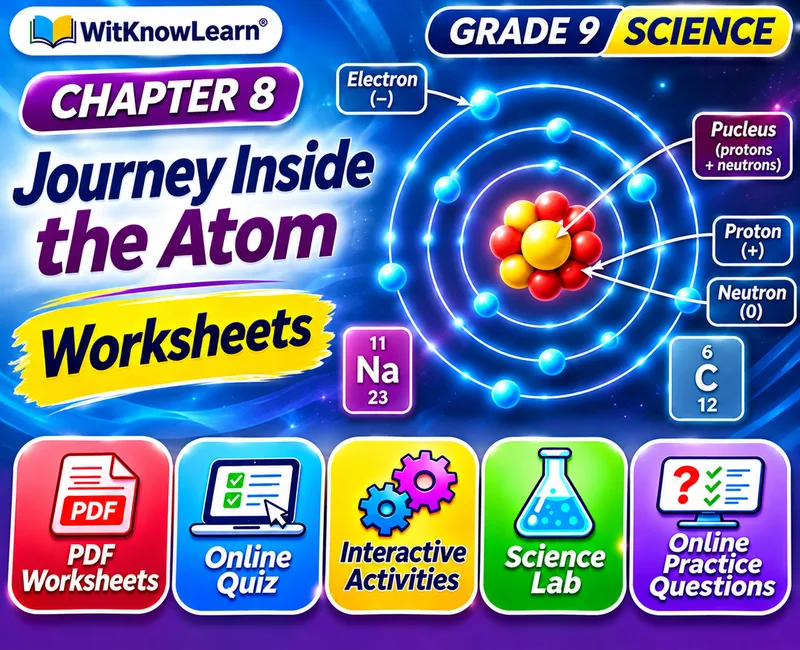
The atomic number (Z) is the number of protons, and it fixes the identity of an element. The mass number (A) is the total of protons and neutrons, together called nucleons. Electrons are so light that we ignore them in A. Electrons fill shells named K, L, M, N. A shell can hold at most 2n² electrons, but the outermost shell holds no more than 8. An outer shell of eight is an octet (two for helium), which makes an atom stable and largely unreactive. The valency, or combining capacity, is the number of electrons an atom loses, gains or shares to complete its octet. Sodium (2, 8, 1) loses one, oxygen (2, 6) gains two and carbon (2, 4) shares four.
Isotopes and isobars
Isotopes are atoms of the same element with the same Z but different A, such as ¹²C and ¹⁴C. They have the same chemistry and are very useful. Uranium-235 fuels nuclear power plants, cobalt-60 is used to treat cancer, iodine-131 treats goitre and thyroid cancer, and carbon-14 dates ancient fossils. Because isotopes occur in different proportions, an element’s atomic mass is a weighted average, which is why chlorine’s atomic mass is 35.5 u. Isobars are atoms of different elements with the same mass number.
Atoms and India
Homi Jehangir Bhabha, the father of the Indian nuclear programme, founded TIFR and the Bhabha Atomic Research Centre (BARC). At BARC, the Dhruva reactor is used for neutron-scattering research on superconductors, battery materials and medicines.
This Journey Inside the Atom worksheet for Class 9 Science brings the atom to life on WitKnowLearn with an online quiz, online activities and interactive games. Flip the fact cards, solve the Atom Lab cases, play the games, do the atom labs, take the challenges and then model the gold foil experiment, atoms and isotopes in the Virtual Lab.
Journey Inside the Atom Class 9 Science Guide
Journey Inside the Atom is Chapter 8 of the NCERT Class 9 Science textbook Exploration. It covers the history of the atom from Kanada and Dalton, the models of Thomson, Rutherford and Bohr, the discovery of the neutron, atomic number and mass number, the distribution of electrons in shells, valency, isotopes and their uses, average atomic mass and isobars. This guide explains each idea clearly for Class 9 students, parents and teachers. It goes with the Journey Inside the Atom Class 9 worksheet on WitKnowLearn, which also has an online quiz, online activities, interactive games and a Virtual Lab on the same page.
What is there in this chapter
- Early ideas of parmanu and atoms
- Thomson, Rutherford and Bohr models
- Electrons, protons and neutrons
- Symbols of elements
- Atomic number, mass number and nucleons
- Electron shells, octet and valency
- Isotopes, their uses, average atomic mass and isobars
Learning objectives
- Explain why each atomic model replaced the one before it.
- Find the numbers of protons, neutrons and electrons from Z and A.
- Write electronic configurations for the first 20 elements.
- Tell isotopes from isobars and compute weighted average mass.
Learning outcomes
After this page a student can:
- Draw atom diagrams with shells and electrons.
- Predict valency from the configuration.
- Explain the gold foil results.
- Name uses of isotopes in medicine, energy and archaeology.
Journey Inside the Atom Class 9 resources on this page
| Resource | What it does |
|---|---|
| Journey Inside the Atom Class 9 online quiz | 20 questions in three levels with a full answer review |
| Flip cards | Six cards on atoms as building blocks, early models, gold foil, orbits, counting particles and isotopes |
| Atom Lab | Three cause-and-effect cases: probing gold atoms, sodium’s octet and a medical tracer |
| 5 interactive games | Inside or outside the nucleus, valency 1 bubbles, atom pioneers memory, isotopes or isobars and Thomson or Rutherford |
| 5 atom labs | Atom ID card, shell filler, octet strategy, nuclide reader and gold foil detector |
| 5 challenges | Marked out of 3 each with a total out of 15 |
| Virtual Lab | Three model experiments: a hidden target, building atoms with beads and bean isotopes |
| Practice sheet | 16 questions with answer boxes and a live score |
Subatomic particles at a glance
| Particle | Charge | Mass | Where | Discovered by |
|---|---|---|---|---|
| Electron | −1 | Negligible | Shells | J. J. Thomson |
| Proton | +1 | About 1 u | Nucleus | - |
| Neutron | 0 | About 1 u | Nucleus | James Chadwick |
Types of questions
- Atomic models and experiments
- Counting protons, neutrons and electrons
- Electronic configuration
- Valency
- Isotopes and isobars
- Average atomic mass
- Assertion and reason and case studies
Solved examples
Common mistakes
| Mistake | Correct |
|---|---|
| Adding electrons to the mass number | A = protons + neutrons only. |
| Filling 18 electrons into M before N for Z ≤ 20 | For the first 20 elements, M takes 8, then N starts. |
| Calling valency the number of valence electrons | Valency is electrons lost, gained or shared. |
| Thinking isotopes differ chemically | Isotopes share chemical properties. |
| Taking a simple average of isotope masses | Use the weighted average by abundance. |
Daily life
Nuclear power, cancer treatment, thyroid medicine, carbon dating, LED lights and advanced batteries all depend on understanding atoms. Indian research centres like BARC and TIFR keep pushing this science forward.
Tips for parents and teachers
- Build bead or clay models of atoms with shells.
- Play an “atom clue” guessing game with Z and A.
- Make a timeline poster of atomic models.
- Read about Homi Bhabha and BARC together.
- Let students retry the challenges to earn 3 stars.
Related Class 9 Science Worksheets
- Exploration Class 9 Science Worksheet
- Matter in Our Surroundings Class 9 Worksheet
- Motion Class 9 Worksheet
- Atoms and Molecules Class 9 Worksheet
- Work and Energy Class 9 Worksheet
- The Fundamental Unit of Life Class 9 Worksheet
- Tissues Class 9 Worksheet
- Is Matter Around Us Pure Class 9 Worksheet
- Gravitation Class 9 Worksheet
- Force and Laws of Motion Class 9 Worksheet
- Sound Class 9 Worksheet
- Improvement in Food Resources Class 9 Worksheet
Frequently Asked Questions
 Download