Class 9 Science · NCERT Exploration · Chapter 13
Earth as a System: Energy, Matter, and Life Class 9 Worksheet with Online Quiz, Games and Activities
How can a warmer Arabian Sea change India’s monsoon, and where does the carbon in your lunch come from? Find out with this Earth as a System: Energy, Matter, and Life worksheet for Class 9 Science, NCERT Exploration Chapter 13: take the Earth as a System: Energy, Matter, and Life Class 9 online quiz, run three experiments in the Virtual Lab and play the activities and interactive games online.
Flip the cards and try the Earth System Lab, then tap the Games, Labs, Challenges or Virtual Lab island.
Earth as a System: Energy, Matter, and Life Class 9 Online Quiz
20 questions · tap an answer to move on · full review at the end
Flip the cards, try the Earth System Lab, then play the games, do the labs and take the challenges. Earn up to 3 stars in every activity.
Fact cards: tap a card to flip it
Earth System Lab
Three real-life cases depend on how energy and matter flow through the Earth system. In each one, predict which choice will work, drag it onto the picture and watch what happens. A wrong choice shows what goes wrong, so you can try again.
Challenge marks: 0 / 15 (0 of 5 challenges done)
Finish all 5 challenges to see your comment.
Virtual Lab: do real experiments step by step
Practice sheet
Earth as a System: Energy, Matter, and Life Class 9 Activities
Cool a hot city, save the ozone layer and power a village in the Earth System Lab, then compare how surfaces heat up, build a model greenhouse and watch cold salty water sink in the Virtual Lab. Earn up to 3 stars in every activity.
One Earth, five spheres
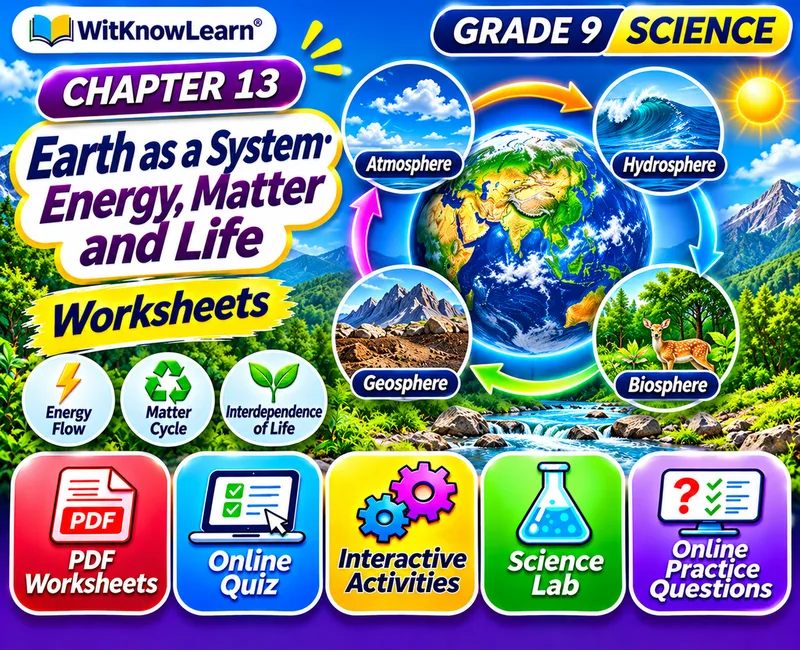
"Earth as a System: Energy, Matter, and Life" is Chapter 13 of the new NCERT Class 9 Science textbook Exploration. It joins ideas from earlier chapters into one picture of the Earth as a system of five interacting spheres: the geosphere (rocks, soil and landforms such as the Deccan plateau), the hydrosphere (oceans, rivers, lakes and groundwater), the cryosphere (glaciers, snow and polar ice), the atmosphere (the air around us) and the biosphere (all living things and their habitats). A change in one sphere spreads to the others. Less winter snow means a smaller lake in summer and less grass for grazing animals. A warmer Arabian Sea adds more water vapour to monsoon winds, bringing floods to some regions and drought to others.
Energy from the Sun
Solar radiation reaches the Earth as electromagnetic waves travelling at 3 × 10⁸ m/s. About 99% of the Sun’s energy arrives as ultraviolet, visible and infrared radiation. Gamma rays and X-rays are filtered high up, and the ozone layer absorbs most UV. Visible light powers photosynthesis, and infrared warms the surface. The solar constant, measured at the top of the atmosphere, is about 1.4 kW/m², but gases, clouds and dust reduce the insolation at the ground to about 1 kW/m² on a clear day. Anna Mani mapped insolation across India, showing the country’s huge solar energy potential.
Uneven heating and the atmosphere
Surfaces heat differently. The fraction of sunlight a surface reflects is its albedo; snow and ice reflect most, while dark soil and ocean water absorb more. Concrete and asphalt store heat and make cities warmer than villages, the urban heat island effect. Because the Earth is a sphere, sunlight is concentrated near the equator and spread out near the poles. The atmosphere, about 78% nitrogen and 21% oxygen, is layered. Nearly all weather happens in the troposphere (up to about 12 km), where temperature falls by about 6.5 °C per km. In the stratosphere (12–50 km), ozone absorbs UV and the air warms with height. Greenhouse gases such as CO₂, methane and water vapour trap the infrared heat given off by the surface and keep the Earth warm enough for life. CFCs once thinned the ozone layer, but the Montreal Protocol is helping it recover.
Winds and ocean currents
Uneven heating creates pressure differences that drive winds. Valley breezes blow up sunny slopes by day and mountain breezes blow down at night. On a planetary scale, rising air forms an equatorial low, sinking air forms sub-tropical highs near 30°, and the Earth’s rotation curves winds into their familiar paths. Winds drag surface water to form ocean currents; warm water flows poleward on the surface while cold, salty, dense water sinks and returns at depth, and rotation turns currents into huge gyres. Currents carry heat and nutrients around the planet.
Cycles of matter
- Water cycle: evaporation, condensation and precipitation link all spheres; a warmer world brings heavier bursts of rain and longer dry spells.
- Carbon cycle: photosynthesis takes in CO₂; respiration, decay and burning return it. Fossil fuels lock carbon away for millions of years. CO₂ has risen from about 315 ppm in 1960 to about 420 ppm.
- Nitrogen cycle: fixation, nitrification, assimilation, ammonification and denitrification move nitrogen between air, soil and life.
- Oxygen cycle: respiration and combustion use oxygen, and photosynthesis restores it.
Human activity disturbs these cycles: excess CO₂ warms the planet and makes the oceans more acidic, fertiliser runoff causes algal blooms, and deforestation reduces rainfall and increases erosion. Renewable energy, planting trees, saving water and Mission LiFE habits help restore the balance.
This Earth as a System worksheet for Class 9 Science brings the chapter to life on WitKnowLearn with an online quiz, online activities and interactive games. Flip the fact cards, solve the Earth System Lab cases, play the games, do the Earth labs, take the challenges and then run three experiments in the Virtual Lab.
Earth as a System: Energy, Matter, and Life Class 9 Science Guide
Earth as a System: Energy, Matter, and Life is Chapter 13 of the NCERT Class 9 Science textbook Exploration. It covers the five spheres of the Earth, solar radiation and insolation, albedo, the layers of the atmosphere, the greenhouse effect, winds and ocean currents, the water, carbon, nitrogen and oxygen cycles, and human impact on the Earth’s processes. This guide explains each idea clearly for Class 9 students, parents and teachers. It goes with the Earth as a System Class 9 worksheet on WitKnowLearn, which also has an online quiz, online activities, interactive games and a Virtual Lab on the same page.
What is there in this chapter
- Geosphere, hydrosphere, cryosphere, atmosphere and biosphere
- The electromagnetic spectrum, solar constant and insolation
- Albedo and the urban heat island effect
- Layers of the atmosphere and the greenhouse effect
- Local winds, planetary winds and ocean currents
- Biogeochemical cycles
- Human impact and ways to restore balance
Learning objectives
- Describe how the Earth’s spheres interact.
- Explain why the Earth is heated unevenly.
- Explain how uneven heating drives winds and ocean currents.
- Describe the carbon, nitrogen, oxygen and water cycles.
Learning outcomes
After this page a student can:
- Calculate solar energy from insolation, area and time.
- Predict how a change in one sphere affects the others.
- Explain the roles of ozone and greenhouse gases.
- Suggest actions that reduce human impact on the cycles.
Earth as a System Class 9 resources on this page
| Resource | What it does |
|---|---|
| Earth as a System: Energy, Matter, and Life Class 9 online quiz | 20 questions in three levels with a full answer review |
| Flip cards | Six cards on the five spheres, the sunlight budget, hot cities, moving air, carbon’s journey and melting ice |
| Earth System Lab | Three cause-and-effect cases: cooling a city plot, choosing a fridge coolant and powering a village |
| 5 interactive games | Carbon in or out, oxygen users, Earth science memory, sphere sort and troposphere or stratosphere |
| 5 Earth labs | Nitrogen cycle, atmosphere climb, sunlight filter, pressure belts and ocean water |
| 5 challenges | Marked out of 3 each with a total out of 15 |
| Virtual Lab | Three full experiments: heating of surfaces, a model greenhouse and why cold salty water sinks |
| Practice sheet | 16 questions with answer boxes and a live score |
Biogeochemical cycles at a glance
| Cycle | Taken from the air by | Returned to the air by |
|---|---|---|
| Carbon | Photosynthesis, oceans | Respiration, decay, burning |
| Nitrogen | Nitrogen-fixing bacteria, lightning | Denitrifying bacteria |
| Oxygen | Respiration, combustion, oxide formation | Photosynthesis |
| Water | Condensation and precipitation | Evaporation and transpiration |
Types of questions
- Spheres and their interactions
- Solar radiation and insolation numericals
- Albedo and uneven heating
- Atmospheric layers and the greenhouse effect
- Winds and ocean currents
- Biogeochemical cycles
- Assertion and reason and case studies
Solved examples
Common mistakes
| Mistake | Correct |
|---|---|
| Thinking CO₂ absorbs incoming sunlight to warm the Earth | The surface absorbs sunlight; greenhouse gases trap the re-radiated infrared. |
| Confusing insolation and insulation | Insolation is solar radiation reaching the surface. |
| Saying the equator is hot because it is closer to the Sun | Sunlight falls more directly there. |
| Thinking all ozone is good | Ground-level ozone is a harmful pollutant. |
| Thinking plants use N₂ gas directly | Nitrogen must first be fixed. |
Daily life
Light-coloured roofs, shady trees, solar panels, careful fertiliser use and saving energy and water all apply the ideas of this chapter. Weather forecasts and monsoon predictions depend on understanding how the spheres interact.
Tips for parents and teachers
- Measure temperatures of different surfaces in sunlight.
- Track local rainfall over a month.
- Trace the carbon and nitrogen in one meal back to the air.
- Discuss Mission LiFE habits at home.
- Let students retry the challenges to earn 3 stars.
Related Class 9 Science Worksheets
- Exploration Class 9 Science Worksheet
- Matter in Our Surroundings Class 9 Worksheet
- Motion Class 9 Worksheet
- Structure of the Atom Class 9 Worksheet
- Work and Energy Class 9 Worksheet
- The Fundamental Unit of Life Class 9 Worksheet
- Tissues Class 9 Worksheet
- Is Matter Around Us Pure Class 9 Worksheet
- Gravitation Class 9 Worksheet
- Force and Laws of Motion Class 9 Worksheet
- Atoms and Molecules Class 9 Worksheet
- Improvement in Food Resources Class 9 Worksheet
Frequently Asked Questions
 Download