Class 9 Science · NCERT Exploration · Chapter 6
How Forces Affect Motion Class 9 Worksheet with Online Quiz, Games and Activities
Why does a canoe move forward when the paddle pushes water back, and why is a loaded canoe slower? Find out with this How Forces Affect Motion worksheet for Class 9 Science, NCERT Exploration Chapter 6: take the How Forces Affect Motion Class 9 online quiz, run three experiments in the Virtual Lab and play the activities and interactive games online.
Flip the cards and try the Force Lab, then tap the Games, Labs, Challenges or Virtual Lab island.
How Forces Affect Motion Class 9 Online Quiz
20 questions · tap an answer to move on · full review at the end
Flip the cards, try the Force Lab, then play the games, do the labs and take the challenges. Earn up to 3 stars in every activity.
Fact cards: tap a card to flip it
Force Lab
Three real-life cases each show one law of motion. In each one, predict which choice will work, drag it onto the picture and watch what happens. A wrong choice shows what goes wrong, so you can try again.
Challenge marks: 0 / 15 (0 of 5 challenges done)
Finish all 5 challenges to see your comment.
Virtual Lab: do real experiments step by step
Practice sheet
How Forces Affect Motion Class 9 Activities
Test all three laws in the Force Lab, push a crate against friction, weigh objects with a spring balance and pull two balances against each other in the Virtual Lab. Earn up to 3 stars in every activity.
What causes motion to change?
"How Forces Affect Motion" is Chapter 6 of the new NCERT Class 9 Science textbook Exploration. Chapter 4 described motion with position, velocity and acceleration, and this chapter asks what causes those changes. It opens with a canoeist: why does pushing water backwards with a paddle send the canoe forwards, and why does the same push make an empty canoe go faster than a loaded one? The answers come from the idea of force and Newton’s three laws of motion.
Force and net force
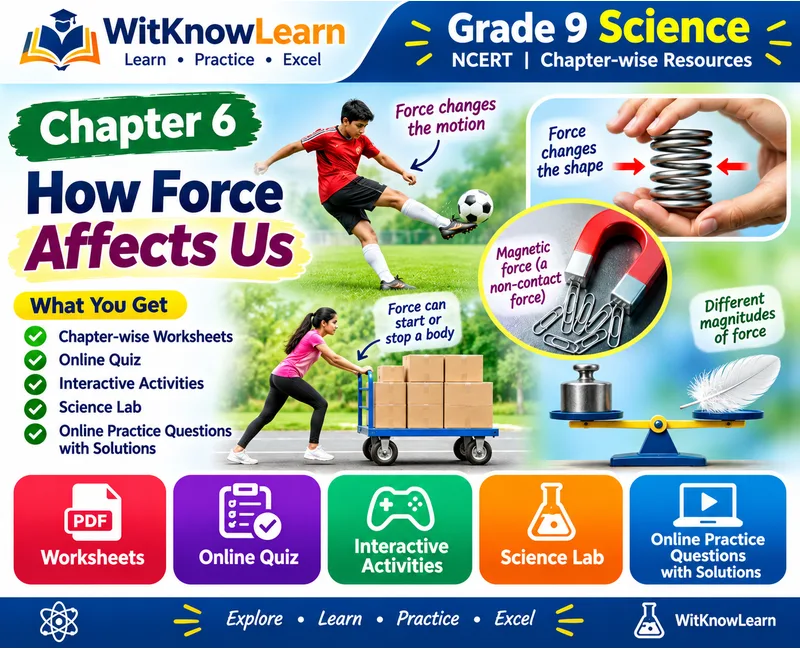
A force can start or stop motion, change speed or direction, and change an object’s shape. When several forces act, what matters is the net force. Forces in the same direction add up. Forces in opposite directions subtract, and the net force points along the larger one. If the forces cancel, they are balanced and the object’s velocity does not change. If they do not cancel, they are unbalanced and the object accelerates. A tug of war shows both cases clearly.
Friction
Friction acts between surfaces in contact and opposes their sliding against each other. Rough surfaces give more friction than smooth ones, so a sliding object slows down sooner on them. Friction can be a nuisance, since it wears out parts and produces heat, and we reduce it with lubricants, smooth coatings, streamlined shapes and even magnetic levitation. It is also essential. When you walk, you push the ground backwards and friction from the ground pushes you forwards. Without it you could not walk, write or stop a bicycle.
Newton’s first law and inertia
For centuries people believed a moving object needed a force to keep it going, because friction always slowed things down. In the 17th century Galileo Galilei argued through thought experiments that on a perfectly smooth horizontal plane an object would keep moving forever. Isaac Newton used the word inertia for an object’s tendency to resist any change in its state of rest or uniform motion, and in 1687 he stated the first law: an object stays at rest or keeps moving with constant velocity unless a net force acts on it. This is why passengers lurch when a bus starts or stops, and why seat belts matter.
Newton’s second law
A net force produces acceleration in its own direction. The acceleration is proportional to the net force and inversely proportional to the mass: a = F/m, or F = ma. One newton (N) is the force that gives a 1 kg mass an acceleration of 1 m s⁻². Holding a 100 g object in your palm takes about 1 N. Weight is the gravitational force W = mg, and g is the same for every object, whatever its mass. In a more complete form, the second law uses momentum (p = mv): force equals the rate of change of momentum. This explains why air bags and seat belts reduce injury. By making the stopping time longer, they make the force smaller. It also explains why a coconut cracks when brought down fast and stopped suddenly.
Newton’s third law
Whenever one object pushes or pulls another, the second pushes or pulls back with a force that is equal in size and opposite in direction. These two forces always act on different objects, so they never cancel each other. A balloon pushes air out and the air pushes the balloon forward. A rocket pushes hot gas down and the gas pushes the rocket up. A swimmer pushes water back and moves forward, and a gun recoils when it fires.
Thinking in systems
Objects joined together, such as two boxes tied by a string or a train of coaches, can be treated as one system. Forces between parts of the system, such as the tension in the string, are internal and cancel out. Only external forces decide how the whole system moves, so a = F ÷ (m₁ + m₂). Newton’s laws work from cricket balls to planets. They need changing only near the speed of light, at atomic scales or very close to extremely massive objects.
This How Forces Affect Motion worksheet for Class 9 Science brings the chapter to life on WitKnowLearn with an online quiz, online activities and interactive games. Flip the fact cards, test the three laws in the Force Lab, play the games, do the force labs, take the challenges and then measure friction, inertia and action-reaction in the Virtual Lab.
How Forces Affect Motion Class 9 Science Guide
How Forces Affect Motion is Chapter 6 of the NCERT Class 9 Science textbook Exploration. It covers force and net force, balanced and unbalanced forces, friction, inertia and Newton’s first law, F = ma and the newton, weight, momentum, Newton’s third law and connected systems. This guide explains each idea clearly for Class 9 students, parents and teachers. It goes with the How Forces Affect Motion Class 9 worksheet on WitKnowLearn, which also has an online quiz, online activities, interactive games and a Virtual Lab on the same page.
What is there in this chapter
- Effects of force and net force
- Balanced and unbalanced forces
- Friction: its causes, uses and how to reduce it
- Galileo, inertia and Newton’s first law
- Newton’s second law, the newton, weight and momentum
- Newton’s third law and rockets
- Connected objects as a system
Learning objectives
- Calculate the net force from several forces.
- Explain everyday events with the three laws of motion.
- Solve problems using F = ma and W = mg.
- Identify action-reaction pairs and internal forces.
Learning outcomes
After this page a student can:
- Predict whether an object will accelerate from the forces on it.
- Explain how seat belts and air bags reduce injury.
- Explain why friction is needed for walking.
- Find the acceleration of two connected boxes.
How Forces Affect Motion Class 9 resources on this page
| Resource | What it does |
|---|---|
| How Forces Affect Motion Class 9 online quiz | 20 questions in three levels with a full answer review |
| Flip cards | Six cards on net force, friction, inertia, mass, action-reaction and systems |
| Force Lab | Three cause-and-effect cases: the tablecloth trick, matching acceleration and leaving the dock |
| 5 interactive games | Balanced or unbalanced, friction helps bubbles, force ideas memory, which law and internal or external |
| 5 force labs | Force formulas, push against friction, surface slide, spring balance and action-reaction finder |
| 5 challenges | Marked out of 3 each with a total out of 15 |
| Virtual Lab | Three full experiments: friction on surfaces, coin and card inertia and two spring balances |
| Practice sheet | 16 questions with answer boxes and a live score |
The three laws at a glance
| Law | Statement | Example |
|---|---|---|
| First | No net force: no change in velocity (inertia) | Passengers lurch when a bus starts |
| Second | F = ma, acceleration along the net force | A loaded cart needs a bigger push |
| Third | Equal and opposite forces on different objects | A rocket pushes gas down and rises |
Types of questions
- Net force calculations
- F = ma and weight numericals
- Friction and balanced forces
- Explaining events with the laws of motion
- Action-reaction pairs
- Connected systems
- Assertion and reason and case studies
Solved examples
Common mistakes
| Mistake | Correct |
|---|---|
| Thinking motion needs a force | Only a change in motion needs a net force. |
| Cancelling action and reaction | They act on different objects and never cancel. |
| Confusing mass and weight | Mass is in kg; weight is a force in N. |
| Forgetting friction in F = ma | Use the net force, after subtracting friction. |
| Saying friction only opposes us | Friction also makes walking and braking possible. |
Daily life
Seat belts, air bags, helmets, sports shoes, ball bearings, rockets and even the way we catch a ball all use Newton’s laws. Understanding forces helps us move safely on roads and design better machines.
Tips for parents and teachers
- Do the coin-on-card trick at home.
- Pull a toy car with a rubber band, empty and then loaded.
- Launch a balloon rocket along a string.
- Discuss why seat belts are compulsory.
- Let students retry the challenges to earn 3 stars.
Related Class 9 Science Worksheets
- Exploration Class 9 Science Worksheet
- Matter in Our Surroundings Class 9 Worksheet
- Motion Class 9 Worksheet
- Atoms and Molecules Class 9 Worksheet
- Structure of the Atom Class 9 Worksheet
- The Fundamental Unit of Life Class 9 Worksheet
- Tissues Class 9 Worksheet
- Is Matter Around Us Pure Class 9 Worksheet
- Gravitation Class 9 Worksheet
- Work and Energy Class 9 Worksheet
- Sound Class 9 Worksheet
- Improvement in Food Resources Class 9 Worksheet
Frequently Asked Questions
 Download