
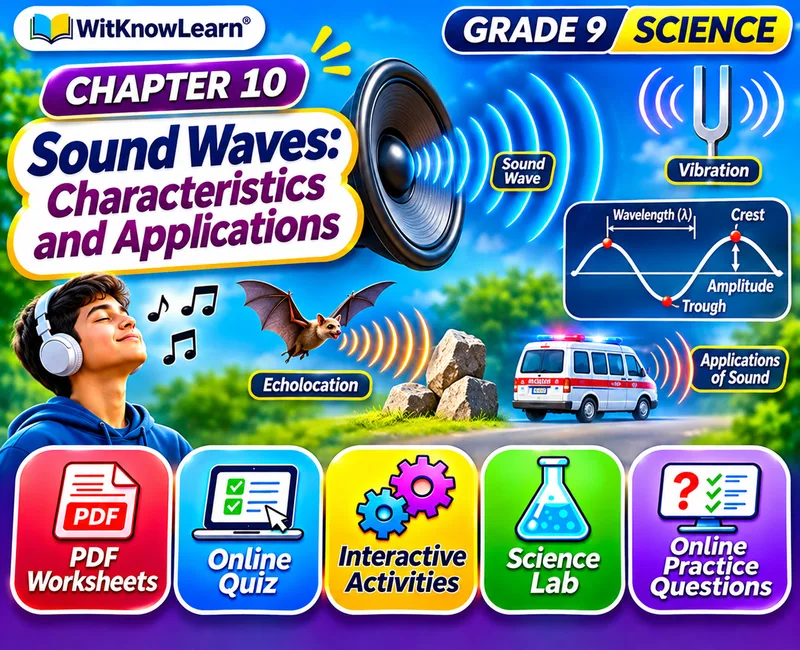
Class 9 Science · NCERT Exploration · Chapter 10
Sound Waves Class 9 Worksheet with Online Quiz, Games and Activities
Can astronauts in space hear each other, and how do bats hunt in the dark? Find out with this Sound Waves worksheet for Class 9 Science, NCERT Exploration Chapter 10: take the Sound Waves Class 9 online quiz, run three experiments in the Virtual Lab and play the activities and interactive games online.
Flip the cards and try the Sound Lab, then tap the Games, Labs, Challenges or Virtual Lab island.
Sound Waves Class 9 Online Quiz
20 questions · tap an answer to move on · full review at the end
Flip the cards, try the Sound Lab, then play the games, do the labs and take the challenges. Earn up to 3 stars in every activity.
Fact cards: tap a card to flip it
Sound Lab
Three real-life cases depend on how sound behaves. In each one, predict which choice will work, drag it onto the picture and watch what happens. A wrong choice shows what goes wrong, so you can try again.
Challenge marks: 0 / 15 (0 of 5 challenges done)
Finish all 5 challenges to see your comment.
Virtual Lab: do real experiments step by step
Practice sheet
Sound Waves Class 9 Activities
Hear a train through the rail, raise a guitar’s pitch and measure sea depth in the Sound Lab, explore frequency and wavelength, time echoes and measure the speed of sound in the Virtual Lab. Earn up to 3 stars in every activity.
Can astronauts hear each other?
"Sound Waves: Characteristics and Applications" is Chapter 10 of the new NCERT Class 9 Science textbook Exploration. It begins with two astronauts repairing a space station. Can they talk to each other and hear the clanking metal? And how do bats find their prey in the dark? To answer these questions, we need to know how sound is produced, how it travels and what makes one sound different from another.
Production and propagation
Sound is a form of energy produced by vibrating objects: a tuning fork’s prongs, a drum skin, vocal cords, guitar strings or the air column in a flute. In the village of Kongthong in Meghalaya, every person even has a whistled “tune name”, a tradition called Jingrwai Iawbei. A vibrating object pushes and pulls the particles of the medium next to it, creating regions of high density called compressions and regions of low density called rarefactions. The disturbance travels outward like the bunched-up turns of a slinky. The particles only vibrate back and forth; it is the energy that travels. Because the particles move parallel to the direction of travel, sound waves are longitudinal. Sound needs a material medium, so it cannot travel through the vacuum of space. That is why astronauts use radios.
Speed of sound
Sound travels fastest in solids, slower in liquids and slowest in gases. That is about 5000 m/s in steel, about 1500 m/s in sea water and about 331 m/s in air at 0 °C, rising to about 344 m/s at 22 °C. Light is far faster, so we see lightning before we hear the thunder. An aircraft flying faster than sound produces a loud sonic boom.
Characteristics of a sound wave
- Wavelength (λ): the distance between two consecutive compressions (or rarefactions).
- Frequency (ν): the number of oscillations per second, in hertz (Hz). Time period T = 1/ν.
- Speed: v = ν × λ. For a fixed speed, a higher frequency means a shorter wavelength.
- Pitch depends on frequency. In music, the notes Sa, Re, Ga, Ma and Pa have rising frequencies.
- Loudness depends on amplitude and is measured in decibels. Leaves rustle at a few dB, conversation is about 60 dB and firecrackers can exceed 100 dB.
Humans hear roughly 20 Hz to 20 kHz. Sound below 20 Hz is infrasound, which elephants can detect. Sound above 20 kHz is ultrasound, which dogs, cats, bats and dolphins can hear.
Echoes and applications
An echo is reflected sound heard separately from the original. Our ears need a gap of at least 0.1 s, so at 340 m/s the reflecting surface must be at least 17 m away. Hard, smooth surfaces give strong echoes, while curtains and soft panels absorb sound. Echoes have many uses. Bats find insects by echolocation. SONAR on ships finds the depth of the sea and locates objects using ultrasound, with depth = speed × time ÷ 2. Doctors use ultrasound scans to see organs and unborn babies safely. Car parking sensors and audio surveillance of drones depend on sound too. Scientists now record sounds from Mars and time undersea earthquakes to detect warming oceans.
This Sound Waves worksheet for Class 9 Science brings the chapter alive on WitKnowLearn with an online quiz, online activities and interactive games. Flip the fact cards, solve the Sound Lab cases, play the games, do the sound labs, take the challenges and then build a string telephone, play bottle music and measure the speed of sound in the Virtual Lab.
Sound Waves Class 9 Science Guide
Sound Waves: Characteristics and Applications is Chapter 10 of the NCERT Class 9 Science textbook Exploration. It covers how sound is produced, how it travels as a longitudinal wave, the need for a medium, the speed of sound, wavelength, frequency, time period, amplitude, pitch and loudness, the range of hearing, echoes and uses such as SONAR and ultrasound. This guide explains each idea clearly for Class 9 students, parents and teachers. It goes with the Sound Waves Class 9 worksheet on WitKnowLearn, which also has an online quiz, online activities, interactive games and a Virtual Lab on the same page.
What is there in this chapter
- Production of sound by vibrations
- Compressions, rarefactions and longitudinal waves
- Speed of sound in different media
- Graph of a sound wave; wavelength, frequency and time period
- Pitch, loudness and decibels
- Infrasound, audible sound and ultrasound
- Echo, SONAR, medical ultrasound and echolocation
Learning objectives
- Explain how sound travels through a medium.
- Use v = νλ and T = 1/ν to solve problems.
- Relate pitch to frequency and loudness to amplitude.
- Calculate distances using echoes.
Learning outcomes
After this page a student can:
- Explain why sound cannot travel in space.
- Compare the speed of sound in solids, liquids and gases.
- Find the depth of the sea from a SONAR echo.
- Name uses of ultrasound in medicine and technology.
Sound Waves Class 9 resources on this page
| Resource | What it does |
|---|---|
| Sound Waves Class 9 online quiz | 20 questions in three levels with a full answer review |
| Flip cards | Six cards on vibration, propagation, vacuum, pitch, echolocation and echoes |
| Sound Lab | Three cause-and-effect cases: a distant train, a higher note and the depth of the sea |
| 5 interactive games | Compression or rarefaction, ultrasound bubbles, wave words memory, speed in media and pitch or loudness |
| 5 sound labs | Wave units, frequency and wavelength, hearing range, echo distance and speed in three media |
| 5 challenges | Marked out of 3 each with a total out of 15 |
| Virtual Lab | Three full experiments: a string telephone, music from water bottles and speed of sound by echo |
| Practice sheet | 16 questions with answer boxes and a live score |
Key formulas at a glance
| Quantity | Formula | Unit |
|---|---|---|
| Frequency | oscillations ÷ time | Hz |
| Time period | T = 1/ν | s |
| Speed of a wave | v = ν × λ | m/s |
| Distance by echo | d = v × t ÷ 2 | m |
Types of questions
- Production and propagation of sound
- Wave graph reading
- v = νλ numericals
- Echo and SONAR calculations
- Pitch and loudness
- Range of hearing
- Assertion and reason and case studies
Solved examples
Common mistakes
| Mistake | Correct |
|---|---|
| Saying air travels from the source to the ear | Energy travels; particles only vibrate. |
| Forgetting to halve the echo distance | Sound goes there and back. |
| Linking pitch to loudness | Pitch depends on frequency. |
| Thinking sound is fastest in air | It is fastest in solids. |
| Mixing up kHz and Hz | 1 kHz = 1000 Hz. |
Daily life
Music, speech, hospital scans, parking sensors, fishing boats, submarines and drone detection all use the physics of sound. Protecting our ears from very loud sounds is also part of this chapter’s message.
Tips for parents and teachers
- Make a string telephone and compare different strings.
- Use a free sound app to see frequencies of musical notes.
- Count seconds between lightning and thunder to estimate distance.
- Find echo spots near school and estimate distances.
- Let students retry the challenges to earn 3 stars.
Related Class 9 Science Worksheets
- Exploration Class 9 Science Worksheet
- Matter in Our Surroundings Class 9 Worksheet
- Motion Class 9 Worksheet
- Structure of the Atom Class 9 Worksheet
- Work and Energy Class 9 Worksheet
- The Fundamental Unit of Life Class 9 Worksheet
- Tissues Class 9 Worksheet
- Is Matter Around Us Pure Class 9 Worksheet
- Gravitation Class 9 Worksheet
- Force and Laws of Motion Class 9 Worksheet
- Atoms and Molecules Class 9 Worksheet
- Improvement in Food Resources Class 9 Worksheet
Frequently Asked Questions
 Download


