Class 9 Science · NCERT Exploration · Chapter 4
Describing Motion Around Us Class 9 Worksheet with Online Quiz, Games and Activities
How far behind a truck should you drive, and why does a car turning at steady speed still accelerate? Find out with this Describing Motion Around Us worksheet for Class 9 Science, NCERT Exploration Chapter 4: take the Describing Motion Around Us Class 9 online quiz, run three experiments in the Virtual Lab and play the activities and interactive games online.
Flip the cards and try the Motion Lab, then tap the Games, Labs, Challenges or Virtual Lab island.
Describing Motion Around Us Class 9 Online Quiz
20 questions · tap an answer to move on · full review at the end
Flip the cards, try the Motion Lab, then play the games, do the labs and take the challenges. Earn up to 3 stars in every activity.
Fact cards: tap a card to flip it
Motion Lab
Three real-life cases depend on describing motion correctly. In each one, predict which choice will work, drag it onto the picture and watch what happens. A wrong choice shows what goes wrong, so you can try again.
Challenge marks: 0 / 15 (0 of 5 challenges done)
Finish all 5 challenges to see your comment.
Virtual Lab: do real experiments step by step
Practice sheet
Describing Motion Around Us Class 9 Activities
Predict safe gaps and throws in the Motion Lab, grow a velocity-time graph, time vehicles in a speed trap and measure your own reaction time in the Virtual Lab. Earn up to 3 stars in every activity.
Everything is moving
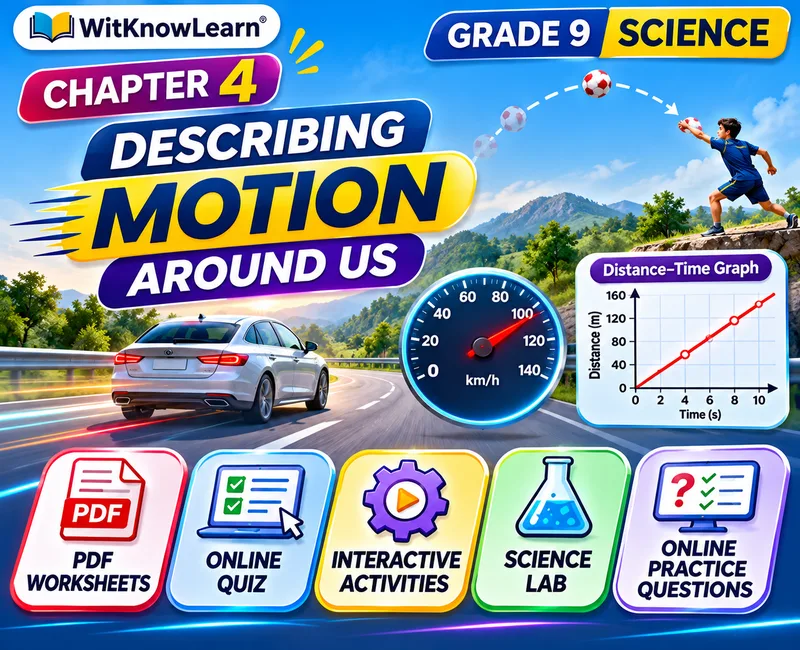
"Describing Motion Around Us" is Chapter 4 of the new NCERT Class 9 Science textbook Exploration. Motion is everywhere, from flitting butterflies and galloping horses to dust dancing in a sunbeam and tides rising and falling. To study such complex motion, scientists begin with idealised, simple forms. This chapter looks closely at motion in a straight line and at uniform circular motion, and shows how to describe motion with words, numbers, equations and graphs. It opens with a practical question: how far behind a truck should we drive so that we can stop safely if it brakes suddenly?
Position, distance and displacement
To describe where something is, we need a reference point (the origin) plus a distance and a direction from it. An object is in motion if its position relative to the reference point changes with time. On a straight line, directions are shown with + and − signs. Note that an instant of time is a single clock reading, while a time interval is the gap between two readings. Distance travelled is the total length of the path. Displacement is the net change in position, which has both a magnitude and a direction. Displacement can never be bigger than the distance travelled, and it is zero whenever an object returns to where it started.
Speed, velocity and acceleration
Average speed = total distance ÷ time interval, and average velocity = displacement ÷ time interval. Both are measured in m s⁻¹ or km h⁻¹ (1 km h⁻¹ = 5/18 m s⁻¹). The idea that speed is distance divided by time is very old: it appears in the Aryabhatiya (5th century CE), and the Ganitakaumudi (14th century CE) uses it in puzzles about travellers measured in yojanas. Average acceleration = change in velocity ÷ time interval, in m s⁻². On a straight path, acceleration points along the motion when speed increases and against it when speed decreases. A fast car moving at a steady velocity has zero acceleration. A freely falling object gains about 9.8 m s⁻¹ every second, which is the acceleration due to gravity, g.
Motion on graphs
- On a position-time graph, a horizontal line means the object is at rest, a straight sloping line means constant velocity and a curve means the velocity is changing. The slope gives the velocity.
- On a velocity-time graph, the slope gives the acceleration and the area between the line and the time axis gives the displacement.
- A graph is not a route map. It shows how position or velocity changes with time, not the path taken.
Kinematic equations
For motion in a straight line with constant acceleration, five quantities are linked: initial velocity u, final velocity v, acceleration a, displacement s and time t. The equations are v = u + at, s = ut + ½at² and v² = u² + 2as, and all three can be derived from the slope and area of a velocity-time graph. They explain why stopping distance is made of two parts: the distance covered at full speed during the driver’s reaction time, and the braking distance. Braking distance grows with the square of the speed. That is why safe gaps matter, and why vehicle-to-vehicle (V2V) warning systems are being developed in many countries, including India.
Motion in a plane and in a circle
A vehicle overtaking another, a kicked ball and a satellite in orbit all move in a plane (two dimensions), while a bird or an aircraft moves in three dimensions. In uniform circular motion an object moves along a circle at constant speed. One revolution covers a distance of 2πR but gives zero displacement. The velocity at any point is along the tangent, so its direction changes continuously. That makes the motion accelerated even though the speed is steady. Uniform circular motion is an idealised model, yet it is the starting point for understanding planets, satellites and vehicles going round curves.
This Describing Motion Around Us worksheet for Class 9 Science turns the chapter into active learning on WitKnowLearn with an online quiz, online activities and interactive games. Flip the fact cards, solve the Motion Lab cases, play the games, work through the motion labs, take the challenges and then measure speeds, reaction times and accelerations in the Virtual Lab.
Describing Motion Around Us Class 9 Science Guide
Describing Motion Around Us is Chapter 4 of the NCERT Class 9 Science textbook Exploration. It covers position, distance and displacement, average speed and velocity, average acceleration, position-time and velocity-time graphs, the kinematic equations and uniform circular motion. This guide explains each idea clearly for Class 9 students, parents and teachers. It goes with the Describing Motion Around Us Class 9 worksheet on WitKnowLearn, which also has an online quiz, online activities, interactive games and a Virtual Lab on the same page.
What is there in this chapter
- Reference point, position, instants and intervals
- Distance travelled and displacement
- Average speed, average velocity and uniform motion
- Average acceleration and acceleration due to gravity
- Plotting and reading position-time and velocity-time graphs
- Kinematic equations and stopping distance
- Motion in a plane and uniform circular motion
Learning objectives
- Tell the difference between scalars and vectors such as distance and displacement.
- Calculate speed, velocity and acceleration with correct units.
- Find velocity, acceleration and displacement from graphs.
- Apply v = u + at, s = ut + ½at² and v² = u² + 2as.
Learning outcomes
After this page a student can:
- Convert between km/h and m/s quickly.
- Explain why stopping distance increases sharply with speed.
- Read the type of motion from the shape of a graph.
- Explain why uniform circular motion is accelerated.
Describing Motion Around Us Class 9 resources on this page
| Resource | What it does |
|---|---|
| Describing Motion Around Us Class 9 online quiz | 20 questions in three levels with a full answer review |
| Flip cards | Six cards on position, displacement, velocity, acceleration, graphs and circular motion |
| Motion Lab | Three cause-and-effect cases: a safe following gap, a hammer throw and measuring g |
| 5 interactive games | Scalar or vector, acceleration bubbles, motion facts memory, read the graph and uniform or non-uniform |
| 5 motion labs | Equation builder, velocity-time graph, unit converter, speed trap and circular track |
| 5 challenges | Marked out of 3 each with a total out of 15 |
| Virtual Lab | Three full experiments: comparing speeds, reaction time with a falling ruler and distance against time on a ramp |
| Practice sheet | 16 questions with answer boxes and a live score |
Key formulas at a glance
| Quantity | Formula | SI unit |
|---|---|---|
| Average speed | total distance ÷ time | m s⁻¹ |
| Average velocity | displacement ÷ time | m s⁻¹ |
| Average acceleration | (v − u) ÷ t | m s⁻² |
| Kinematic equations | v = u + at, s = ut + ½at², v² = u² + 2as | - |
| Speed in uniform circular motion | 2πR ÷ T | m s⁻¹ |
Types of questions
- Distance and displacement on straight and circular paths
- Average speed and average velocity
- Acceleration and unit conversion
- Graph reading and graph area
- Kinematic equation numericals
- Stopping distance and road safety
- Assertion and reason
Solved examples
Common mistakes
| Mistake | Correct |
|---|---|
| Treating displacement as the path length | Displacement is the straight-line change in position, with direction. |
| Mixing km/h and m/s in one equation | Convert everything to SI units first. |
| Thinking constant speed means no acceleration | A change in direction alone is acceleration. |
| Reading a position-time graph as a map | Graphs show change with time, not the route. |
| Forgetting the minus sign when slowing down | Acceleration is negative when it opposes the velocity. |
Daily life
Speedometers, cricket ball speed guns, sports timers, satellite orbits and road safety signs all use the ideas in this chapter. Keeping a safe distance, slowing down in rain and fog and never using a phone while driving all come straight from the physics of stopping distance.
Tips for parents and teachers
- Time family members walking a measured distance and calculate speeds.
- Draw velocity-time graphs from a journey’s speedometer readings.
- Do the ruler-drop reaction test together.
- Discuss road safety and stopping distance during car rides.
- Let students retry the challenges to earn 3 stars.
Related Class 9 Science Worksheets
- Exploration Class 9 Science Worksheet
- Matter in Our Surroundings Class 9 Worksheet
- Is Matter Around Us Pure Class 9 Worksheet
- Atoms and Molecules Class 9 Worksheet
- Structure of the Atom Class 9 Worksheet
- The Fundamental Unit of Life Class 9 Worksheet
- Tissues Class 9 Worksheet
- Force and Laws of Motion Class 9 Worksheet
- Gravitation Class 9 Worksheet
- Work and Energy Class 9 Worksheet
- Sound Class 9 Worksheet
- Improvement in Food Resources Class 9 Worksheet
Frequently Asked Questions
 Download