Articles A An The Worksheet for Class 2
Notice the sound. Follow the story. Discover how a kite becomes the kite through picture clues, sound sorting and practical language workshops.
Explore an articles a an the worksheet for Class 2 with online quiz and online activities. Practise a and an sound rules, definite and indefinite articles, first mentions and known nouns through picture questions, story building, sorting and a mind map. Use the worksheet download already provided on this page for written practice.
0 of 20 answered
1. Choose the correct phrase for any one apple.
You can return to any question and change your answer.
First sound sorting
Learning goal: Choose a or an using the first spoken sound.
- Say the word aloud and notice its first sound.
- Choose A or An. Sort all eight words.
ball
Your turn!
Four article discoveries
Learning goal: Learn sound rules and useful extensions.
- Open all four discovery cards.
- Read each example aloud and explain one fact to a partner.
Sounds matter more than letters
A uniform begins with a you sound. An hour begins with a vowel sound because h is silent.
One countable item
A pear and an orange each name one countable item. A and an do not go directly before plural pears or oranges.
The works before different sounds
The apple and the basket are both possible when we mean particular known things. The does not follow the a/an sound choice.
An article is not always needed
My bag already has my before the noun. Do not add a to make a my bag. General plural nouns can also have no article: I like pears.
Your turn!
Articles A An The Learning Guide
📖 Read the a an the guide
Articles help introduce or identify nouns. A, an and the are used before nouns or noun phrases. A and an normally introduce one unspecified countable item. The points to an item or group the listener can identify.
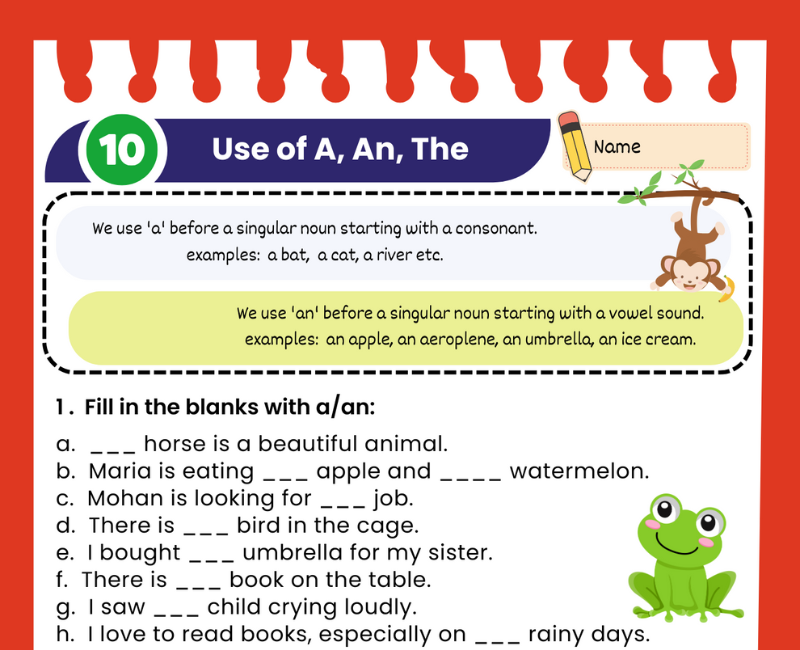
A and an depend on sound. Say a tent and an insect. Use a before a consonant sound and an before a vowel sound. Look at the first sound of the next spoken word.
An adjective can change the choice. Compare an egg with a blue egg. The noun is still egg, but blue is now the next word after the article.
First mention and later mention. I found a shell. The shell is pink. We introduce one shell with a and refer to the same shell with the. This is a useful pattern, not a rule that every first mention must use a or an.
The can identify something already clear from context. If both people know which door is meant, Please close the door is possible without an earlier sentence introducing it.
Sound challenge. A uniform begins with a you sound. An hour begins with a vowel sound because h is silent. These are useful extension examples.
Extra practice. A and an do not go directly before plural nouns. General plurals can have no article: I like pears. A particular group can use the: the pears in that bowl. Do not add an article before my in my bag.
Worksheet practice: Use the worksheet download for written revision. The online quiz adds picture and reasoning questions. The activities add sound sorting, memory matching, drawing, a partner lab and story building.
💡 Teaching Tips for Parents and Teachers
Begin with the spoken sound
Say the noun phrase aloud. Start with familiar words such as tent and insect before introducing sound challenges such as uniform and hour.
Give the a clear reason
Introduce an object with a or an, then refer to the same object using the. Add colour or position clues when several similar objects are present.
Review creative work together
Check that a or an fits the next sound and that the listener can identify the noun after the. Accept different sensible descriptions and review capitals and ending marks.
💬 Frequently Asked Questions
What are articles for Class 2?
A, an and the are articles. They help introduce a noun or identify a particular noun or group. For example: a tent, an insect and the tent we saw.
When do we use a?
Use a before one unspecified countable item when the next word begins with a consonant sound. Examples include a basket and a blue egg.
When do we use an?
Use an before one unspecified countable item when the next word begins with a vowel sound. Examples include an insect and an old basket.
When do we use the?
Use the when the listener or reader can identify which thing or group you mean. It may already have been mentioned or may be clear from the situation.
Do we choose a and an by letters or sounds?
Choose by sound. Many vowel letters begin vowel sounds, but some do not. A uniform begins with a you sound, so a is correct.
Why do we say an hour?
The h in hour is silent. Hour begins with a vowel sound, so we use an hour.
Why do we say a uniform?
Uniform begins with a consonant sound like y in you. The sound decides the article even though the written word begins with u.
What happens when an adjective comes before the noun?
Listen to the first sound of the adjective next to the article. Compare an egg with a blue egg and a book with an old book.
Can we use a or an before plural nouns?
Not directly. A and an normally refer to one countable item. Use a pear but not a pears. Particular plural groups can use the, as in the pears in that bowl.
What is the difference between a an and the?
A and an often introduce any one item of a type. The identifies a particular item or group the listener can recognise.
Do we always use a or an the first time we mention something?
No. That is a helpful story pattern when introducing an unspecified item. We can use the on a first mention if the listener already knows which thing is meant, such as the door both people can see.
How can I teach articles through games?
Sort familiar noun phrases by sound, match nouns with a or an, give clues to identify the correct picture and build short stories that introduce an item before referring to it again.
Photo credit and grammar references
Chair photograph by Amitbalani via Wikimedia Commons · CC0.
British Council articles for children · Cambridge article meanings
 Download