Fire and Ice Class 10 Worksheet with Answers
How can two opposite natural forces represent emotions with a similar destructive effect? Use the Fire and Ice Class 10 worksheet with answers to practise explaining Robert Frost’s symbolism, the speaker’s reasoning and the poem’s warning about human behaviour.
Attempt the questions independently before checking the answers. Move beyond naming symbols by explaining how the poem connects them with desire, hatred and destruction.
Develop Close Reading through Poetry Practice
“Fire and Ice” uses a brief discussion about the end of the world to explore powerful human emotions. Its compact form makes careful attention to individual words, contrasts and shifts especially important.
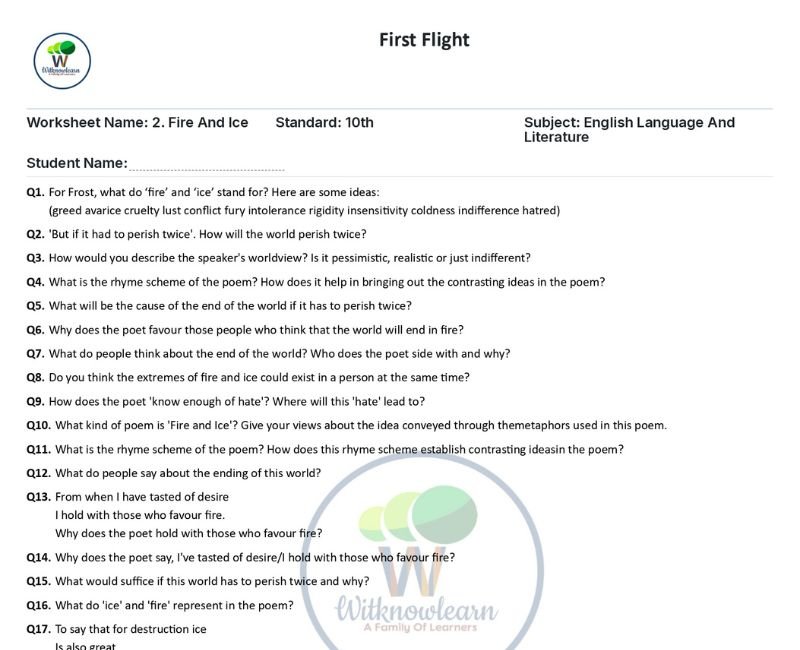
The mixed English worksheet format supports short and long-answer work, extract-based questions, objective responses and vocabulary activities. Use these tasks to develop both literal comprehension and supported interpretation.
Identify the question’s demand before writing. A task asking what fire represents needs a direct answer; one asking how the symbol works needs a connection between its physical qualities and the emotion it suggests.
Explain Fire as a Symbol of Desire
Questions about fire should connect its heat and consuming energy with uncontrolled desire. Explain how an emotion can become destructive when it dominates judgement or disregards others.
The speaker’s initial preference is linked with experience of desire. When asked about this reasoning, focus on the connection stated in the poem rather than inventing a personal incident from the poet’s life.
A balanced answer distinguishes destructive excess from ordinary wishes or ambitions. The poem’s warning should not be reduced to a claim that every desire is harmful.
Practice Prompt: Explain a Symbol’s Effect
Question: Why is fire an effective image for uncontrolled desire?
Answer approach: Identify qualities such as intensity, spread and consumption. Explain how these help readers imagine the damage caused by an unchecked emotion.
Interpret Ice and the Destructive Power of Hatred
Ice is connected explicitly with hatred. Interpretations may also discuss emotional coldness, indifference or an absence of sympathy when these ideas are clearly linked with the poem’s language.
For questions comparing the symbols, explain how their contrasting qualities lead towards the same destructive possibility. One suggests consuming intensity; the other suggests freezing coldness.
Do not describe ice as harmless simply because it lacks fire’s heat. The speaker recognises that it can also be sufficient for destruction.
Follow the Speaker’s Reasoning Carefully
The poem begins by presenting different views, then develops the speaker’s response. Sequence questions require you to distinguish the initial preference from the later consideration of another possibility.
Explain the conditional nature of the imagined second destruction. The speaker is testing an alternative, not reporting that the world has actually ended twice.
Questions about the conclusion should consider how the final judgement brings the two forces together despite their opposition. This helps you interpret the whole poem rather than treating its images separately.
Separate Literary Reflection from Scientific Prediction
The poem’s imagined destruction supports a reflection on emotions and human conduct. Do not turn a symbolism answer into a scientific forecast unless a question explicitly asks you to explore that distinction.
Answer Extract-Based Questions with Evidence
Read the extract in relation to the complete poem. Identify whether it presents the competing views, the speaker’s experience of desire or the recognition of hatred’s destructive power.
For extract-based MCQs, compare every option with the wording. For True/False tasks, check the entire statement. For fill-in-the-blank questions, ensure the answer fits both the meaning and the grammar.
Vocabulary questions should be answered in context. Words connected with destruction or sufficiency contribute to the argument, so explain their role when the task requires more than a definition.
A Routine for Poetry Extract Questions
- Read the lines as part of a complete sentence.
- Identify the viewpoint or symbol being discussed.
- Read the question’s exact instruction.
- Select a relevant word, contrast or detail.
- Explain how the evidence supports your response.
When asked for a word from the extract, provide the word that appears there rather than replacing it with a synonym.
Practise Poetic Devices and Their Effects
For device questions, identify the feature and explain how it contributes to meaning. Symbolism makes abstract emotions easier to imagine through physical images.
Check the rhyme scheme using line-ending sounds. For alliteration, identify repeated initial consonant sounds. For enjambment, examine how the sentence continues across a line break.
Do not assume that every contrasting pair is an oxymoron. Fire and ice are opposing images, but naming a device requires attention to how the words are arranged and used.
| Question Area | Skill Developed | Answer-Writing Focus |
|---|---|---|
| Fire and desire | Symbolic interpretation | Connect physical qualities with uncontrolled emotion. |
| Ice and hatred | Meaning and inference | Explain why coldness can also suggest destruction. |
| The speaker’s changing consideration | Understanding argument | Distinguish initial preference from the alternative possibility. |
| Contrasting images | Comparison | Explain different qualities and a shared destructive outcome. |
| Rhyme and sound devices | Recognition of form | Use precise sound evidence and explain its effect. |
| The central message | Supported judgement | Connect the warning with both symbols. |
Explain the Title and the Poem’s Tone
A title answer should discuss both images and their relationship. Explain how their opposition introduces the poem’s central comparison while their shared destructive potential unites them.
For questions about tone, consider the restrained, conversational manner in which a disturbing possibility is discussed. Support your interpretation through the speaker’s phrasing and reasoning.
Avoid assuming that a serious subject must be expressed through an emotional outburst. The contrast between the calm voice and the scale of destruction can itself be significant.
Write Focused Short and Extended Responses
For a short answer, state the main point, add relevant evidence and explain the connection. Follow the word limit stated in the task. A clear interpretation is stronger than a long list of possible meanings.
For an extended response, organise two or three connected points. An answer about destructive emotions can examine desire, hatred and the significance of their comparison.
When a question invites an everyday example, keep it brief and relate it directly to the poem. Avoid replacing literary analysis with a general discussion of social problems.
Use the Answers for Active Revision
Complete your first attempt before consulting the answers. Compare the meaning, evidence and reasoning rather than expecting identical wording.
- Check symbols: have you linked fire and ice with the correct emotions?
- Check reasoning: have you preserved the conditional argument?
- Check devices: does the example demonstrate the term you named?
- Check expression: are your sentences clear and complete?
Rewrite responses where the central idea is correct but its explanation is incomplete. Teachers can use the worksheet after a reading aloud to help students connect sound, structure and meaning.
Related Poetry Practice
Explore another poem by Robert Frost through the Dust of Snow Class 10 worksheet with answers.
Compare how the poems use natural elements to explore human experience. Support the comparison with each poem’s distinct mood and message.
Frequently Asked Questions About Fire and Ice
Who wrote Fire and Ice?
Robert Frost wrote “Fire and Ice”. The poem uses contrasting natural forces to reflect on destructive human emotions.
What does fire represent?
Fire represents desire, especially its uncontrolled or consuming form. Explain the connection through the image’s intensity and destructive capacity.
What does ice represent?
Ice represents hatred. Its coldness can also support an interpretation involving emotional indifference or a lack of compassion.
Why does the speaker initially favour fire?
His experience of desire leads him to recognise its destructive potential. This personal understanding supports his initial preference.
Does the speaker finally dismiss ice?
No. He acknowledges that hatred also has sufficient destructive power. The conclusion gives ice a serious place in the comparison.
What is the rhyme scheme of Fire and Ice?
The rhyme scheme is ABAABCBCB. Identify it by assigning the same letter to line endings that rhyme.
Why is the title appropriate?
It names the opposing images through which the poem explores desire and hatred. Their contrast and shared destructive potential shape the poem’s argument.
What is the central message of the poem?
Unchecked desire and hatred can both be destructive. The poem encourages reflection on how intense craving and emotional coldness damage human relationships and society.
 Download