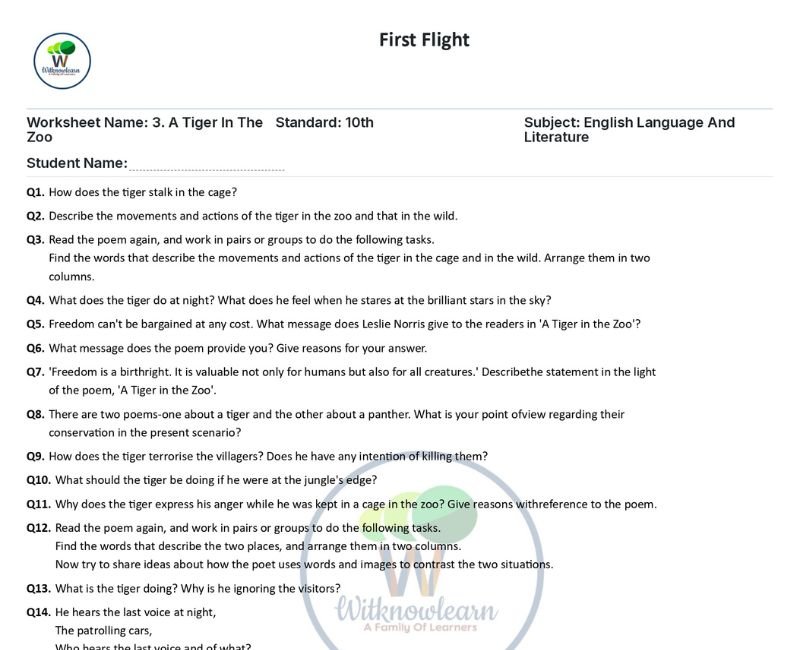
A Tiger in the Zoo Class 10 Worksheet with Answers
A powerful animal moves within a confined space while the poet imagines where he should be. Use the A Tiger in the Zoo Class 10 worksheet with answers to practise explaining this contrast through movement, setting, imagery and emotion.
Attempt the questions independently before checking the answers. Support your interpretations with details from the poem and explain how the language shapes the reader’s response.
Develop Close Reading and Poetry Interpretation
“A Tiger in the Zoo” by Leslie Norris contrasts a captive tiger’s existence with an imagined life in the wild. Worksheet practice helps you distinguish these settings and explain their importance without simply paraphrasing every stanza.
The mixed English practice format supports short and long-answer work, extract-based questions, objective responses and vocabulary activities. For poetry, focus on how individual words contribute to the larger contrast.
Read the task carefully. A question about location needs an accurate detail; a question about the effect of captivity requires an explanation supported by the tiger’s behaviour.
Separate the Actual Scene from the Imagined Wild
The poem moves between the zoo and the environment the tiger should inhabit. Identify which setting a question concerns before selecting evidence.
In a comparison answer, use a common basis such as movement, surroundings or the expression of strength. Explain each side rather than giving two unrelated descriptions.
Pay attention to language indicating possibility or expectation. The forest scenes present an imagined alternative, so avoid describing them as confirmed events in this particular tiger’s past.
Practice Prompt: Compare through a Common Focus
Question: How does the poem contrast the tiger’s movement in captivity with his imagined movement in the wild?
Answer approach: Identify the restriction in the cage, then examine the freedom suggested by the forest images. Explain how the difference affects the presentation of his natural power.
Interpret the Tiger’s Suppressed Anger
Questions about the tiger’s emotional state require you to connect his outward behaviour with the frustration suggested by confinement. Explain how apparent quietness can coexist with anger.
Do not assume that silent movement means contentment. Consider the limited space, repeated pacing and contrast with the activities imagined outside the zoo.
A supported answer can discuss helplessness or frustration while recognising that these are interpretations drawn from the poem’s presentation. Avoid inventing a detailed history of capture.
Explain Strength without Freedom
The tiger remains physically powerful, but the enclosure prevents that power from finding its natural expression. Questions on this contrast should distinguish strength from the freedom to use it.
When discussing his response to visitors, explain how his lack of engagement contributes to the portrayal of captivity. Do not assign a definite intention beyond what the poem supports.
For longer responses about dignity, connect the animal’s physical presence with the restrictions imposed on him. Use precise details instead of relying only on a general statement that cages are unpleasant.
Answer Extract-Based Questions Accurately
Read the extract in relation to the complete poem. Identify whether it describes the cage, an imagined forest scene or the night at the zoo.
For extract-based MCQs, compare every option with the wording. For True/False statements, check the whole claim, especially whether an imagined action is being treated as an actual one. For fill-in-the-blank tasks, ensure the answer fits meaning and grammar.
Vocabulary questions should be answered through context. Movement words can communicate stealth, confinement or force, depending on the scene in which they appear.
A Routine for Poetry Extract Practice
- Identify the setting of the lines.
- Check whether the action is actual or imagined.
- Read the question’s exact instruction.
- Select a supporting word, action or image.
- Explain the meaning or effect when required.
When a task asks for a word from the extract, provide the word appearing there rather than a different synonym.
Practise Imagery and Poetic Devices
Imagery questions ask you to explain how language creates an impression through sight, sound, movement or touch. Connect a selected image with the tiger’s appearance or situation.
For a device question, identify the feature, provide a brief example where requested and explain its effect. The expression “quiet rage”, for example, brings apparently opposing ideas together to suggest restrained anger.
Check alliteration through repeated initial consonant sounds and rhyme through line-ending sounds. For enjambment, examine whether the sentence continues across the line break. Avoid choosing a device only because a phrase sounds descriptive.
| Question Area | Skill Developed | Answer-Writing Focus |
|---|---|---|
| The zoo and the wild | Comparison | Use a common basis and explain both settings. |
| Restricted movement | Inference | Connect physical limits with frustration. |
| Suppressed anger | Interpretation of expression | Explain how quietness and rage coexist. |
| Descriptions of strength | Analysis of contrast | Distinguish power from freedom to act. |
| Sound and visual imagery | Close reading | Explain how language shapes the reader’s impression. |
| The final night scene | Supported interpretation | Connect the closing image with the wider theme. |
Interpret the Final Stanza Carefully
The closing scene changes the atmosphere from daytime confinement to night-time observation. Questions about the ending require you to examine what the tiger hears and where he directs his gaze.
You may interpret the stars as suggesting an open world beyond the enclosure, but distinguish this reading from a literal statement about the tiger’s thoughts.
When discussing repeated language, explain how it links the animal with the scene he observes. The effect matters as much as identifying the repetition.
Keep Interpretations Grounded in the Poem
Use phrases such as “the image suggests” when discussing an implied meaning. Avoid presenting imagined memories, plans or motives as facts about the tiger.
Write Clear Short and Extended Answers
For a short answer, begin with the main point, include a relevant detail and explain its significance. Follow the word limit stated in the task.
For an extended comparison, organise your response around setting, movement and the expression of strength. Explain how these details develop the contrast between captivity and freedom.
A question about the poem’s message should remain focused on its portrayal of the tiger. If asked for a broader opinion about animal welfare, distinguish your evaluation from what the poem directly presents.
Use the Answers to Strengthen Independent Practice
Complete the worksheet before consulting the answers. Compare meaning, evidence and reasoning rather than expecting identical wording.
- Check settings: have you confused the zoo with the imagined wild?
- Check inference: is your explanation supported by the language?
- Check devices: does your example demonstrate the term you named?
- Check expression: are your sentences clear and complete?
Rewrite an answer where a correct detail lacks an explanation. Teachers can use the worksheet after reading the poem aloud, helping students notice changes in movement, sound and atmosphere.
Related Interpretation Practice
For another perspective on freedom and dignity, use the Nelson Mandela Long Walk to Freedom Class 10 worksheet.
For further practice with contrasting poetic images, try the Fire and Ice Class 10 worksheet with answers.
Frequently Asked Questions About A Tiger in the Zoo
Who wrote A Tiger in the Zoo?
Leslie Norris wrote “A Tiger in the Zoo”. The poem contrasts captivity with an imagined existence in the wild.
What does “quiet rage” mean?
It describes suppressed anger. The tiger appears quiet, but his confinement suggests frustration that he cannot freely express through natural activity.
Which poetic device is used in “quiet rage”?
It is commonly identified as an oxymoron because it brings apparently contradictory ideas together. Explain how the phrase captures restrained anger.
Does the poem describe the tiger’s actual past in the forest?
No. It imagines where he should be and how he could behave in the wild. Keep that distinction clear in comparison answers.
Why is the tiger’s strength significant in captivity?
His physical power remains, but the enclosure restricts its expression. This contrast emphasises the loss of freedom.
Why does the tiger ignore visitors?
His lack of engagement contributes to the portrayal of frustration and isolation. Support this interpretation with the wider description of his confinement.
What can the stars suggest in the ending?
They can suggest an open world beyond the cage. Present this as an interpretation rather than a confirmed statement of the tiger’s thoughts.
How should I compare the tiger’s two settings?
Choose common points such as space, movement and the use of strength. Explain each setting with relevant evidence, then show what the contrast reveals about captivity.
 Download