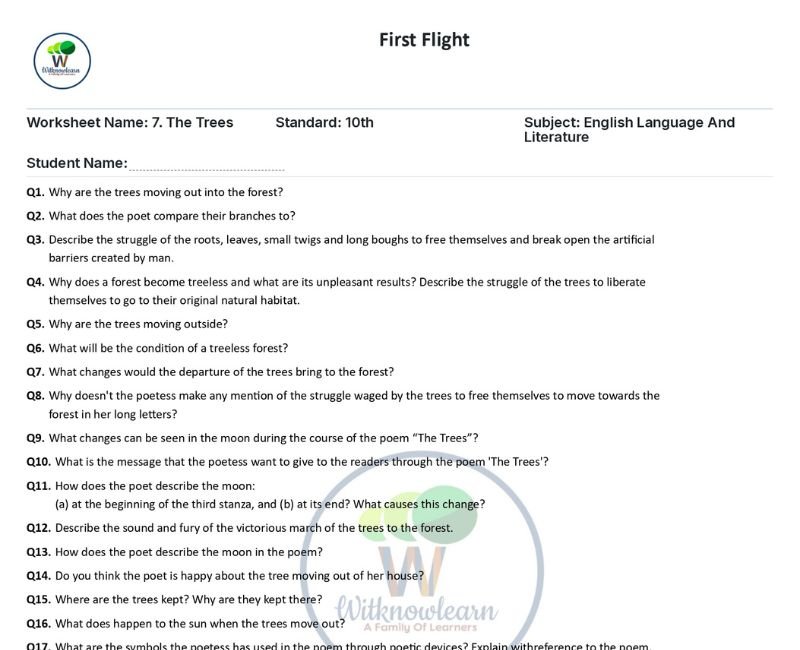
The Trees Class 10 Worksheet with Answers
A moving forest, struggling branches and a changing view of the moon make Adrienne Rich’s poem an engaging challenge for young readers. This The Trees Class 10 worksheet with answers supports practice in understanding poetic images, explaining language and developing thoughtful responses.
Attempt the questions independently, support your ideas with details from the poem, and use the answers to review your reasoning. Focus on explaining how an image works rather than simply remembering its meaning.
Turn Your Understanding into Clear Answers
Reading a poem and answering a question about it require different skills. You may understand the general theme but still need practice selecting evidence, interpreting a phrase or writing a focused explanation. Use this worksheet as an opportunity to move from recognition to independent response.
Follow the question-and-answer approach used across WitKnowLearn’s English worksheets. Work through short and extended responses, extract-based tasks, objective questions and vocabulary activities before consulting the answers. For each task, check whether you have addressed the exact instruction: identify, describe, explain, infer or compare.
Keep your textbook nearby during the first attempt. Later, revisit selected questions without looking at the poem. This helps you discover which details you can recall accurately and which passages need another careful reading.
Practice Areas for The Trees Poem
1. Follow the Movement through the Poem
Track the movement from enclosure towards the forest. Make a brief sequence chart before answering a question about the development of the scene. Choose details that show a change rather than retelling every stanza.
Pay attention to action words. When a question asks about effort, explain what the chosen verb adds to the scene. A useful response connects the action with its effect on the reader.
2. Explain Images of Effort and Release
The comparison between the branches and patients leaving hospital gives you an opportunity to practise explaining a simile. Identify both sides of the comparison, then consider the shared qualities suggested by their movement.
For any image-based question, ask yourself: What can I picture? Which word creates that picture? How does it support my answer? These three questions help you develop an explanation beyond a one-word label.
3. Build Interpretations from Evidence
The movement of the trees can be read as an image of liberation. When exploring symbolism, introduce your interpretation clearly and support it with a relevant detail. Use phrases such as “suggests” or “can represent” when discussing meanings beyond the immediate scene.
A strong thematic answer explains the connection between evidence and interpretation. Avoid adding a general paragraph about freedom unless you can show how it answers the particular question.
4. Respond to Questions about the Speaker
The speaker writes letters while scarcely mentioning the trees’ departure. This detail invites interpretation rather than a single factual explanation. Consider what the silence might suggest, then justify your reading.
Keep the distinction between observation and inference clear. First state what the speaker does; then explain what you think that behaviour may mean. This makes your response easier to follow and assess.
5. Discuss the Final Image Precisely
Questions about the closing moon image require careful visualisation. Explain the appearance described in the poem and connect it with the changed scene. Choose precise language so that your answer communicates what the reader sees.
Read your explanation aloud. If someone unfamiliar with the question could picture the scene from your response, you have probably expressed the image clearly.
Example Practice Prompt
Question: How can descriptions of movement help a reader understand the poem’s theme?
Answer approach: Begin with your interpretation of the movement. Select one relevant action from the poem, explain the effort it conveys, and connect that effort to your main point. Keep the response centred on the question rather than giving a complete summary.
After writing, underline your evidence and circle the sentence that explains it. If you have evidence without explanation, add the missing connection.
The Trees Extract-Based Questions: A Reading Routine
For The Trees extract-based questions, begin with the supplied passage. Read it once for the scene and again for the detail required by the question. Your knowledge of the whole poem should support your response, while the extract provides your immediate evidence.
Use These Four Steps
- Locate the focus: Decide whether the question concerns an action, image, word meaning, poetic device or inference.
- Find the evidence: Select the phrase that directly supports your response.
- Explain its effect: Describe what the language helps the reader imagine or understand.
- Check your conclusion: Ensure that your answer follows from the passage and does not depend on an unsupported assumption.
For MCQs, explain to yourself why your selected option fits. For True or False tasks, locate the detail that confirms or corrects the statement.
Organise Your Worksheet Practice
| Question Area | Skill to Practise | What to Check |
|---|---|---|
| Short-answer questions | Selecting relevant details | Does the opening sentence answer the question directly? |
| Extract-based MCQs | Close reading and inference | Can you justify the option using the passage? |
| Vocabulary and blanks | Understanding words in context | Does the meaning or word fit the surrounding sentence? |
| Poetic-device questions | Identifying and explaining language | Have you included an example and its effect? |
| Extended responses | Developing an interpretation | Does each supporting point advance your main idea? |
| Comparison questions | Connecting two texts | Have you supported the comparison with details from both poems? |
Write Focused Short and Long Answers
For short answers, start with the requested point and add a relevant explanation. A question about one image usually needs close attention to that image. Follow any word limit stated in the task and remove sentences that repeat the same idea.
For The Trees long-answer questions, plan a main claim and two supporting points before writing. Develop each point through evidence and explanation. If the task asks for comparison, organise your response around shared ideas or meaningful differences rather than writing two separate summaries.
Make the Answer Key Useful
Compare the reasoning in your response with the provided answer. You do not need identical wording. Look for accurate details, a clear explanation and a direct response to the task.
Choose one improvement for each answer: stronger evidence, clearer vocabulary or a more focused opening. Rewrite only the part that needs attention, then try a similar question independently.
Related Class 10 Poetry Practice
Use the A Tiger in the Zoo worksheet with answers to practise a comparison involving confinement and freedom. Choose one detail from each poem and explain the relationship between them.
For another perspective on personal freedom, explore the Amanda Class 10 worksheet with answers. Practise distinguishing a character’s imagined escape from the movement presented in The Trees.
Frequently Asked Questions about The Trees Class 10
Who wrote the poem The Trees?
Adrienne Rich wrote The Trees. The poem is studied in the Class 10 English textbook First Flight.
What is the central theme of The Trees?
Freedom from confinement is a central theme. The trees’ movement towards the forest also invites reflection on nature’s need for its own space.
What cannot happen in the treeless forest?
Birds cannot perch on trees, insects cannot hide in them, and tree shade is absent. These details help establish the emptiness of the forest.
What are the roots, leaves and twigs doing?
The roots loosen themselves from the veranda floor, the leaves press towards the glass, and the twigs become stiff with effort.
Why are the branches compared to discharged patients?
The comparison suggests strained, unsteady movement after confinement. It gives the branches a human quality and emphasises the effort involved in leaving.
Does the moon actually break at the end?
No. Its light appears in fragments through the trees. The mirror comparison describes this changed appearance.
Can the trees symbolise human beings?
Yes. One possible interpretation connects their escape with people seeking release from restrictions. Support this reading with details from the poem.
How should I revise The Trees questions and answers?
Attempt a mixture of factual, extract-based and interpretive questions. Review your answers, identify one recurring difficulty, and practise that skill again using a different passage or prompt.
 Download