From the Diary of Anne Frank Class 10 Worksheet with Answers
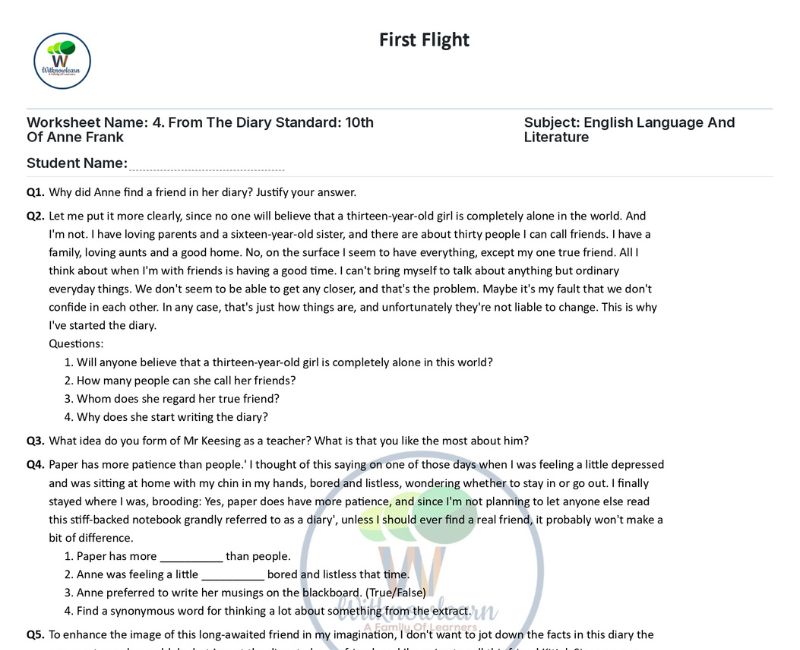
How can someone have friends and still feel the need for a trusted confidante? How does a school punishment become an opportunity for creative expression? Explore these questions through the From the Diary of Anne Frank Class 10 worksheet with answers.
Practise comprehension, extract-based responses, vocabulary, character analysis and longer answers. Attempt the questions first, then use the answers to check your interpretation and improve your written expression.
Turn Close Reading into Clear Answers
“From the Diary of Anne Frank” presents Anne’s reasons for keeping a diary alongside her observations about family, friendship and school. Its personal voice gives students useful practice in recognising feelings, interpreting humour and supporting character judgements.
This worksheet follows a mixed English practice format, combining short and long-answer work with passage-based questions, objective responses and language activities. Approach each task according to its instruction: identify a detail, explain a reason, infer a quality or evaluate an action.
Keep your responses focused on the prescribed extract. Anne’s wider life provides important historical context, but an answer about this chapter should use the events and reflections relevant to the question.
Explain Why Anne Wants to Keep a Diary
Questions about Anne’s diary require a distinction between having company and having someone with whom she can share her deepest thoughts. Avoid interpreting her need to write as proof that she has no family or acquaintances.
When explaining her decision, connect her feelings with the kind of relationship she hopes to create through writing. Consider why she gives the diary a name and addresses it as a companion.
For an inference question, show what this choice reveals about her emotional needs or reflective nature. A supported explanation is stronger than simply calling her lonely.
Practice Prompt: Explain an Apparent Contradiction
Question: How can Anne describe herself as surrounded by people yet still feel the need for a diary?
Answer approach: Distinguish everyday companionship from the freedom to share private feelings. Explain how the diary meets a need that her existing relationships do not fully satisfy.
Answer Extract-Based Questions with Context
Before answering questions on a passage, identify whether Anne is explaining her diary, introducing her background or describing her classroom experiences. The context helps you understand both her words and her tone.
For extract-based MCQs, compare all options with the passage. A description may sound generally suitable for Anne but fail to match the specific evidence. For True/False and fill-in-the-blank tasks, check the exact detail and sentence structure.
Vocabulary questions should be answered through context. Notice whether a word expresses irritation, amusement, uncertainty or affection. Its meaning contributes to how the passage presents a person or situation.
A Passage-Based Practice Routine
- Identify the situation and the people involved.
- Read the question’s task word carefully.
- Find a supporting phrase, action or detail.
- Write a direct response in your own words.
- Check that your inference remains supported by the passage.
If asked to select a word from the extract, give the word from the passage rather than replacing it with your own synonym.
Analyse Anne’s Response to Mr Keesing
The classroom episode offers practice in explaining motivation, argument and humour. Examine why Mr Keesing assigns extra work and how Anne responds to the task.
When discussing her first essay, identify the reasoning she uses to defend her talkativeness. Then explain what that reasoning reveals about her quick thinking and ability to make an assignment engaging.
For questions about the later poem, consider how creativity changes the teacher’s response. Explain the connection between the humorous piece and the development of their classroom relationship.
Support a Character Sketch with Evidence
Anne’s character can be explored through her self-observation, need for expression and inventive responses. Select qualities that match the question and support each one with a relevant example.
A character sketch can recognise that she is talkative while also discussing her intelligence, honesty and sense of humour. These qualities should be explained through actions rather than presented as an unsupported list.
Mr Keesing also deserves a balanced assessment. Compare his initial disciplinary approach with his later appreciation of Anne’s writing. This allows you to discuss a change in attitude instead of reducing him to a single label.
| Practice Area | Skill Developed | Answer-Writing Focus |
|---|---|---|
| Reasons for keeping a diary | Understanding emotional motivation | Distinguish companionship from a trusted confidante. |
| Extract-based objective questions | Close reading | Match the answer with the passage’s evidence. |
| Anne’s essays and arguments | Explaining reasoning | Show how she develops a defence of her behaviour. |
| Humour and the poem | Interpreting effect | Explain how creativity changes the response to punishment. |
| Character sketches | Evidence-based judgement | Connect selected qualities with actions or reflections. |
| Vocabulary and language activities | Meaning in context | Check both meaning and grammatical fit. |
Recognise the Features of Diary Writing
The chapter’s diary form shapes how readers encounter Anne’s thoughts. Her first-person voice, direct address and personal reflections create a sense of closeness.
If asked how the diary differs from a formal account, discuss its purpose and tone. Anne records her own feelings and observations rather than presenting a detached report.
For an optional writing activity, try a brief diary entry about a school experience. Include what happened, how you felt and what you realised. Use this to understand personal reflection, while following the specific instructions of any assigned task.
Interpret Humour Carefully
Do not stop at saying that Anne’s response is funny. Explain the unexpected argument, playful comparison or creative choice that produces humour, then connect it with Mr Keesing’s reaction.
Write Focused Short and Long Responses
For a short answer, begin with the main point, add a relevant detail and explain its significance. Follow the word limit given in the question.
For a longer answer about Anne’s personality, organise your points around different aspects of her behaviour. For a comparison of Mr Keesing’s attitudes, show the initial response, the reason for change and the outcome.
Check that every sentence contributes to the answer. Avoid adding a complete biography when the task concerns a classroom incident or Anne’s reason for writing.
Use the Answers to Improve Your Next Attempt
Complete the worksheet before consulting the answers. Compare the central meaning, supporting details and reasoning rather than expecting identical wording.
- Check accuracy: have you confused the essays, poem or people involved?
- Check interpretation: have you explained feelings without oversimplifying them?
- Check evidence: does each character judgement have support?
- Check expression: are your sentences clear and grammatically complete?
Rewrite one incomplete response and attempt it again later without looking. Teachers can use the worksheet for homework, classroom practice or discussion followed by independent writing.
Related Chapter Revision
Review the textbook responses through From the Diary of Anne Frank questions and answers, then return to the worksheet for independent practice.
For further work on interpreting a narrator’s feelings and viewpoint, try the Black Aeroplane Class 10 worksheet with answers.
Frequently Asked Questions
Why did Anne Frank decide to keep a diary?
She wanted a trusted companion with whom she could share her private thoughts. Although she had people around her, she felt she lacked that deeper emotional connection.
What does Anne mean when she says paper has more patience than people?
She feels that writing allows her to express herself freely without being interrupted or judged. The statement explains why a diary seems suitable for her personal reflections.
Who is Kitty in the chapter?
Kitty is the name Anne gives to the diary companion she addresses. This makes her entries feel like conversations with a trusted friend.
Why does Anne include a brief account of her background?
She wants her diary companion to understand her circumstances. The introduction provides context for the experiences and feelings she records.
Why does Mr Keesing give Anne extra homework?
He is annoyed by her talking during his lessons. He assigns essays as a disciplinary response to her talkativeness.
How does Anne defend her talkativeness in the first essay?
She argues that talking is a student’s trait and adds that she has inherited the habit from her mother. Her response combines reasoning with humour.
Who helps Anne with the poem about the ducks?
Her friend Sanne, who is good at poetry, helps her. The humorous poem offers a creative response to Mr Keesing’s assignment.
How does Mr Keesing’s attitude change?
He appreciates the humour in Anne’s poem and shares it with others. He subsequently stops assigning her extra essays for talking, showing a more understanding response.
 Download