Nelson Mandela Long Walk to Freedom Class 10 Worksheet
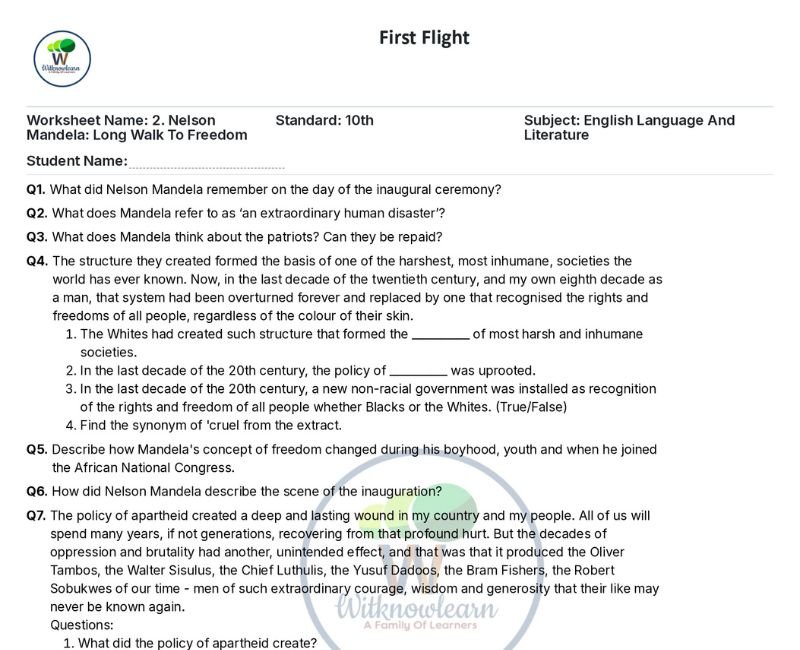
What makes a person courageous? How does personal freedom connect with the freedom of a nation? Practise explaining these ideas through the Nelson Mandela Long Walk to Freedom Class 10 worksheet, using evidence from the chapter to support your answers.
Work through the questions independently, then use the answers to check your understanding, improve your expression and identify points that need another reading.
Practise Reading, Interpretation and Written Responses
“Nelson Mandela: Long Walk to Freedom” combines an account of a historic inauguration with reflections on dignity, courage and responsibility. Strong answers explain the significance of the events and the ideas Mandela develops through them.
This Class 10 English worksheet follows a mixed practice format, bringing together short and long-answer work, passage-based questions, objective responses, vocabulary and interpretation. Use each type of question to develop a different skill rather than approaching every task as a request for the chapter summary.
Before writing, identify whether the question asks for a fact, a reason, an inference or an evaluation. This helps you select the right evidence and keep the response relevant.
Approach Extract-Based Questions Carefully
Read the passage once to understand its subject and again to locate the details needed for the questions. Notice whether Mandela is describing the ceremony, remembering the struggle or explaining his beliefs.
For extract-based MCQs, compare every option with the passage. An option may sound reasonable but still fail to answer the exact question. For True/False statements, check the whole statement, including words that change its meaning.
When completing a blank, make sure the answer is accurate and fits the sentence grammatically. For synonyms and word meanings, use the context rather than selecting the first familiar meaning.
Four Checks for Passage-Based Practice
- Context: What situation or idea does the extract describe?
- Demand: What exactly must you identify or explain?
- Evidence: Which detail supports the answer?
- Precision: Does your response match the passage without adding assumptions?
Use this routine for both objective questions and written extract responses.
Explain the Significance of the Inauguration
Questions about the inauguration require more than naming a date or place. Practise connecting the ceremony with the transition from racial exclusion towards a democratic order.
Consider why international guests attended and what their presence represented. When discussing the military display or the officers’ changed attitude, explain how these details symbolise a transformation in the country’s institutions.
Keep historical details separate from interpretation. First establish the event accurately, then explain its importance in the chapter.
Practice Prompt: Move Beyond Description
Question: Why is the inauguration presented as a shared achievement rather than only Mandela’s personal success?
Answer approach: Connect the ceremony with the efforts of many people, Mandela’s recognition of earlier freedom fighters and the wider promise of dignity for the nation. Explain how these points support the idea of collective achievement.
Answer Questions on Freedom and Responsibility
Trace how Mandela’s understanding of freedom develops. A comparison question should show the movement from childhood experiences and personal choices towards concern for the rights of others.
For questions about obligations, identify the two responsibilities and explain why an unjust society made them difficult to fulfil together. Naming the obligations alone does not fully explain the conflict.
When evaluating freedom, consider dignity, opportunity and responsibility. Avoid replacing Mandela’s argument with a broad statement that freedom means doing anything one wishes.
Support Character and Value-Based Answers
A character sketch should connect qualities with evidence. You might discuss Mandela’s courage, humility, perseverance or concern for others, but each selected quality needs a relevant example or idea from the chapter.
Value-based questions also require textual support. If asked about leadership, explain how acknowledging others or working towards shared rights demonstrates leadership. If asked about reconciliation, examine the importance of overcoming hatred.
| Question Area | What to Practise | How to Strengthen the Answer |
|---|---|---|
| Inauguration and its significance | Connecting events with historical change | Explain what the ceremony represents. |
| Courage | Interpreting an abstract idea | Distinguish experiencing fear from overcoming it. |
| Personal and collective freedom | Comparison and development | Show how Mandela’s priorities broaden. |
| Twin obligations | Cause-and-effect reasoning | Explain why the social system creates a conflict. |
| Character sketch | Evidence-based judgement | Support selected qualities with relevant details. |
| Vocabulary and expressions | Meaning in context | Check how the word functions in the passage. |
Write Clear Short and Long Answers
For a short answer, begin with the main point, add a relevant detail and explain the connection. Follow the word limit given in the question. A focused response is stronger than a lengthy retelling containing unrelated information.
For a longer answer, plan two or three connected points. If the question asks how Mandela’s idea of freedom changes, organise the response around stages in that development. If it asks you to justify a statement, make every paragraph contribute to that judgement.
Use clear linking words such as “because”, “therefore” and “however” when they show a real relationship. Check sentence structure, tense and spelling after completing the content.
Explain the Meaning Before Giving an Opinion
A question about the freedom of both the oppressed and the oppressor requires careful interpretation. Explain how oppression harms the victim’s rights and the oppressor’s humanity. Then develop your evaluation from that distinction.
Use the Answers to Improve Your Next Attempt
Attempt the worksheet before reading the answers. Afterwards, compare the central meaning and supporting points rather than checking whether every sentence uses identical wording.
- Correct factual errors: check names, events and the context of statements.
- Add missing reasoning: explain why your evidence supports the answer.
- Remove repetition: avoid restating the same point in different words.
- Rewrite selectively: improve the answers where your interpretation was incomplete.
Teachers can use the worksheet for classroom practice, homework or discussion before written work. Students can revisit difficult questions after reviewing the chapter and check whether their explanations have become clearer.
Related Chapter Revision
Review the textbook responses through Nelson Mandela Long Walk to Freedom questions and answers, then return to the worksheet for independent practice.
For further work on character motives and evidence-based interpretation, try the A Letter to God Class 10 worksheet with answers.
Frequently Asked Questions
Why is 10 May 1994 important in the chapter?
It marks Mandela’s inauguration as South Africa’s first Black president following the country’s first democratic national election based on universal adult suffrage. The ceremony represents a major transition from apartheid towards democracy.
What does apartheid mean?
Apartheid was a system of institutionalised racial segregation and discrimination in South Africa. In chapter answers, connect it with the denial of equal rights and opportunities.
Why did international leaders attend the inauguration?
Their presence recognised South Africa’s democratic transformation and its return to international acceptance after the isolation associated with apartheid.
What does Mandela mean by courage?
He understands courage as overcoming fear rather than never experiencing it. A strong answer makes this distinction explicit.
What are Mandela’s twin obligations?
They are responsibilities towards family and responsibilities towards one’s people and country. He explains that apartheid made it difficult for a Black South African to fulfil both freely.
How did Mandela’s understanding of freedom change?
His early concern with personal freedom broadened into a commitment to the freedom and dignity of his people. He came to see individual freedom as inseparable from the rights of others.
Why does Mandela say the oppressor also needs freedom?
He believes that hatred and prejudice imprison the oppressor morally. Oppression denies the victim’s rights while damaging the humanity of the person who practises it.
How should I write Mandela’s character sketch?
Select relevant qualities, such as courage, humility and perseverance, and support them with his actions or reflections. Organise the response around evidence rather than a list of adjectives.
 Download