The Midnight Visitor Class 10 Worksheet with Answers
How can a convincing story become a powerful defence? Explore Robert Arthur’s suspenseful chapter through WitKnowLearn’s The Midnight Visitor Class 10 worksheet with answers.
Practise explaining Ausable’s strategy, tracing changes in control and interpreting the surprise ending. Attempt the questions independently, then use the answers to review your evidence and sharpen your explanations.
Read the Story as a Contest of Judgement
This chapter encourages readers to examine what characters believe and how those beliefs influence their decisions. When answering a question, distinguish what is actually true from what a character is persuaded to accept.
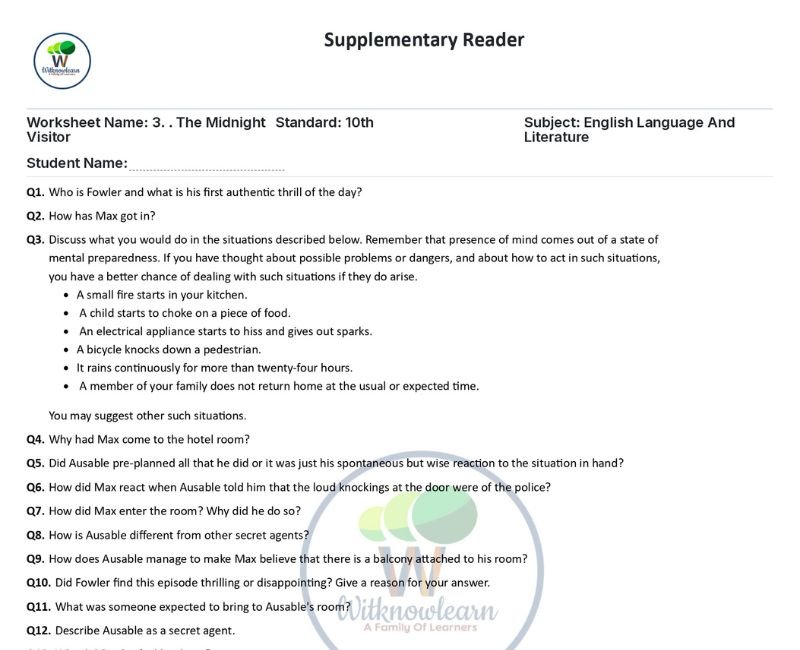
Use the question-and-answer approach followed across WitKnowLearn’s English worksheets. Complete factual tasks, extract-based activities, vocabulary questions and written responses before consulting the answers.
For your first attempt, keep the textbook nearby and identify the detail supporting each response. Later, revisit selected questions without looking at the chapter. Check whether you can explain the reasoning behind an event as accurately as you can recall it.
The Midnight Visitor Questions: Areas to Practise
Examine Fowler’s Expectations
For questions about first impressions, identify what Fowler expects and compare it with what he observes. Explain how this contrast prepares the reader for later developments.
Keep appearance and ability separate in your response. Select details that show why an initial judgement may need revision as the story unfolds.
Trace Ausable’s Control of the Conversation
Questions about Ausable’s presence of mind require more than a statement that he is clever. Identify a particular remark or decision and explain how it affects the situation.
Follow the exchange carefully. Ask which character introduces information, who accepts it and what action follows. This helps you explain how the dialogue develops the plot.
Analyse the Balcony Story
When discussing the invented balcony, focus on how the claim influences Max’s understanding of the room. Explain why a detail becomes convincing within the conversation.
For a strategy-based answer, connect the explanation with the choice it makes possible. Avoid describing the balcony as a real feature when discussing what the reader eventually learns.
Explain the Effect of the Knock
A small event can change a tense scene when a character assigns it a particular meaning. Examine how the knock is interpreted and how that interpretation affects the next decision.
Organise your explanation as event, claim and response. This structure helps you show cause and effect without repeating the entire episode.
Interpret Max’s Misjudgement
For questions about Max, compare his apparent advantage with the information on which he relies. Explain how his assumptions contribute to the outcome.
A balanced character response should use evidence from the scene. Distinguish possession of a weapon from control over the other characters’ thinking.
Original Practice Prompt
Question: How does Ausable turn another character’s assumption into an advantage?
Answer approach: Identify the assumption, explain how Ausable strengthens it and connect it to the action that follows.
After writing, underline the sentence explaining the connection between belief and action. If your answer only lists events, add the reasoning that makes them significant.
The Midnight Visitor Extract-Based Questions
For The Midnight Visitor extract-based questions, establish who is speaking and what the listener believes at that moment. Then locate the expression or action required by the question.
An extract may test reference, vocabulary, inference or character understanding. Read the task before selecting evidence. Your knowledge of the chapter provides context, while the supplied passage guides the immediate response.
A Four-Step Extract Routine
- Locate the scene: Identify the point reached in the confrontation.
- Identify the speaker: Check whose claim or reaction is being examined.
- Select the evidence: Find the detail that directly supports your answer.
- Explain its significance: Connect the detail with the question’s focus.
For MCQs, compare every option with the passage. For True or False statements, identify the evidence that confirms the statement or reveals what needs correction.
Organise Your Worksheet Practice
| Practice Area | Skill to Develop | Self-Check |
|---|---|---|
| Factual questions | Accurate recall | Have you distinguished actual events from invented claims? |
| First impressions | Comparing expectation and observation | Have you explained why the contrast matters? |
| Ausable’s strategy | Tracing cause and effect | Have you connected his words with another character’s response? |
| Extract-based questions | Close reading | Does the passage support your explanation? |
| Suspense and surprise | Examining narrative technique | Have you identified what the reader knows at each stage? |
| Extended responses | Developing an interpretation | Does each point support your main claim? |
Explain How Suspense Is Created
For suspense questions, identify what creates uncertainty or danger in the scene. Then examine how dialogue and delayed information affect the reader’s expectations.
Choose a specific moment rather than calling the whole story exciting. Explain what the reader expects at that point and how a later detail changes the understanding of it.
For a question about the surprise ending, connect the revelation with an earlier claim. Showing that relationship explains how the ending works and why it changes the meaning of the preceding events.
Write Strong Character and Theme Responses
For The Midnight Visitor character sketch of Ausable, choose a few qualities and support each with a relevant action. Explain how the evidence demonstrates the quality rather than presenting a list of adjectives.
For a comparison with Max, use a common basis such as judgement, confidence or response to pressure. Discuss both characters through that basis and explain the difference.
For The Midnight Visitor long-answer questions, plan a main claim and two supporting points. Develop each through the chapter’s events or dialogue, and follow any word limit given in the task.
Check Accuracy before Adding Detail
Review names, references and the difference between truth and deception. A detailed answer becomes confusing if it treats a fabricated explanation as an actual feature of the setting.
Compare your response with the provided answer for accuracy, relevance and reasoning. Rewrite one unclear connection before moving to the next question.
Related Class 10 English Practice
Explore the Black Aeroplane worksheet with answers to practise explaining suspense and the effect of unexpected information.
Use The Thief’s Story worksheet for further practice in interpreting motives, decisions and details that reveal more than characters say directly.
FAQs about The Midnight Visitor Class 10
Who wrote The Midnight Visitor?
Robert Arthur wrote the story. It is studied in the Class 10 supplementary reader Footprints Without Feet.
Who is Fowler?
Fowler is a writer who accompanies Ausable, hoping to encounter the excitement associated with a secret agent’s work.
Why is Fowler initially disappointed?
Ausable’s appearance, manner and ordinary surroundings do not match Fowler’s expectations of a glamorous secret agent.
Why is Max waiting in Ausable’s room?
Max wants to obtain an important report about new missiles that he expects Ausable to receive.
Was there really a balcony outside the window?
No. Ausable invents the balcony story and persuades Max to believe it.
Who knocks at the door?
Henry, the waiter, knocks to bring the drinks Ausable had ordered. Ausable tells Max that the police have arrived.
How does Ausable defeat Max?
Max attempts to escape through the window, trusting the invented balcony story. Ausable’s deception turns Max’s belief into a fatal mistake.
What does the story suggest about intelligence?
It suggests that calm judgement and quick thinking can be more effective than an impressive appearance or apparent physical advantage.
 Download