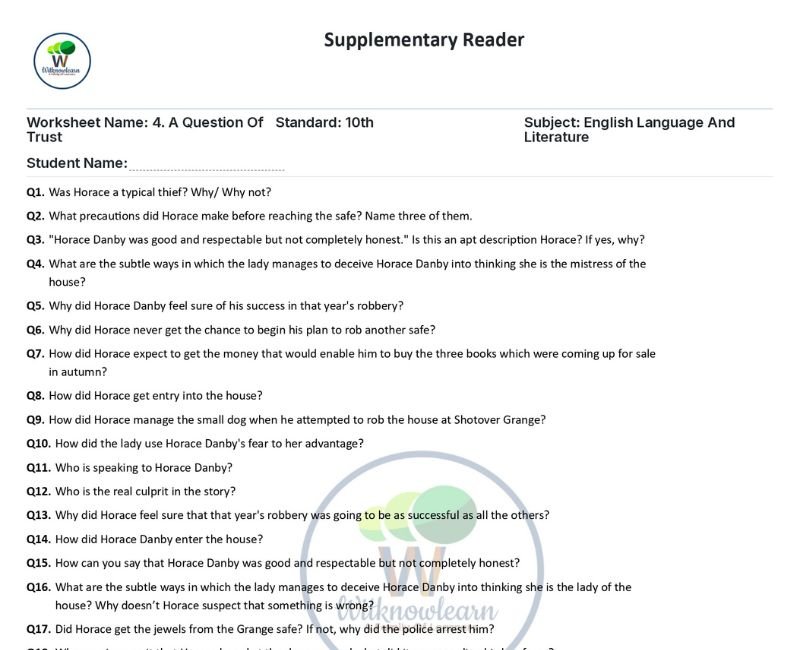
A Question of Trust Class 10 Worksheet with Answers
A carefully planned robbery takes an unexpected turn when the thief accepts a stranger’s claim. Explore Victor Canning’s story through WitKnowLearn’s A Question of Trust Class 10 worksheet with answers.
Practise explaining Horace Danby’s decisions, interpreting the woman’s behaviour and examining the irony of the ending. Attempt the questions first, then use the answers to review your evidence and reasoning.
Practise Reading beyond First Impressions
This chapter invites students to question appearances and follow the consequences of an assumption. When answering, distinguish what a character believes from what the story eventually reveals.
Use the question-and-answer approach followed across WitKnowLearn’s English worksheets. Work through factual tasks, extract-based activities, vocabulary questions and short or extended responses before consulting the answers.
During your first attempt, keep the textbook open and mark the supporting detail for each answer. Later, revisit selected questions without referring to the chapter. Check whether you can explain why an event happens as accurately as you can recall the event itself.
A Question of Trust Questions: Areas to Practise
Examine Horace’s Contradictory Character
For a character-based question, compare Horace’s outward reputation with his secret activities. Explain how the contrast affects the reader’s understanding rather than treating one description as the whole truth.
Separate a character’s justification from your evaluation of it. If a question asks whether his motive makes his behaviour acceptable, use evidence and explain your judgement clearly.
Distinguish Preparation from Good Judgement
Questions about the robbery plan require attention to both what Horace studies and what he fails to verify. Organise your rough work around preparation, assumption and consequence.
This structure helps you explain how someone can be methodical in one part of a plan and careless in another. Choose the details relevant to the question instead of listing everything he does.
Analyse the Woman’s Performance
When discussing deception, examine how the woman presents herself and directs the conversation. Select the behaviour that encourages Horace to accept her identity.
A convincing answer connects a detail with its effect. Explain how the performance influences his interpretation and the decision that follows.
Trace the Loss of Control
Follow how the encounter changes Horace’s position. Identify what he wants, what he fears and what he agrees to do. Then explain how those pressures affect his judgement.
For a turning-point question, choose the moment that redirects his actions. State its significance rather than merely describing the scene.
Explain the Evidence and the Ending
For questions about the outcome, connect an earlier action with the evidence discovered later. This helps you show cause and effect across the chapter.
When explaining irony, identify the expectation and the result that overturns it. Show how the final revelation changes the meaning of the earlier conversation.
Original Practice Prompt
Question: How does Horace’s desire to escape trouble make him vulnerable to deception?
Answer approach: Identify the pressure he faces, explain the solution he accepts and connect that acceptance with his failure to check the stranger’s claim.
After writing, underline the sentence explaining the connection between his motive and his decision. Add that connection if your response only recounts events.
A Question of Trust Extract-Based Questions
For A Question of Trust extract-based questions, identify the speaker, the situation and what each character knows or assumes at that moment.
An extract may test reference, vocabulary, inference or character understanding. Read the instruction before choosing evidence. Use the passage to support the immediate answer and the wider chapter to establish context.
A Four-Step Extract Routine
- Locate the moment: Identify whether it occurs during preparation, the encounter or the aftermath.
- Check the viewpoint: Distinguish a claim from a confirmed fact.
- Find the evidence: Select the expression or action required by the question.
- Explain its effect: Connect the detail with the character’s response or the plot.
For MCQs, compare all options with the extract. For True or False tasks, locate the detail that confirms the statement or shows what needs correction.
Organise Your Worksheet Practice
| Practice Area | Skill to Develop | Self-Check |
|---|---|---|
| Factual questions | Accurate recall | Have you separated a character’s claim from the actual situation? |
| Character sketches | Interpreting contradictions | Does each quality have supporting evidence? |
| Deception and persuasion | Explaining influence | Have you connected the behaviour with its effect? |
| Extract-based questions | Close reading | Does the passage support your response? |
| Cause and consequence | Connecting events | Have you explained how an earlier action affects the ending? |
| Title and irony | Developing an interpretation | Have you identified the contrast behind your explanation? |
Discuss the Title with Specific Evidence
For a title-based response, decide which aspect of trust you will examine. Consider who relies on whom, the basis for that confidence and the consequences when the belief proves mistaken.
Choose two connected details and explain their relationship. A general statement that trust is important does not fully explain why the title suits this particular story.
If a question asks for a comparison with another chapter, establish a common basis and support both texts. Explain how trust operates differently in the two situations.
Write Focused Short and Extended Answers
For A Question of Trust short questions and answers, begin with the requested point. Add relevant evidence and a brief explanation, following any word limit stated in the task.
For A Question of Trust long-answer questions, plan a main claim and two supporting points. Develop each through the chapter’s events or dialogue. Keep the response centred on the instruction rather than giving a complete summary.
Check questions with several parts carefully. If you are asked to describe a decision and explain its consequences, include both. Use clear references so the reader can follow which character you mean.
Review Meaning before Memorising Wording
Compare your response with the answers for accurate details, relevant evidence and clear reasoning. Your wording can differ while expressing the same supported idea.
Choose one improvement for a weak answer: clarify an assumption, explain a consequence or strengthen the evidence. Rewrite that part and apply the correction to another task.
Related Class 10 English Practice
Explore The Midnight Visitor worksheet with answers to compare how convincing claims influence another character’s decisions.
Use The Thief’s Story worksheet for a different treatment of trust and dishonesty. Build a comparison using evidence from both chapters.
FAQs about A Question of Trust Class 10
Who wrote A Question of Trust?
Victor Canning wrote the story. It is studied in the Class 10 supplementary reader Footprints Without Feet.
Why does Horace Danby steal?
He steals once a year to finance his purchase of rare and expensive books.
Why does Horace believe the woman?
Her confident manner, apparent familiarity with the house and control of the conversation persuade him that she is the owner’s wife.
Who is the woman really?
She is another thief pretending to be the lady of the house.
Why does Horace open the safe for her?
He believes that helping her obtain the jewels will persuade her to let him leave without involving the police.
What mistake leaves evidence against Horace?
He handles the safe without his gloves, leaving fingerprints that connect him with the robbery.
What makes the ending ironic?
A thief who carefully plans his own robberies is deceived by another thief and takes the blame for her success.
Why is A Question of Trust a suitable title?
Horace’s misplaced confidence in the woman determines his actions and leads to his downfall, making trust central to the plot.
 Download