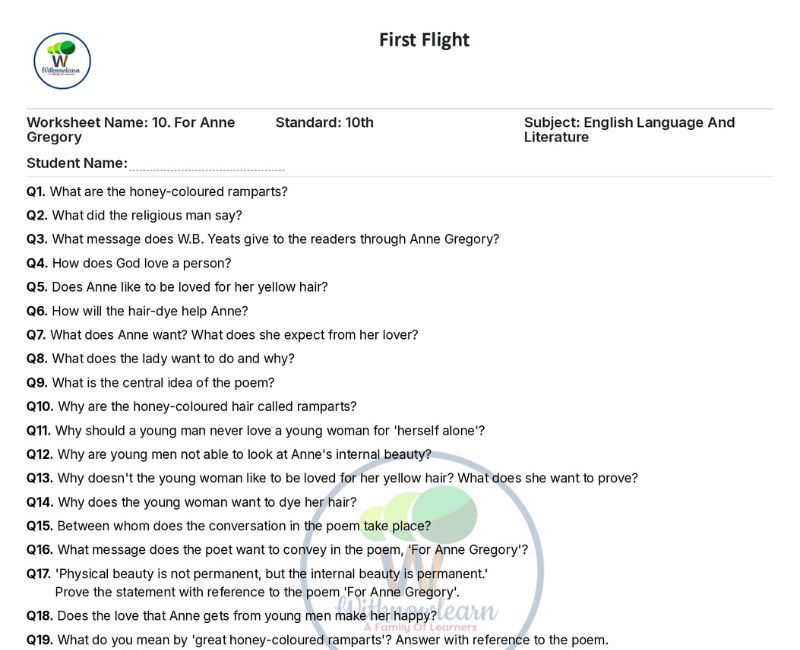
For Anne Gregory Class 10 Worksheet with Answers
Can a person be loved for who they are when outward beauty attracts so much attention? Explore the question through WitKnowLearn’s For Anne Gregory Class 10 worksheet with answers, based on the poem by W. B. Yeats.
Practise interpreting the dialogue, explaining imagery and writing thoughtful responses. Attempt the questions independently, then use the answers to review the accuracy and clarity of your reasoning.
Turn the Poem’s Dialogue into Focused Answers
A short conversation can contain several competing ideas. While answering questions about this poem, identify whose view you are explaining and how it relates to the other speaker’s response.
Follow the question-and-answer approach used across WitKnowLearn’s English worksheets. Work through factual questions, extract-based tasks, vocabulary activities and written responses before consulting the answers.
During your first attempt, keep the textbook open and mark the evidence for each response. Later, revisit selected questions without looking at the poem. Check whether you can recall the relevant detail and explain its significance in your own words.
For Anne Gregory Questions: Areas to Practise
Follow the Exchange of Ideas
Map the conversation before writing an answer about its development. Note the opening claim, Anne’s response and the final reply. This helps you explain how the argument progresses instead of presenting disconnected statements.
Use clear references in your answer. Words such as “the speaker,” “Anne” and “the final reply” help the reader follow whose position you are discussing.
Explain What the Hair Represents
Anne’s yellow hair becomes a focus for the discussion of outward attractiveness. For an image-based question, describe the feature and explain its role in the conversation.
When discussing symbolism, connect your interpretation to the language of the poem. State what the detail can represent, then show how that reading helps answer the question.
Interpret Anne’s Proposed Solution
Anne proposes changing her hair colour so that someone might love her for herself. When analysing this response, distinguish what she hopes to achieve from whether the conversation accepts her solution.
A useful answer can identify the proposal, explain its purpose and then connect it to the reply that follows. Keep these stages separate so that your reasoning remains clear.
Read the Final Claim Carefully
The final speaker refers to an old religious man’s claim that only God can love Anne entirely for herself. Explain this as a position expressed within the poem’s dialogue.
For an interpretive question, consider how the final reply changes or complicates the discussion. Support your view with the relevant detail rather than replacing the poem’s argument with a general opinion.
Distinguish Attraction from Understanding
Questions about appearance and inner qualities require precise language. Decide whether the task asks you to explain the poem, evaluate a speaker’s view or offer your own response.
If a personal response is requested, begin with the issue raised in the poem and develop your position with reasons. Keep your interpretation of the text separate from your own judgement.
Original Practice Prompt
Question: How does Anne’s reply challenge the opening speaker’s view?
Answer approach: State the opening position briefly, identify Anne’s proposed response and explain how it attempts to overcome the difficulty raised.
After writing, check whether you have compared the two positions. An answer that discusses Anne alone may leave the relationship between the speakers unexplained.
For Anne Gregory Extract-Based Questions
For For Anne Gregory extract-based questions Class 10, identify the speaker and the point being made in the supplied passage. Then examine the detail required by the question.
A task may focus on a reference word, an image, an inference or a contrast. Read the instruction before deciding which part of your knowledge is relevant. Use the extract as your immediate source of evidence.
A Four-Step Reading Routine
- Establish the context: Locate the passage within the exchange.
- Identify the task: Decide whether you need to recall, explain, interpret or select an answer.
- Find the evidence: Choose the expression that directly supports your response.
- Check your explanation: Confirm that it follows from the passage and answers every part of the question.
For MCQs, compare all options with the speaker’s meaning. For True or False tasks, locate the detail that confirms the statement or indicates the correction needed.
Organise Your Worksheet Practice
| Practice Area | Skill to Develop | What to Check |
|---|---|---|
| Speaker identification | Following the dialogue | Have you attributed the view correctly? |
| Imagery and symbolism | Explaining language | Have you connected the image to its role in the poem? |
| Anne’s response | Interpreting an argument | Have you explained both the proposal and its purpose? |
| Extract-based questions | Close reading | Does the passage support your answer? |
| Theme-based responses | Developing an interpretation | Have you used evidence rather than broad statements alone? |
| Personal-response tasks | Reasoned judgement | Is your opinion clearly connected to the question? |
Explain Poetic Devices through Their Effect
When preparing For Anne Gregory poetic devices, start with the example supplied in the question. Identify the feature, explain the picture or relationship it creates and connect that effect to the discussion.
For a metaphor question, explain the two ideas brought together. For repetition, consider what receives emphasis. For a rhyme question, inspect the relevant line endings carefully.
Practise completing a sentence such as “This expression emphasises…” with a specific explanation. Naming the device is the starting point; describing its contribution demonstrates understanding.
Write Strong Short and Extended Responses
For For Anne Gregory short questions and answers, begin with the requested point. Add a relevant detail and explain it briefly. Follow any word limit provided and remove repeated ideas.
For an extended answer, plan your main claim and two supporting points before writing. Organise the response around the question: dialogue, imagery, appearance or the final argument. Develop each point through evidence and explanation.
Be careful with absolute statements. If you are discussing what a speaker claims, make that clear. This gives your answer greater precision and allows you to evaluate the claim thoughtfully when the task requires it.
Review for Meaning and Accuracy
Compare your response with the answers for correct details, relevant evidence and clear explanation. Your wording can differ while conveying the same supported idea.
Choose one improvement for each weak answer: identify the speaker more clearly, add the missing connection or replace a vague phrase. Rewrite that part and apply the correction to another task.
Related Class 10 Poetry Practice
Explore the Amanda Class 10 worksheet with answers to practise distinguishing spoken comments from a character’s perspective.
Use The Tale of Custard the Dragon worksheet for further practice in comparing outward impressions with what a character reveals through behaviour.
FAQs about For Anne Gregory Class 10
Who wrote For Anne Gregory?
W. B. Yeats wrote the poem. It is studied in the Class 10 English textbook First Flight.
What is the central issue in the poem?
The dialogue explores whether Anne can be loved for herself rather than for her physical beauty.
Why is Anne’s hair important?
Her yellow hair represents the outward beauty that attracts young men and becomes central to the speakers’ discussion.
Why does Anne suggest changing her hair colour?
She hopes that changing her appearance will allow a young man to love her for her inner self.
Which hair colours does Anne mention?
She mentions brown, black and carrot-coloured hair as possible alternatives to her yellow hair.
What does the reference to God contribute?
It introduces the final speaker’s claim that divine love can value Anne entirely for herself, contrasting it with attraction based on appearance.
How does the dialogue help develop the poem?
It presents an opening claim, Anne’s proposed solution and a final reply. Their exchange develops the question of what love values.
How should I revise For Anne Gregory questions and answers?
Practise identifying speakers, explaining images and developing theme-based responses. Review your evidence and improve one unclear explanation before attempting another task.
 Download